1. Serving Size
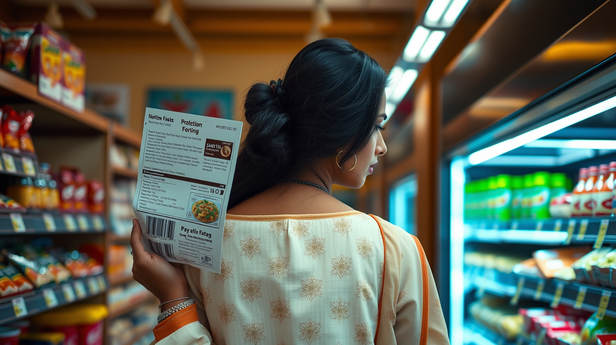
Every number on a nutrition label, calories, sodium, fat, sugar, is calculated per serving, not per packet. A 200g bag of bhujia might list its nutrition for a 30g serving. Eat the bag and multiply everything by six. The FSSAI mandates that serving sizes appear on all packaged food labels, but there is no rule that the serving size must be realistic. Manufacturers routinely set it low enough to make the numbers look clean. Before reading any other figure, find the serving size and decide whether it matches how you actually eat the product.

2. Sodium Content
Indians consume an average of 8 to 11 grams of salt per day, more than double the WHO's recommended 5 grams, according to data from the Indian Council of Medical Research. Most of that excess does not come from the salt shaker. It comes from packaged snacks, instant noodles, ready-to-eat curries, and processed breads, where sodium hides in quantities that the calorie count does not signal at all. A product can be low in calories and contain 900mg of sodium per serving. Check the sodium figure against a daily ceiling of 2,000mg. Anything above 600mg per serving is high.
3. The Order of the Ingredients List
Ingredients are listed in descending order of weight. Whatever appears first is present in the largest quantity. A biscuit that lists refined wheat flour, sugar, and vanaspati in the first three positions is primarily those three things, regardless of what the front of the pack claims. If a "multigrain" bread lists whole wheat as the fourth ingredient after maida, enriched flour, and sugar, it is a maida bread with a marketing problem. The ingredients list is the one place on the label where the law requires manufacturers to be structurally honest.
4. Added Sugar Under Other Names
Sugar appears on Indian food labels under at least a dozen names: dextrose, maltose, corn syrup, invert sugar, fructose, rice syrup, barley malt, cane juice, and more. A product can legally claim "no added sugar" if it uses one of these alternatives in place of sucrose. Scan the ingredients list for any word ending in -ose, any syrup, and any "juice concentrate." If two or three of these appear in the first five ingredients, the product is high in sugar regardless of what the front panel says.
5. Preservative Codes
The FSSAI requires that preservatives be declared by name or by their INS (International Numbering System) code. INS 211 is sodium benzoate, commonly found in packaged juices and soft drinks, and linked to hyperactivity in children in a 2007 study published in The Lancet. INS 220 is sulphur dioxide, used in dried fruits and some packaged chutneys, and a known trigger for asthma. INS 249 and 250 are potassium and sodium nitrite, used in processed meats. None of these are illegal in permitted quantities, but knowing the code tells you what you are choosing to consume, which the label by itself will not volunteer.
6. Partially Hydrogenated Oils and Trans Fat
The FSSAI capped trans fat in packaged food at 2% of total fat content. That sounds protective. A product can still contain trans fat up to that threshold and legally display "0g trans fat" on its label if the per-serving amount rounds down to zero. The tell is in the ingredients list: "partially hydrogenated vegetable oil" or "vanaspati" signals trans fat regardless of what the nutrition panel says. These fats raise LDL cholesterol and lower HDL in a way that saturated fat alone does not. Dalda-era vanaspati is not gone from Indian packaged food. It is just quieter.
7. The Green and Brown Dot, and What Comes After It
The green circle means vegetarian. The brown triangle means non-vegetarian. Both are FSSAI-mandated and both are reliable for the primary ingredient. What they do not cover is processing aids, flavour carriers, and additives. Certain red food dyes, some emulsifiers coded as INS 471, and specific flavour enhancers are derived from animal sources and may appear in products carrying the green dot. If you are vegetarian for dietary or religious reasons and the category matters, read the additives and flavouring entries in the ingredients list, not just the dot on the front.
8. The FSSAI License Number
Every legally manufactured packaged food product sold in India must carry a 14-digit FSSAI license number. Its presence does not guarantee quality, but its absence is a hard red flag. Products sold through social media, local fairs, or informal channels sometimes skip this entirely. The number is also searchable on the FSSAI's FoSCoS portal, where you can verify whether the license is active and whether the manufacturing address matches what the label states. For imported products, an Indian importer's FSSAI number must appear. If it does not, the product has not cleared the regulatory check it was supposed to.
The calorie count sits in the most prominent position on most Indian food labels because it is the number that sells restraint. But a 100-calorie snack can carry 700mg of sodium, three names for sugar, and a preservative code that a parent of an asthmatic child would want to know about. The front of the pack is advertising. The back is closer to the truth, and even there, you have to know what you are looking for.