Most claims systems were built for a world that no longer exists. The best system for claims management today has to handle rising claims volume without slowing down legitimate payouts, talk to modern insurtech platforms without expensive middleware, and flag fraud without burning adjuster time. After reviewing platforms used by North American TPAs and independent adjusters, the gap between purpose-built tools and generic alternatives becomes clear fast. This guide covers the top options, what makes each one worth considering, and how to pick the right fit.
How was this ranking put together?
Public data drove every decision here. We pulled and compared feature pages, verified user reviews, published case studies, and directory listings side by side. Only platforms with a real track record inside insurance operations made the cut.
→ See the full research breakdown.
- VCA Software - Best for insurance claims management for TPAs and adjusting firms
- Five Sigma Best for insurance claims automation
- Lemonade Best for digital-first insurance solutions
- Guidewire-Best for Enterprise P&C Insurance Platforms
Why Systems for Claims Management Are Worth a Closer Look
Picking the right claims platform looks like a tactical decision on the surface, but it's really an operational one. When claims volume spikes after a weather event or a busy filing season, a system that can't keep up creates a backlog that costs money and claimant trust at the same time.
Fragmented legacy systems make things worse. When your claims software can't talk to your billing system or a carrier's API, adjusters end up doing manual work that should have been automated years ago.
The right platform tightens average claims cycle time, cuts claims leakage by keeping reserves accurate, and lifts straight-through processing rates so routine claims resolve without anyone touching them. That's not a small gain. That's the difference between a profitable book of business and one that quietly bleeds.
Comparing the 5 Best Systems for Claims Management
Note: All data in this table is sourced from review platforms and the official websites of the listed companies.
|
Company Name |
Years Operating |
Headquartered In |
|
VCA Software |
Since 1998 |
Bolton, Ontario |
|
Five Sigma |
Since 2017 |
Tel Aviv, Israel |
|
Lemonade |
Since 2015 |
New York, NY |
|
Guidewire |
Since 2001 |
San Mateo, California |
1. VCA Software - Best for Claims Management at TPAs and Adjusting Firms
How Is VCA Software Positioned in Its Market?
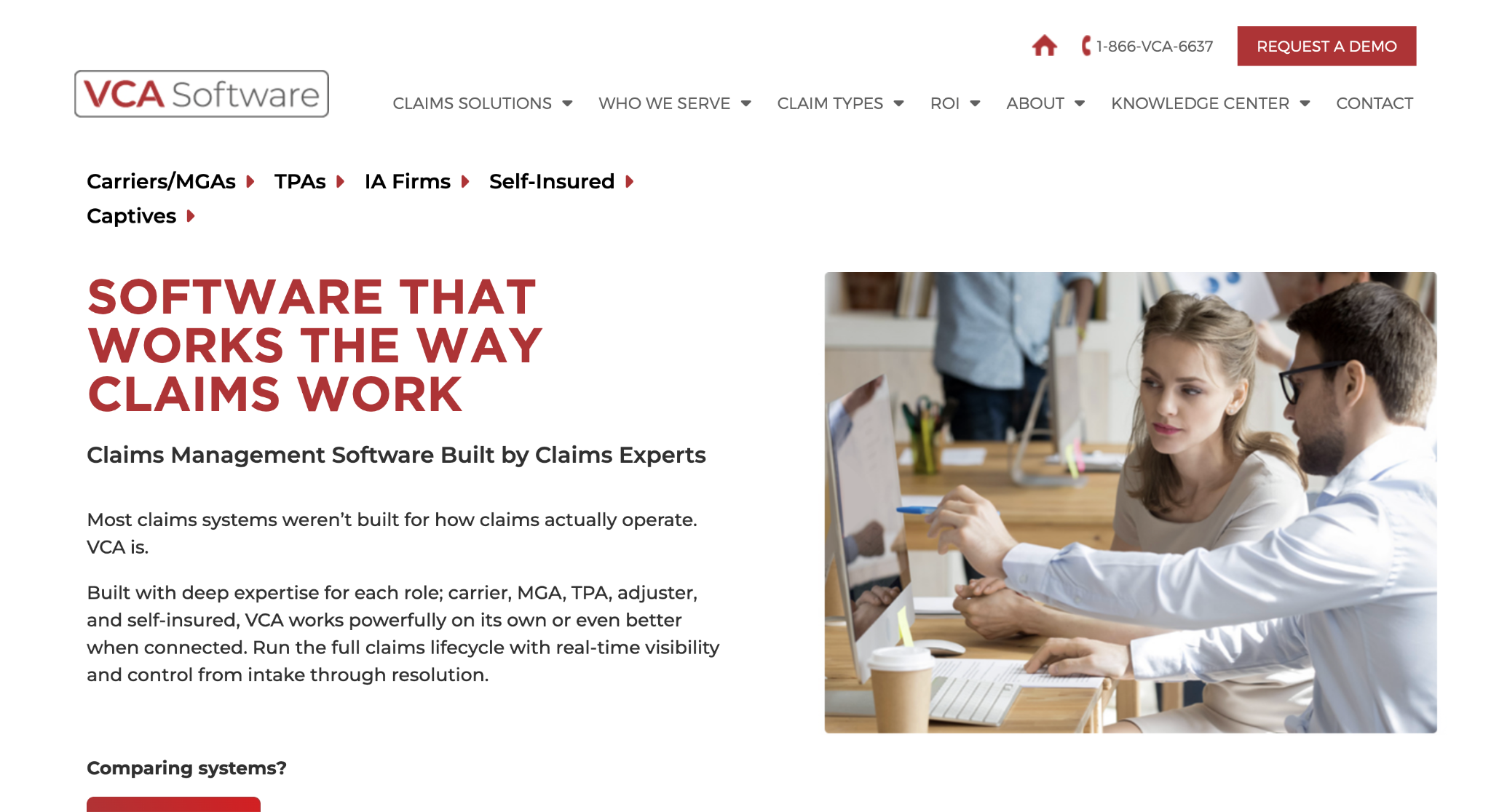
VCA Software has been in the claims management space since 1998, serving carriers, TPAs, independent adjusters, brokers, and self-insured companies across more than 15 countries. The VCA Software claims management platform is created to help claims teams manage workflows, case information, reporting, payments, and day-to-day claims operations within one system. Teams can reportedly complete training in under two hours, making the platform easier to introduce without a lengthy onboarding process. Optional modules also include Lloyd’s of London reporting compliance, ClaimPay for digital payments, and VCA Insights for analytics, allowing firms to add features based on their operational needs.
Why Does VCA Software Stand Out for System for Claims Management?
Mid-sized TPAs and adjusting firms often get stuck choosing between enterprise tools that cost too much and lightweight tools that can't handle the volume and workload. VCA Software fills that gap with enterprise-grade functionality at mid-range pricing and a 2-3 week setup timeline that means operations don't stall during the switch.
What Users Are Actually Saying:
Ease of use comes up repeatedly in reviews, especially from adjusters who aren't particularly technical. Users point to how quickly new staff get up to speed, which matters a lot when claims volume spikes and you're bringing adjusters on fast. The combination of depth and approachability is the note that comes up most consistently.
2. Five Sigma - Best for Insurance Claims Automation
How Is Five Sigma Positioned in Its Market?
Five Sigma, founded in 2017, built its platform around AI from day one rather than layering it on after the fact. That difference shows up in how the product actually works. Their Clive AI adjuster can run independently or sit on top of a carrier's existing system, which gives insurers a way to get automation benefits without ripping out legacy infrastructure. They serve insurers, MGAs, TPAs, and self-insured enterprises, with clients that include INSHUR and Xceedance. Celent recognized them with its highest distinction for both advanced technology and breadth of functionality (not cheap, but worth it for operations prioritizing automation).
Why Does Five Sigma Stand Out for a System for Claims Management?
Most claims platforms treat automation as a feature. Five Sigma treats it as the architecture, covering intake, triage, liability assessment, fraud detection, and settlement in a connected flow. For insurers trying to lift straight-through processing rates without hiring more adjusters, that foundation-level approach is hard to match.
What Users Are Actually Saying:
Feedback from insurance operations teams points to the flexibility of deployment as a genuine differentiator. The option to run Clive as an overlay on an existing system means teams aren't forced into a full platform replacement on day one. That kind of pragmatic design is rare in this space and tends to show up in user reviews as a relief, not just a feature.
3. Lemonade - Best for Digital-First Insurance Solutions

How Is Lemonade Positioned in Its Market?
Lemonade is a full-stack insurance carrier, not a software vendor, and that distinction matters when evaluating it alongside claims management platforms. Founded in 2015, they built their entire operation around a digital app, covering homeowners, renters, car, pet, and term life insurance across the US and Europe. Their AI claims processing is genuinely fast (think seconds, not days), and they've earned recognition from J.D. Power and a financial strength rating from Demotech. With $1.62 billion in gross earned premiums and over 2 million customers, they show what a digitally native claims operation can look like at scale.
Why Does Lemonade Stand Out for a System For Claims Management?
Where most carriers still rely on manual touchpoints, Lemonade has built a model where a large share of claims resolve through automated processing with no human involvement. That approach shows what's possible when AI is given real authority in the claims workflow, not just a supporting role.
What Users Are Actually Saying:
Customers consistently mention the speed of claims resolution as the standout experience, particularly for straightforward renters' and homeowners' claims. The mobile-first interface cuts the friction that makes most claims feel like a chore. The Giveback program also generates genuine positive sentiment, which is not something you typically see in insurance reviews.
4. Guidewire - Best for Enterprise P&C Insurance Platforms
How Is Guidewire Positioned in Its Market?
Guidewire has been the platform of record for large P&C carriers since 2001, and their footprint reflects that. Over 570 insurers across 43 countries run on their stack, with ClaimCenter sitting alongside PolicyCenter and BillingCenter as main products. More than 1,700 successful setups and the industry's largest R&D team back that up (think enterprise pricing, with enterprise depth to match). Gartner named them a Leader in the Magic Quadrant for P&C Core Insurance Platforms in North America, and client results have included 60% cost reductions in documented case studies.
Why Does Guidewire Stand Out for a System for Claims Management?
Large carriers managing diverse lines of business across multiple states need a platform that handles scale and variation, and Guidewire's depth across policy, claims, and billing in one connected system answers that need directly. Their ProNavigator adds decision support on top of that foundation, giving adjusters smarter tools without replacing the workflow they already know.
What Users Are Actually Saying:
Reviews from claims directors and operations leaders at mid-to-large carriers tend to focus on the depth of configuration options, which can be a strength and a challenge at the same time. Setup timelines come up as something to plan for carefully. That kind of detail is expected at this scale, and from what the data shows, firms that invest in proper setup see the returns.
Methodology Behind These Picks
Building a reliable shortlist for claims management software required a structured process, not just a quick scan of vendor marketing pages. Here's how the research was conducted.
Gathering Your Baseline Information
The starting point was a broad sweep across insurance-focused directories, software review platforms, and published case studies from carriers, TPAs, and adjusting firms. Vendor websites were reviewed alongside independent sources to build an initial longlist of platforms with a meaningful presence in the claims management category. Options that only appeared in vendor-produced materials without any third-party corroboration were set aside early.
The Shortlist Cut
From the longlist, each option was filtered against a clear standard: verifiable use in insurance operations, not just adjacency to the space. Review patterns were analyzed for consistency, with attention to whether feedback came from actual claims professionals (adjusters, claims directors, TPA operators) rather than general business users. Platforms with thin or inconsistent review histories were removed regardless of how polished their product pages looked.
Fact-Checking the Picks
Each company that made the shortlist was checked against its own published claims. Features listed on product pages were cross-referenced with what users actually reported in reviews. Where vendors cited specific outcomes (like setup timelines, processing speeds, or client results), those claims were checked against available case studies and independent mentions. Discrepancies between marketing language and real-world feedback were noted and factored into the final assessment.
Authority Signals and Industry Standing
Industry recognition carries weight when it comes from credible sources. Mentions in Celent research reports and Gartner Magic Quadrant analyses were taken as meaningful signals, since those evaluations involve structured assessments rather than self-reported data. Awards and certifications specific to the insurance industry were reviewed for each company to understand where they sit in the broader market.
System for Claims Management Track Record
The final check focused on claims management as a main service area, not a side capability. Each company was evaluated for dedicated claims-related service pages, verified reviews from claims operations professionals, and case studies showing real results in insurance contexts. Platforms that treat claims management as a main product rather than a secondary feature of a broader tool scored higher on relevance and fit for the audience this guide serves.
Picking the Right System For Claims Management for You
The right claims platform depends on what your operation actually looks like today, not the idealized version. Before committing to anything, match the platform's strengths to your specific bottlenecks.
- Industry/Domain Experience: Look for platforms built specifically for insurance, not general workflow tools adapted for claims. The difference shows up in how the system handles coverage analysis, reserve accuracy, and state-mandated documentation requirements.
- Features and Capabilities: Map your workflow first. If your biggest gap is straight-through processing for high-volume simple claims, an AI-native platform like Five Sigma makes sense. If you need end-to-end TPA functionality with Lloyd's compliance, VCA Software covers that ground well.
- Pricing Structure: Enterprise platforms like Guidewire carry enterprise price tags. Smaller TPAs and adjusting firms get more mileage from mid-range platforms that don't require long setup runways or large IT teams to maintain.
- Results Measurement: Ask vendors how they measure claims cycle time improvement and claims leakage reduction for clients similar to yours. Vague answers are a signal worth paying attention to.
- Industry Knowledge and Compliance: State Department of Insurance mandates, HIPAA requirements, and NAIC guidelines vary significantly. The platform you pick needs to have those built into its workflow, not bolted on as an afterthought.
The Verdict
Choosing a claims management system comes down to fit, not features. Large P&C carriers with complex multi-line operations will find Guidewire worth the investment. TPAs and independent adjusters looking for power without the enterprise overhead get a strong match in VCA Software. Five Sigma makes sense for teams where automation is the priority. As claims volume and workload keep growing across North America, the platforms that combine speed, accuracy, and compliance will pull further ahead.