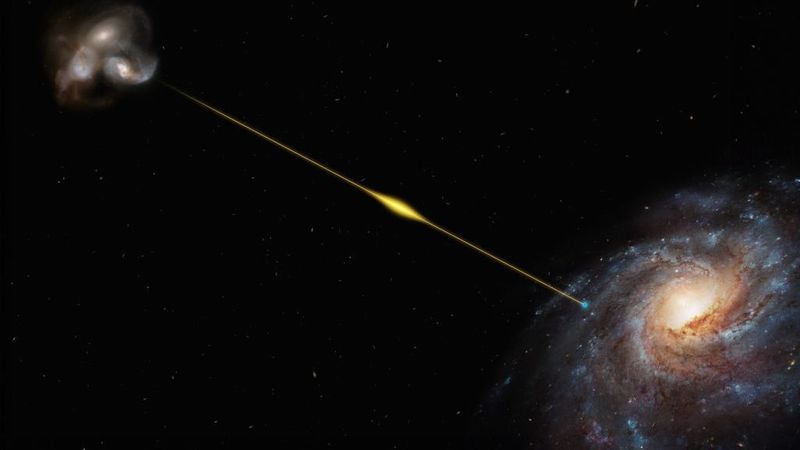
Ancient, Distant Signal From Space Offers Insight Into Universe’s Weight Scientists identify record-breaking fast radio burst dating back eight billion years, shedding light on 'missing' matter between galaxies. Zenger · Oct 20, 2023
How 8-Billion-Year-Old Radio Waves Could Help Us Weigh the Universe A bright burst of radio waves from a distant galaxy created a helpful snapshot of the universe's structure. Inverse · Oct 19, 2023
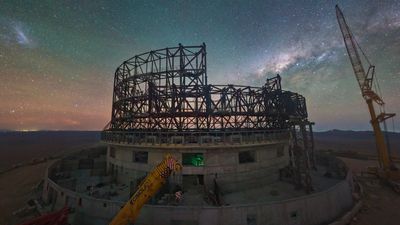
From The Lab: Paris Observatory's role in building the world's biggest telescope The Extremely Large Telescope (ELT), which is currently being built in the Atacama desert in Chile, will be the biggest telescope ever built.Its primary mirror will be 39 metres in diameter, which is slightly less than the size of the Arc de Triomphe in Paris, while it's main structure will… Radio France Internationale · Sep 20, 2023
On A Cosmic Scale, The Universe Is Quite Small — This Could Transform Our Understanding Of It A new paper argues that the observable Universe is mostly all there is. Inverse · Sep 18, 2023
Rare and dazzling cosmic explosion spotted by researchers The explosion, which outshines most supernovae in the universe, was spotted by researchers at the Queen’s University, Belfast. The Independent UK · Sep 6, 2023
Gravitational waves show black holes prefer certain masses before they collide Knowing that black holes tend to have these masses could help provide a new way of measuring the expansion rate of the universe. Space · Aug 14, 2023
Euclid space telescope captures its first glimpses of universe Designed to investigate some of the universe’s biggest mysteries, the Euclid space telescope, has captured its first glimpses of the cosmos, CNN reported. The spacecraft’s two instruments took the preliminary test images, revealing glittering starry views. Read further on Dynamite News : Dynamite News · Aug 2, 2023
Webb Telescope Finds Complex Carbon in the Early Universe, Baffling Astronomers Cosmic dust of the ancient past is beginning to appear to the ultrasensitive instruments aboard the James Webb Space Telescope. Inverse · Jul 19, 2023
Third LIGO will put India on the research map Explore the fascinating research and scientific curiosity behind LIGO India, contributing to groundbreaking discoveries in physics. Read more on The Hindu. The Hindu · Jul 7, 2023
Astronomers see ancient galaxies flickering in slow motion due to expanding space According to our best understanding of physics, the fact space is expanding should influence the apparent flow of time, with the distant Universe appearing to run in slow motion. The Conversation · Jul 3, 2023
Science This Week | Euclid telescope blasts off to study the ‘dark’ universe, physics helps in understanding hate groups and more Check out The Hindu’s science wrap featuring top stories on new discoveries, findings, and studies in the scientific world from this week. The Hindu · Jul 2, 2023
"'We Came Here to Exclude the Negro. Nothing Short of This Will Answer.'" From Justice Jackson's opinion, joined by Justice Sotomayor, dissenting from the denial of certiorari today in Harness v. Watson: The President of the 1890 Mississippi Constitutional Convention said it plain: "Let us tell the truth if it bursts the bottom of the Universe … We came here to exclude the… Reason · Jun 30, 2023
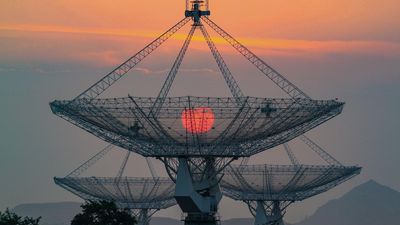
India’s largest radio telescope plays vital role in detecting universe’s vibrations An international team of astronomers from India, Japan and Europe has published the results from monitoring pulsars, called ‘nature’s best clocks’, by using six of the world’s most sensitive radio telescopes, including India’s largest telescope, the Pune-based uGMRT. The Hindu · Jun 29, 2023
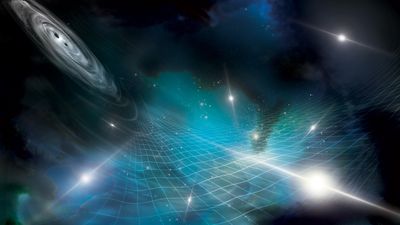
The universe is rippling with a faint 'gravitational wave background' created by colliding black holes, huge international study suggests A 15-year search reveals the first evidence of a cosmic 'gravitational wave background' emitted by ancient, colliding black holes. LiveScience · Jun 29, 2023
The Conversation · Jun 29, 2023 Using a detector the size of a galaxy, astronomers find strongest evidence yet for gravitational waves from supermassive black hole pairs When black holes and other enormously massive, dense objects whirl around one another, they send out ripples in space and time called gravitational waves. These waves are one of the few ways we have to study the enigmatic cosmic giants that create them.
The Conversation · Jun 28, 2023 Cosmological models are built on a simple, century-old idea -- but new observations demand a radical rethink Our ideas about the Universe are based on a century-old simplification known as the cosmological principle. It suggests that when averaged on large scales, the Cosmos is homogeneous and matter is distributed evenly throughout.
Inverse · Jun 21, 2023 Physicists May Be Tantalizingly Close to Identifying What Dark Matter is Made Of There’s some potentially big news on the hunt for dark matter. Astronomers may have a handle on what makes this mysterious cosmic stuff: strange particles called “axions.”
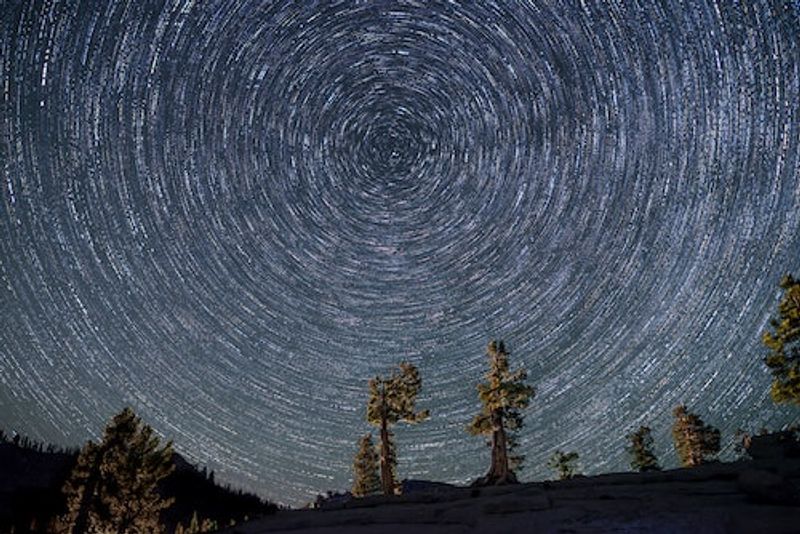
The Conversation · Jun 18, 2023 Why is the sky dark at night? The 200-year history of a question that transformed our understanding of the Universe As dawn rose over the German city of Bremen on May 7 1823, Heinrich Olbers put the finishing touches to an article that left his name in history. After the deaths of his wife and daughter, Dr Olbers had recently given up his work as an opthalmologist to devote himself…
Zenger · Jun 9, 2023 Universe’s Most Distant Molecules Detected 12 Billion Light Years Away “Discoveries like this are precisely what Webb was built to do.
Inverse · May 14, 2023 Our Newest Space Observatories Will Unveil An Unprecedented View of the Earliest Cosmic Period A new version of the LISA observatory could catch gravitational waves with far more detail and expand our knowledge of the Universe.
Inverse · May 12, 2023 Astronomers Discover the Dark Source of the Brightest Cosmic Blast Ever AT2021lwx is outshining and outlasting supernovas by a big margin.
The Conversation · May 11, 2023 How fast is the Universe really expanding? Multiple views of an exploding star raise new questions How did we get here? Where are we going? And how long will it take? These questions are as old as humanity itself, and, if they’ve already been asked by other species elsewhere in the Universe, potentially very much older than that.
Salon · Apr 30, 2023 Astronomers solve a 60-year mystery Until now, no one knew for sure what quasars — among the most massive explosions in the universe — really were
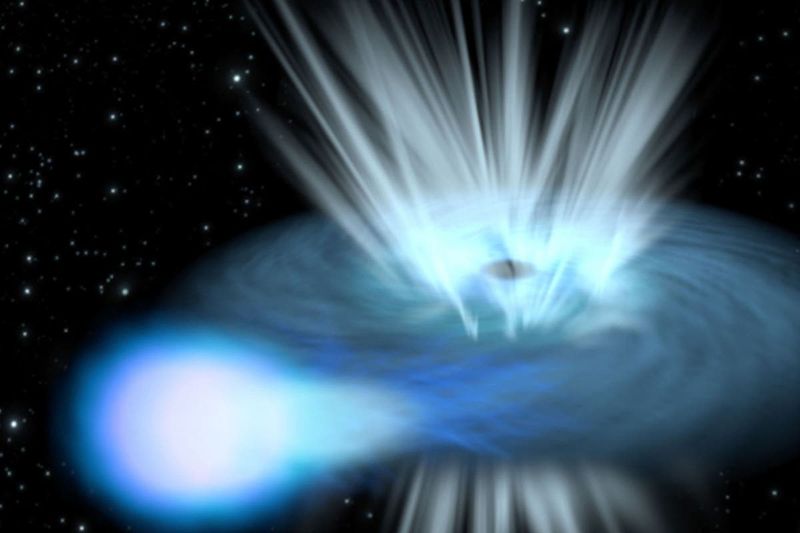
Inverse · Apr 26, 2023 Astronomers Just Captured the First-Ever View of a Black Hole’s Galaxy-Sized Jet A new study gives insight about the ring of hot churning material destined to plummet into a supermassive black hole, and its connection to a high-speed jet.
The Independent UK · Apr 26, 2023 Astronomers solve the mystery of how quasars are ignited These celestial objects were first discovered 60 years ago.