Astronomers find mysterious signal coming to us from the early universe Blast of energy originated just three billion years after the Big Bang The Independent UK · Oct 8
An overlooked era of cosmology is stealing the show in the quest to understand the cosmos Could you imagine if pagers made a comeback? Sure, your smartphone would still be your notepad-flashlight-camera-personal assistant-MP3 player-wallet-social media browser. But imagine if pagers made it so easy to do that one important thing – pinging your friends and associates – that we all brought them back into our lives,… The Conversation · Sep 25
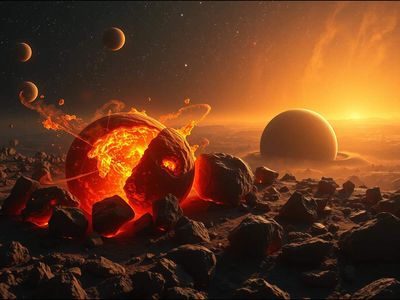
The first rocky planets may have formed just 100 million years after the Big Bang, scientists say — and they could have been surprisingly Earth-like New simulations indicate rocky planets may have formed just 100 million years after the Big Bang. Massive stars exploded, scattering heavy elements needed for planet formation. These enriched pockets of debris could have quickly formed planetesimals. Water may have also arrived early, providing key habitability ingredients. This suggests early cosmic… The Economic Times · Sep 5
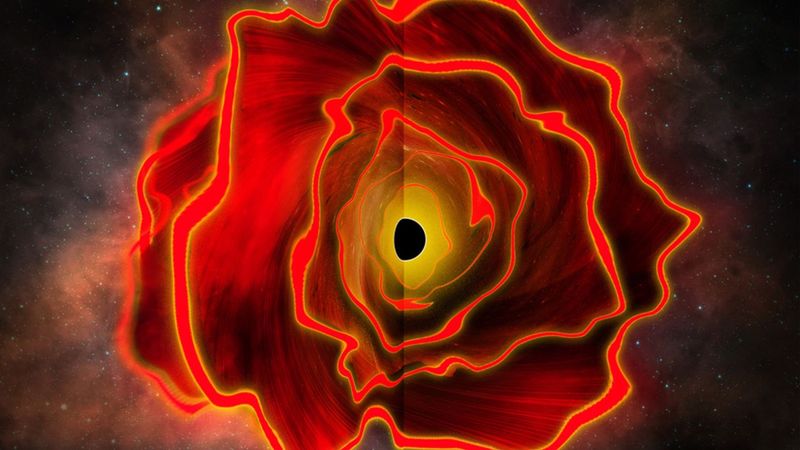
Black hole star? Solar-system-size 'dot' from the early universe is our best evidence yet of a brand-new type of cosmic object The James Webb Space Telescope has identified the most promising candidate yet for a black hole star, lurking 660 million years after the Big Bang. The hypothetical entity, which shines 100 billion times brighter than a typical star, could shed light on the origins of the mysterious "little red dots." LiveScience · Aug 20
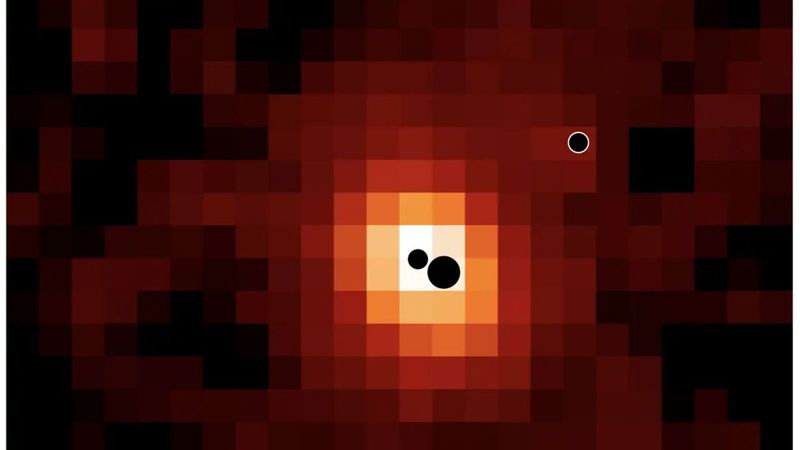
Scientists find 3 supermassive black holes on the verge of collision inside a distant galaxy A greedy galaxy that existed less than 1.3 billion years after the Big Bang is hoarding supermassive black holes. Space · Aug 17
Farthest 'black hole star' ever found could help solve the James Webb Space Telescope's little red dot mystery A distant black hole star is providing strong evidence that these objects lie at the hearts of the mysterious little red dots found shortly after the Big Bang by the James Webb Space Telescope. Space · Aug 12
The Boomerang Nebula is three times colder than Antarctica, and colder than space itself Tucked roughly 5,000 light years away in the constellation Centaurus lies a place far colder than anything found on Earth. Known as the Boomerang Nebula, this dying star system holds the record for the coldest known naturally occurring object in the entire universe, sitting at just one degree above absolute… The Times of India · Jul 23
“Thanks 23&Me”: 45 Times People Found Out Something That Was Purposely Hidden From Them There are questions we might not get answers to. Like: Where is Cleopatra's tomb? Or what caused the Big Bang? But certain secrets reveal themselves to us whether we're digging or not. After people online were asked to share something they found out that they were definitely never supposed to… Bored Panda · Jul 21
James Webb telescope uses trippy Einstein prediction to probe the farthest reaches of the universe — Space photo of the week The James Webb telescope peers through a warped bubble of space-time to study galaxies from the first billion years after the Big Bang. LiveScience · Jul 19
Earth's largest particle accelerator opens new window into the early universe just after the Big Bang: 'A culmination of a decades-long quest' According to one researcher, this observation "promises new insights into the evolution of the early universe." Space · Jul 17
A ravenous black hole in our backyard could be our window into the ancient universe A feeding black hole at the heart of a nearby galaxy is behaving similarly to cosmic titans that existed just after the Big Bang. Space · Jul 10
Scientists have discovered the oldest quasar ever seen, and it shines with the light of a trillion suns Using the ESA's Euclid space telescope, astronomers have discovered a treasure trove of black hole-powered quasars in the early universe, including the most ancient and distant ever seen. Space · Jul 9
Cristiano Ronaldo's famous CR7 nickname inspired the name of a galaxy. Here's its origin and how it got its name Cosmic Redshift 7, a galaxy discovered in 2015, holds significance for early universe study. Its name honors footballer Cristiano Ronaldo's famous nickname, a deliberate astronomical coincidence. This distant galaxy, observed over 800 million years after the Big Bang, is unusually bright. Researchers initially hoped it contained the universe's first stars,… The Economic Times · Jul 7
What came before the Big Bang? It’s a question big enough to make your head spin! Eight-year-old Ellie from Atlanta, Georgia, wants to know what came before the Big Bang? The Conversation · Jun 16
The Economic Times · Jun 15 This gas led to the formation of stars and expansion of galaxies: New study reveals how neutral gas shaped the early Universe This gas led to the formation of stars and expansion of galaxies during the early stages of the Universe. A new study by an international team of researchers has provided direct evidence of neutral gas in distant galaxies. Using ALMA and data from JWST, scientists detected a signal that helped…
Space · Jun 3 Can black holes turn into white holes? It's not such a crazy idea, scientists say New research suggests primordial black holes born during the Big Bang could live much longer than previously estimated — long enough to become energy-spewing white holes.
Space · May 28 James Webb Space Telescope discovers a black hole that formed before its host galaxy. Scientists aren't sure how Observations of "Little Red Dot" ancient galaxies by the James Webb Space Telescope could answer the question: which comes first, the black hole or its galaxy? The shocking answer could represent a complete paradigm shift.
Space · Apr 29 What is quantum gravity? Scientists think it could explain the beginning of our universe A new recipe of "quadratic gravity" could help to better define the picture of the Big Bang and the singularity that existed prior to the dawn of time.
The Independent UK · Apr 16 Scientists unearth new theory about how the universe began – and it’s not just the Big Bang IN FULL
The Independent UK · Apr 16 ‘Cosmic fossils’ left by black holes created before the big bang may still shape the universe Universe may have been created on the rebound from a previous collapse from which it still bears the scars
The Conversation · Apr 14 Could dark matter be made of black holes from a different universe? New research suggests that relic black holes from before the big bang may still shape galaxies today. These black holes could explain dark matter, one of the biggest unsolved questions in cosmology.
Space · Apr 10 Ripples in spacetime may have revealed 1st evidence of tiny black holes born in the Big Bang Gravitational waves may have provided the first tantalizing evidence of tiny primordial black holes born during the Big Bang, which could account for dark matter.
Space · Apr 8 Large Hadron Collider gives scientists their best look yet at conditions right after the Big Bang The ALICE experiment at the world's most powerful particle accelerator, the Large Hadron Collider, has given scientists their best look yet at quark-gluon plasma, the primordial matter that filled the universe moments after the Big Bang.
LiveScience · Apr 3 A new tweak to Einstein's relativity could transform our understanding of the Big Bang A new physics paper proposes modifications to Einstein’s theory of relativity that could solve one of the biggest issues about our understanding of the Big Bang.
MyLifeXP · Mar 25 Who Created God? The Question That Breaks Logic There is one question that doesn’t just challenge beliefs it stops your mind completely. If God created everything… then who created God?” At first, it sounds simple. Almost logical. But the moment you think deeper, something unusual happens. Your thoughts slow down. Answers disappear. Because this question doesn’t just question…








 Space
 LiveScience
 The Conversation
 Inverse
 The Independent UK
 Evening Standard
 Asharq Al-Awsat
 Salon
 The Guardian - UK
 The Hindu
 WEKU
 The Economic Times
