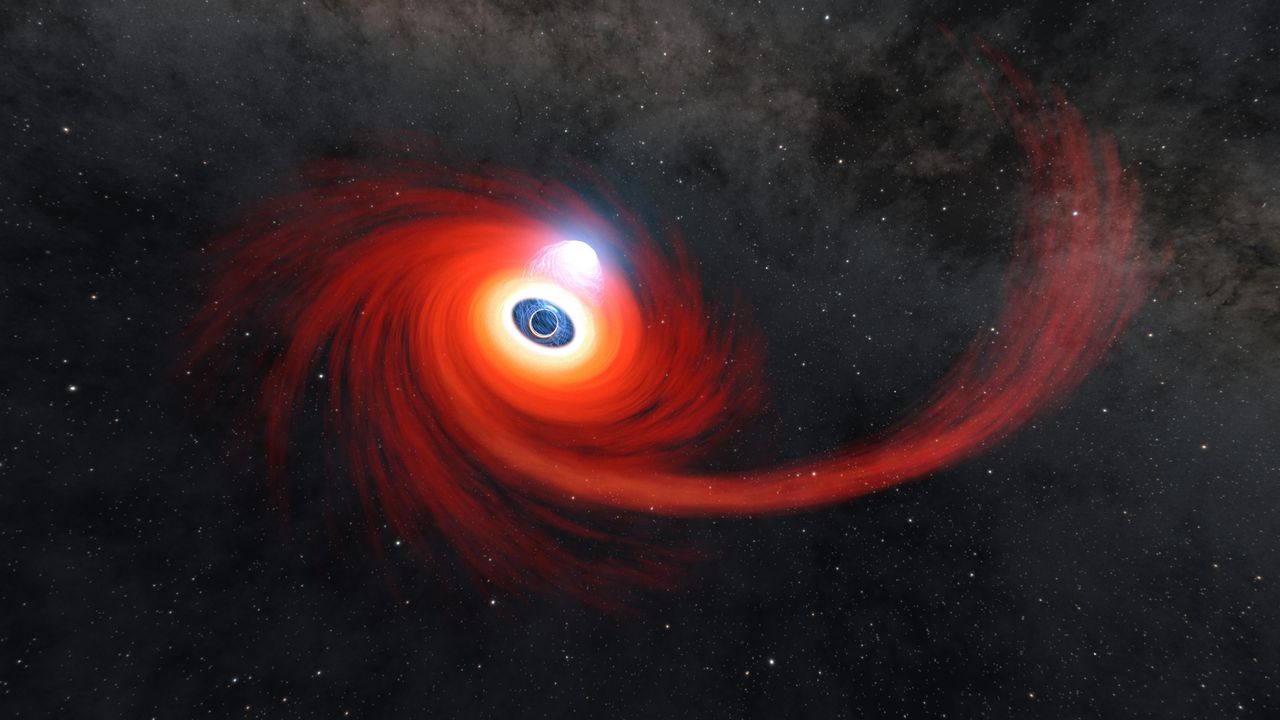
The most distant 'black hole star' yet found, existing in the universe less than 660 million years after the Big Bang, has provided a vital clue as to the origin of the mysterious "little red dots" that populate the James Webb Space Telescope's images of the early universe.
The consensus seems to be that these bizarre objects, which were first discovered in 2022, are growing supermassive black holes entombed within huge clouds of gas that have spectrums similar to cool, red stars, such as red giants. Recently, astronomers have been finding that some of these objects are placed within the center of young galaxies whose light has been traveling for about 12 billion years, give or take a billion, to reach us. Given their distance and faintness, black hole stars' light is difficult to disentangle from the light of a surrounding galaxy, especially when we know there is likely a galaxy there that's too faint for the JWST to resolve.