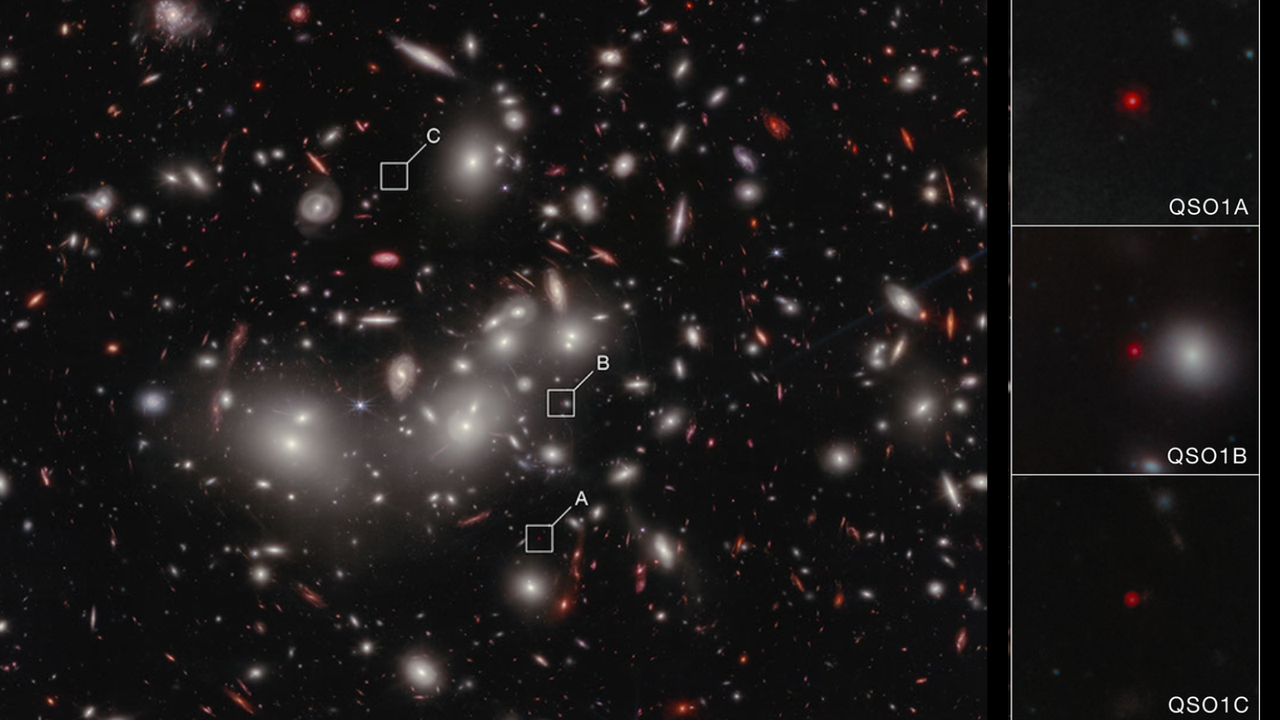
Observations of ancient galaxies called "Little Red Dots" by the James Webb Space Telescope (JWST) could finally answer the question: which comes first, the black hole or its galaxy? It turns out that the answer isn't what scientists expected and could thus represent a complete paradigm shift in our understanding of how black holes grow.
Little Red Dots were first spotted in 2022 by the JWST, immediately presenting themselves to astronomers as something completely new, perhaps a type of galaxy never seen before. The mystery of these objects deepened when scientists discovered that they are remarkably common in the infant universe but seem to disappear around 1.5 billion years after the Big Bang. But Little Red Dots are far from the only cosmic mystery that the JWST has dropped into the lap of scientists.
The $10 billion space telescope has also discovered a wealth of supermassive black holes with masses millions to billions of times that of the sun prior to the universe being 1 billion years old. That is problematic because the feeding and merging processes that allow black holes to grow to supermassive status had always been thought to take longer than 1 billion years.