
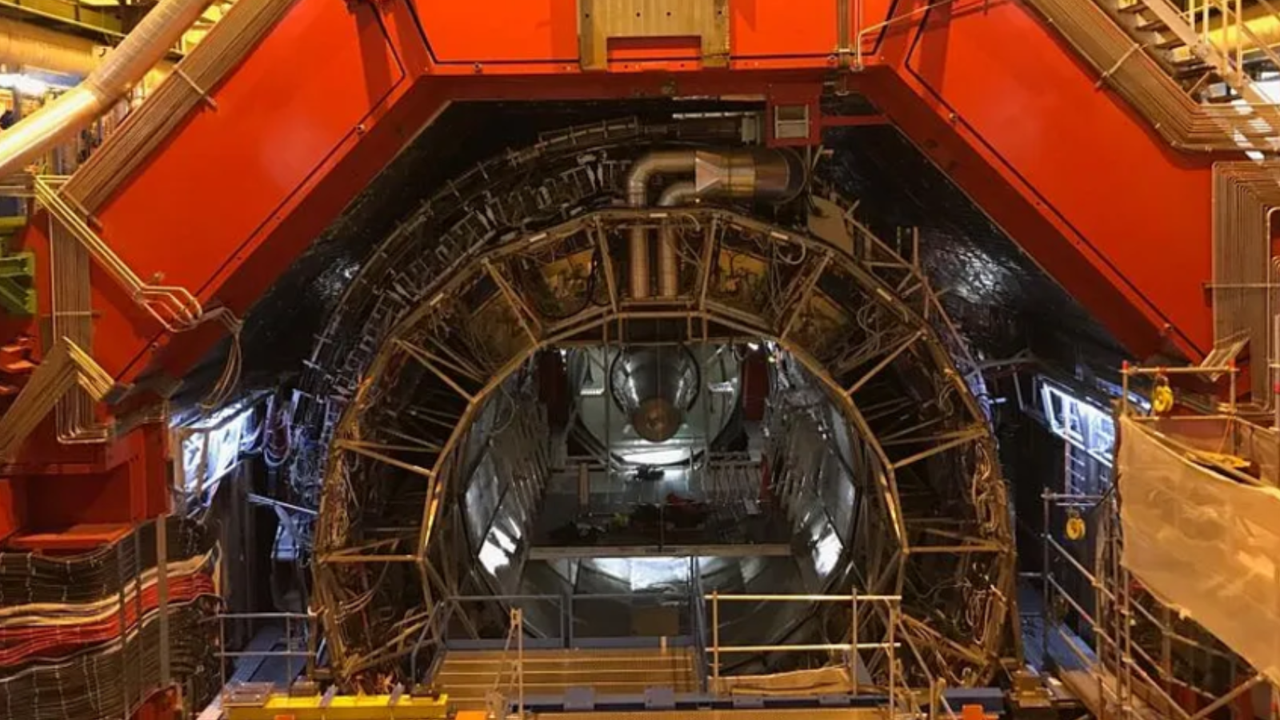
The world's most powerful particle accelerator, the Large Hadron Collider, has given scientists their best look yet at quark-gluon plasma, the primordial matter that filled the universe moments after the Big Bang.
During the first fractions of a second of the universe's existence, the cosmos was filled with a hot and dense primordial soup called quark-gluon plasma. At the nearly 17-mile-long circular particle accelerator, the Large Hadron Collider (LHC) that sits deep below the French Alps, CERN scientists recreated the quark-gluon plasma by smashing together atomic nuclei of iron at near-light speed. The project is called ALICE (A Large Ion Collider Experiment).















