
Get all your news in one place.
100's of premium titles.
One app.
Start reading
The Conversation
The Conversation
Daniel Reardon, Postdoctoral researcher in pulsar timing and gravitational waves, Swinburne University of Technology

Using a detector the size of a galaxy, astronomers find strongest evidence yet for gravitational waves from supermassive black hole pairs

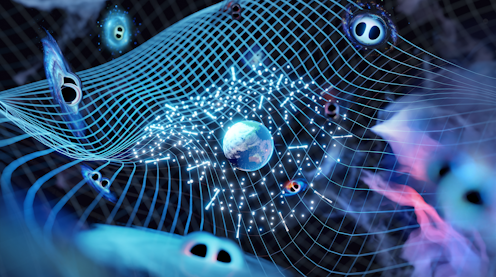
OzGrav / Swinburne / Carl Knox

When black holes and other enormously massive, dense objects whirl around one another, they send out ripples in space and time called gravitational waves. These waves are one of the few ways we have to study the enigmatic cosmic giants that create them.

Astronomers have observed the high-frequency “chirps” of colliding black holes, but the ultra-low-frequency rumble of supermassive black holes orbiting one another has proven harder to detect. For decades, we have been observing pulsars, a type of star that pulses like a lighthouse, in search of the faint rippling of these waves.

Sign up to read this article
Read news from 100's of titles, curated specifically for you.
Already a member? Sign in here
Related Stories
Top stories on inkl right now
One subscription that gives you access to news from hundreds of sites
Already a member? Sign in here
Our Picks
Fourteen days free
Download the app
One app. One membership.
100+ trusted global sources.







