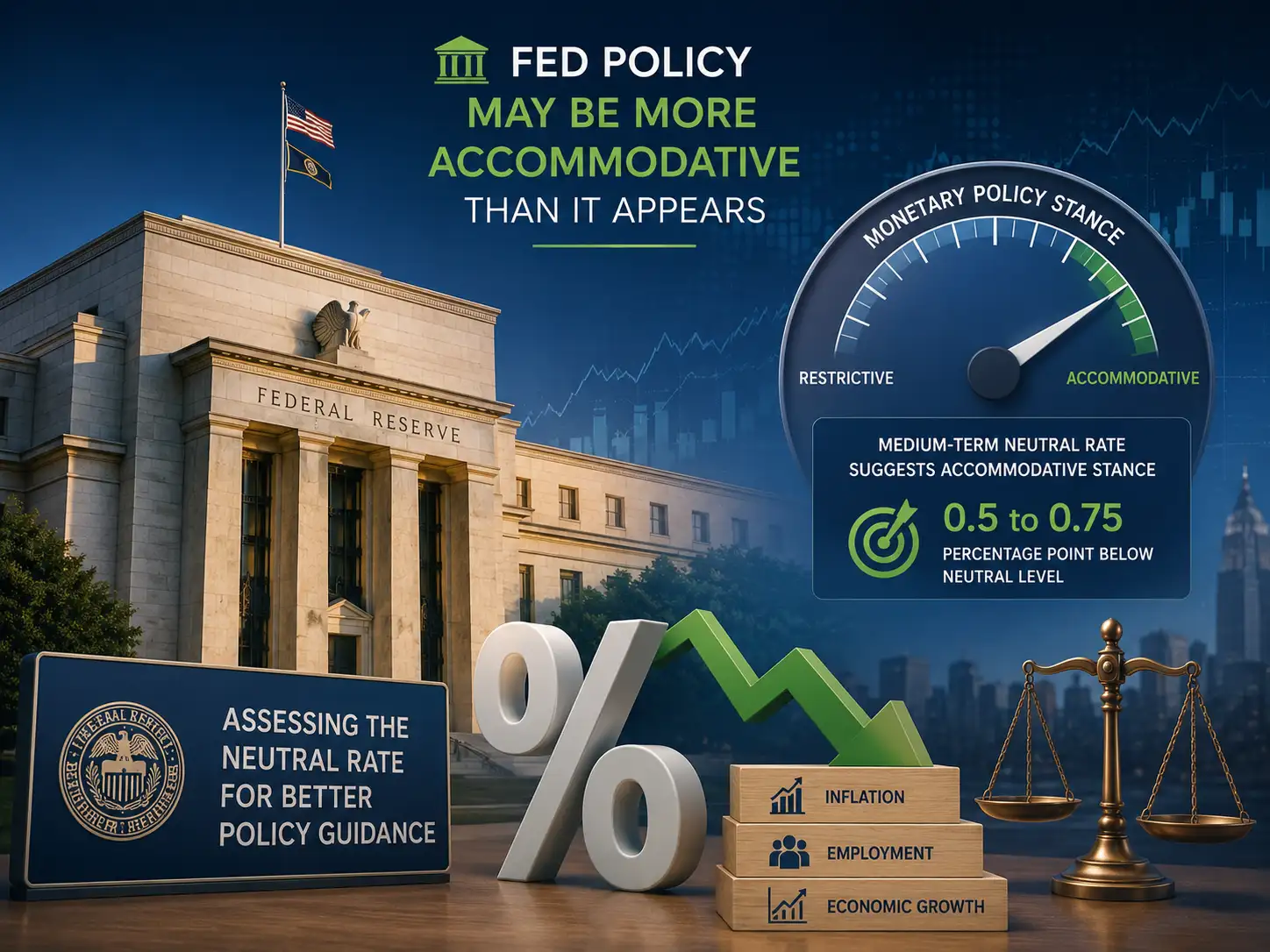
The Federal Reserve’s current interest-rate stance may be more accommodative than policymakers generally believe when assessed against a medium-term estimate of the economy’s neutral interest rate, according to research published by the Federal Reserve Bank of San Francisco, Reuters reported.
The finding contrasts with the view of many U.S. central bank policymakers, who have generally assessed monetary policy as restrictive or close to neutral. It also differs from estimates of the longer-run neutral rate, which suggest that the Fed’s current benchmark interest-rate range of 3.50%-3.75% remains roughly half a percentage point above a neutral level.

Medium-term measure offers different picture
The San Francisco Fed research argues that relying on a medium-term estimate of the neutral rate could provide a better guide for monetary policy than using longer-run measures alone. Reuters reported the findings based on the regional Fed bank’s latest Economic Letter.
The research suggests that the current federal funds target range is around 0.5 to 0.75 percentage point below the level indicated by the medium-term neutral-rate measure. Such a setting would imply that monetary policy is providing some support to economic activity rather than restraining it.
The study was authored by Vasco Curdia, a research adviser at the San Francisco Fed. It said the medium-run real natural rate estimates as of August 2026 point to an accommodative policy stance, although the researchers emphasized that uncertainty surrounding the estimate remains significant.
Implications for monetary policy
Neutral-rate estimates are closely watched by Fed policymakers because they help determine whether borrowing costs are sufficiently high to cool inflation or sufficiently low to support economic growth and employment.
Widely used monetary-policy rules typically rely on estimates of the longer-run neutral rate. That measure tends to change gradually and is therefore considered more stable. Policymakers also sometimes examine short-run neutral-rate estimates, although those measures can fluctuate considerably in response to economic and financial conditions.
The San Francisco Fed research suggests that a medium-term measure could strike a better balance between the stability of longer-run estimates and the volatility of short-run measures.
Policy debate ahead
The findings add another dimension to the debate over where U.S. interest rates should be set as the Federal Reserve assesses inflation, employment and economic growth.
If policymakers place greater weight on the medium-term neutral rate, the current policy stance could be viewed as less restrictive than conventional measures suggest. That could have implications for future discussions over the timing and pace of potential interest-rate adjustments.
At the same time, the significant uncertainty around estimates of the neutral rate means the measure is unlikely to provide policymakers with a definitive signal on its own. Reuters noted that Fed officials continue to weigh a broad range of economic indicators when determining the appropriate path for monetary policy.
(Disclaimer: Recommendations, suggestions, views, and opinions given by experts are their own. These do not represent the views of The Economic Times.)