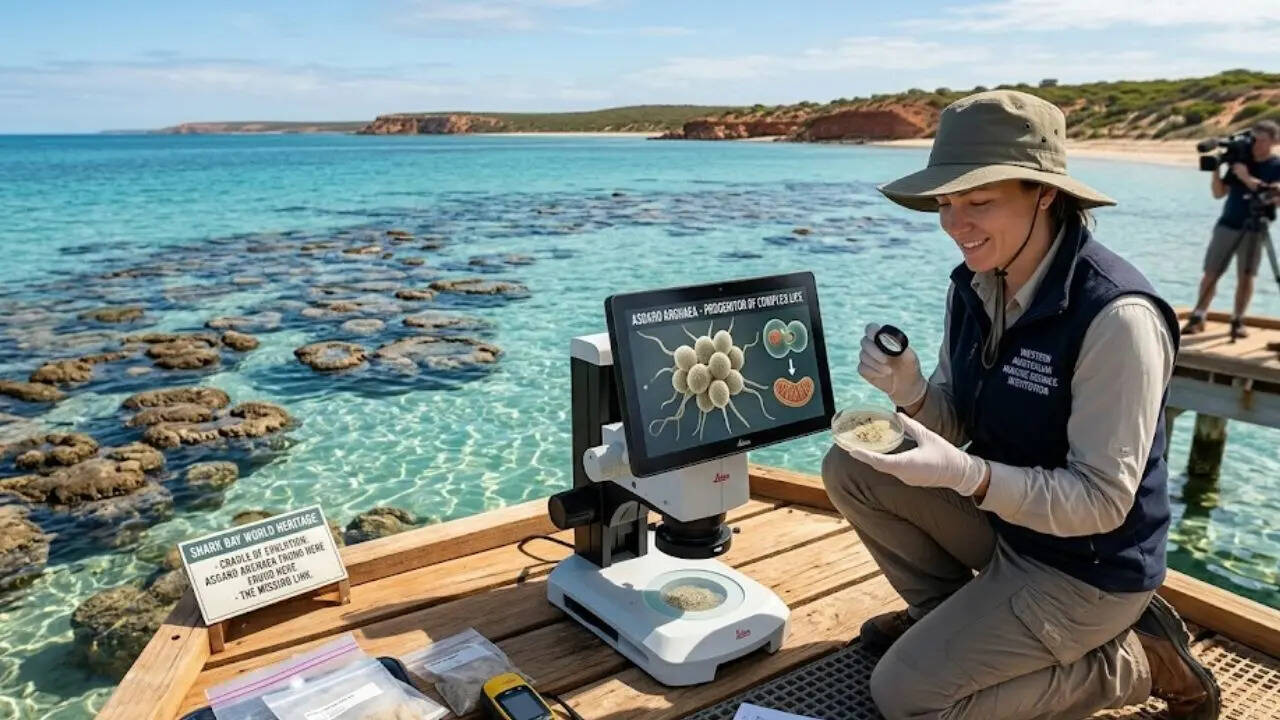
Scientists have discovered an archaea called ‘Asgard’ in the extremely high-salinity waters of Shark Bay, Australia, which contains microbes that provide a long-standing evolutionary enigma for many centuries - how did simple, single-celled bacteria develop into such complex multicellular organisms, animals, and human beings? These unique microorganisms serve as an evolutionary link; they carry with them the cellular machinery thought to be unique to complex cells, thus showing us the evolutionary transition point in evolution.
The proto-eukaryote, which we now call a ‘living fossil,’ represents that particular initial microorganism that can exist and consume other initial microorganisms. This created the first eukaryotic cell. Without this unique, microscopic ancestor found in the hypersaline basins of Australia, the branch of the evolutionary tree representing humanity would never have developed. Exploring these hyper-diversified microbes allows geneticists to trace the origins of complex organelles, finally bridging the gap between primitive lifeforms.