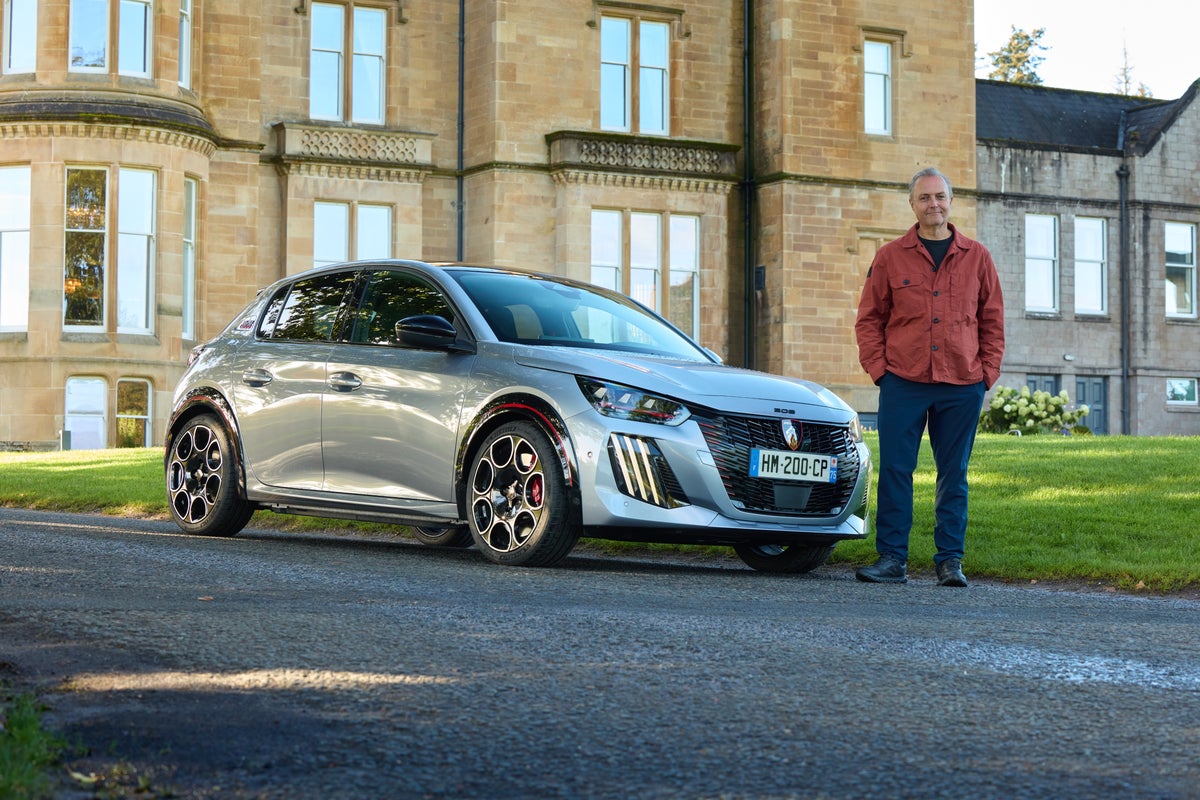
Before we go any further, a little housekeeping: this is a GTi with a small ‘i’. Volkswagen prefers GTI, with all three letters standing to attention, but Peugeot has always done things a little differently. For anyone with fond memories of a 205 GTi, seeing that badge on a small Peugeot again is rather cheering, even if the petrol engine has now made way for electric power.
This is Peugeot’s first electric GTi, developed by Peugeot Sport rather than simply having some red trim added to an ordinary E-208. The people involved also work on the company’s 9X8 endurance racing car, and their contribution stretches from the motor’s control software and battery cooling to the suspension, differential and brakes. There’s quite a lot going on underneath those familiar clothes, which helps explain why this car is so much fun to drive.

Peugeot has even put some numbers to what makes a hot hatch fun. In an April 2026 OnePoll survey of 2,000 UK motorists, the 1,000 car enthusiasts among them picked acceleration, agile handling and steering feel as the top three ingredients, at 61, 52 and 39 per cent respectively. All ranked ahead of engine sound, at 35 per cent – that’s encouraging for an electric GTi, although there has been a bit of effort on that, too.
It certainly looks the part, too. Smart, classy and reasonably restrained, the GTi hasn’t lost the neat proportions of the ordinary 208 in the process of becoming considerably more muscular. There are wider wheel arches, a front spoiler and a gloss-black rear diffuser incorporating an LED fog light, while the familiar three-claw lighting appears at both ends. Red details feature on the grille, headlights, front badge, wheel arches, brake callipers, rear spoiler and GTi badges on the rear pillars, without making it look as though somebody’s been let loose with a roll of red insulating tape.
The 18-inch wheels are another nod to the 205 GTi, mixing the curved centre of the old 1.6’s wheels with the outer shape associated with the 1.9. Their perforated design helps cool the brakes, too, so this isn’t just an exercise in making those of us of a certain age feel nostalgic. Inside, the restraint largely continues, although the red carpets and bright red seatbelts are rather less shy. I’ll come back to those.
At £33,495 after the Electric Car Grant, this is good value, and my drive around Loch Lomond left me in no doubt that Peugeot Sport has done its job. The problem is that the rest of the 208 feels a bit old these days, because it is! The cockpit layout and infotainment haven’t suddenly become better just because the car now goes rather quicker, while the range is on the meagre side and that’s before you start enjoying yourself. That’s why this is an eight-out-of-ten car, rather than something scoring even higher.
How we tested
I drove a varied route around Loch Lomond in Scotland, assessing performance, handling, comfort, refinement, technology, practicality and quality on different roads, including town streets and the usual Fowler car park practicality test.
Peugeot E-208 GTi: £33,495, Peugeot.co.uk
Independent rating: 8/10
- Pros: Great fun to drive, plenty of grip, confidence-inspiring handling, smart styling, good value
- Cons: Ageing interior and infotainment, awkward i-Cockpit driving position, limited range
Peugeot E-208 GTi specs
- Price: £33,495 including £1,500 Electric Car Grant (£34,995 OTR)
- Battery size: 54kWh
- Maximum claimed range: 233 miles with optional Hankook tyres; 219 miles with standard Michelin tyres
- Charging : 100kW DC; 20 to 80 per cent in 27 minutes
Battery, range, charging, performance and drive
The roads around Loch Lomond were a lovely place to discover what the GTi can do, with fast, sweeping stretches through the hills, tighter turns, dual carriageways and narrow town streets. They weren’t all dry, either, which made the amount of grip particularly reassuring. This isn’t a car that needs perfect weather and a beautifully surfaced road before you can start to enjoy it.
The steering is nicely weighted and gives you confidence straight away, even if it doesn’t tell your hands a huge amount about what the tyres are doing. There’s a difference between steering feel and being able to place a car accurately, and the Peugeot does the latter very well. Through faster, flowing bends, you can pick your line and put the car where you want it, while tighter corners reveal a car that feels happy to be thrown around. There was plenty of grip from the Michelin tyres my car was sitting on, even on those damp Scottish roads, rather than a constant sense that the power was going to overwhelm it.
Peugeot Sport has made some substantial changes to get it there. The body sits 25mm lower than a regular E-208, the front track is 56mm wider and the rear track grows by 28mm. There are specific springs and dampers with hydraulic bump stops, plus a 31mm rear anti-roll bar alongside the original 17mm front bar. A mechanical limited-slip differential is built into the gearbox to help make the most of the available traction. In other words, this is rather more involved and intriguing than just turning up the power and hoping for the best.
The ride lands just on the right side of firm. Some of the more ropey Scottish surfaces made it a little uncomfortable, but I’d put much of that down to the roads themselves. It’s certainly not a soft-riding little hatchback, yet the firmness doesn’t undo the enjoyment of driving it. The combination of that accurately weighted steering, grip and confidence through corners was the highlight of my time with the car.
The motor produces 277bhp and 345Nm of torque, with the 0–62mph sprint taking 5.5 seconds and the top speed is limited to 112mph. For a little family-history lesson, Peugeot quotes 7.8 seconds for the old 205 GTi 1.9 and 6.5 seconds for the later 208 GTi by Peugeot Sport. This new electric version certainly isn’t short of straight-line performance.
There are eco, normal and sport driving modes, with an unusual decision in sport: regenerative braking is switched off. Peugeot wanted the brakes to work through the conventional hydraulic system alone in that setting, rather than blending motor regeneration and friction braking. The stability control also has a sport setting allowing greater freedom, particularly for track use.
The battery has a gross capacity of 54kWh, of which 51kWh is usable. Its cooling has been adapted using knowledge from the 9X8 racing programme, with particular attention to controlling when coolant flows and how much is supplied. Peugeot says the aim is to sustain performance during demanding driving, rather than have the car reduce its power as the battery gets hot. That’s a useful distinction: keeping the performance available isn’t the same thing as making the battery’s energy last indefinitely.
Tyre choice makes a difference to the maximum claimed range. The standard 215/40 R18 Michelin Pilot Sport 4S tyres give 219 miles, while the no-cost optional Hankook Ventus S1 Evo3 tyres increase that to 233 miles. Those headline 233 miles therefore aren’t the figure for my car on its standard Michelins. And if you use the performance hard, as the GTi rather encourages you to do, and the already modest range will drop further.
Charging tops out at 100kW DC, with a claimed 20 to 80 per cent time of 27 minutes on a suitable rapid charger – not especially special by today’s standards.
Interior, practicality and boot space
The outside manages to look sporty without making a huge fuss about it, and much of the interior does the same. It’s smart and classy, with the GTi additions fitting the familiar 208 dashboard nicely rather than fighting with it. Then you look down at the bright red carpet, or reach for an equally bright red seatbelt, and realise that Peugeot hasn’t been entirely restrained. The 205 GTi references aren’t difficult to spot.
There are red floor mats, too, along with red stitching across the dashboard, door panels and steering wheel. Alcantara appears on the wheel and centre-console inserts, while the exclusive front seats have integrated headrests and extra lateral support. The central red inserts and mesh detailing look back to the seats of the old 205 GTi, with elements inspired by both the 1.6 and 1.9. It’s a more considered treatment than simply stitching a GTi badge onto the standard seats, and it gives the cabin some personality.
Unfortunately, it doesn’t fix my longstanding issue with Peugeot’s i-Cockpit. The idea is that you look over the small steering wheel at the driver display, rather than through it. In practice, I have to drop the wheel down into my lap to see the instruments properly, which isn’t where I’d ideally want it. It might also make it more difficult for some people to get in and out with the steering wheel down low.
The wheel itself is nicely trimmed in perforated leather and Alcantara, with a red 208 GTi emblem, but making it look and feel more special doesn’t solve where it needs to sit. It’s something to spend time checking before ordering, rather than assuming you’ll get used to it after a few days. Set the seat where you’d normally want it, adjust the wheel and make sure you can see the display without having to rearrange yourself. The usual Fowler car park test includes getting into and out of a car, not just squeezing it between the white lines, and this is precisely the sort of everyday detail that deserves attention.
There’s good front space, cramped rear accommodation for tall adults, a small boot and no front boot. The GTi’s appeal remains the way it drives, and the character added by those red details, rather than any reinvention of the 208’s interior.
Technology, stereo and infotainment
The touchscreen measures 10-inches, and it’s one of the clearest reminders that the 208 isn’t a new car. This is familiar Stellantis infotainment, and it feels a bit old-fashioned now: the screen is quite small by today’s standards and usability isn’t particularly good. I’m not asking for a television across the dashboard, but finding and using the functions you need shouldn’t feel more complicated than it has to.
The system is Peugeot’s i-Connect Advanced, with connected TomTom navigation and a route planner that takes account of range and charging stops. Wireless Apple CarPlay and Android Auto are included, as is voice control activated by saying “OK Peugeot”. There’s useful functionality here, even if the way it’s presented doesn’t feel as fresh as the GTi badge might suggest.
The GTi gets its own, red-themed digital graphics and performance pages, while the ambient lighting starts off red but offers seven other colours. There’s also a selectable sound linked to motor speed, which can be switched on or off. That’s separate from listening to music: it’s there to add an artificial soundtrack to the driving experience, rather than requiring the electric motor to do an impression of a petrol engine all by itself. I quite liked it.
The MyPeugeot app lets you pre-condition the cabin remotely, schedule charging and plan journeys, while Vehicle-to-Load capability allows the car to supply electricity to compatible external devices. Those are useful everyday EV features, although they don’t change my view of the central touchscreen or the awkward relationship between the steering wheel and driver display.
There’s a slightly unusual twist to the story, too. A new 208 is due next year with Peugeot’s novel, but brilliant, Hypersquare steering wheel and steer-by-wire technology. This GTi won’t move across to that new car: it will continue on the existing CMP platform alongside the petrol-powered 208s. So, while a new generation of Peugeot cabin technology is coming, this isn’t the car that will get it.
Prices and running costs
The E-208 GTi costs £34,995 on the road before the £1,500 Electric Car Grant, bringing the starting price down to £33,495. I think that’s really good value for what you’re getting, particularly when you consider how much work has gone into the suspension, differential, brakes and motor controls. The appeal isn’t just the acceleration figure or a familiar badge; it’s how enjoyable and confidence-inspiring the car is on a proper road.
The specification includes the 18-inch alloy wheels, full LED headlights, GTi sports seats, Alcantara-trimmed steering wheel, connected navigation, wireless Apple CarPlay and Android Auto, performance displays and ambient lighting. The standard Michelins can be swapped for the Hankooks at no extra cost, with that choice giving you another 14 miles of maximum claimed range. It’s worth being clear about which tyres you’re ordering rather than looking only at the biggest range number.
The battery is covered for eight years or 100,000 miles, whichever comes first. Peugeot Care can extend vehicle cover to the same age and mileage limits, but it’s important to understand the distinction: that combines three years of manufacturer warranty with up to five years of additional, service-activated cover. Keeping that extra protection requires scheduled servicing at a participating Peugeot retailer, and the cover has its own terms and exclusions.
Running costs will depend on where you charge and how enthusiastically you use the performance. My bigger reservation is the limited distance between charges, particularly when you’re enjoying the car. The GTi is good value and great fun, but you’re buying an extensively reworked version of an ageing 208, not a completely new electric hatchback. The driving experience makes a very good case for it; the cockpit and infotainment are the compromises.
The verdict: Peugeot E-208 GTi
Great to drive, grippy and good value, the E-208 GTi gets the fun bit right. It’s the ageing 208 underneath, awkward cockpit and limited range that hold it back overall.
Peugeot E-208 GTi rivals
- Volkswagen ID. Polo GTI
- Cupra Raval
- Vauxhall Corsa GSE
FAQs
How long does it take to charge?
The Peugeot E-208 GTi can charge from 20 to 80 per cent in 27 minutes using a suitable rapid charger, with a maximum DC charging rate of 100kW. Peugeot also quotes four hours and 40 minutes on a 7.4kW wallbox.
How much does it cost and is it worth it?
The on-the-road price is £34,995, reduced to £33,495 by the £1,500 Electric Car Grant. I think it’s good value, with the grip, confidence-inspiring handling and enjoyment to justify the GTi badge. The limited range, awkward i-Cockpit and ageing infotainment are the main drawbacks, which is why my verdict is eight out of ten.
Does Peugeot replace batteries for free?
The battery warranty lasts eight years or 100,000 miles, whichever comes first, and includes a minimum 70 per cent capacity guarantee. Separate Peugeot Care vehicle coverage can last up to eight years or 100,000 miles, subject to its servicing requirements and conditions.
Why trust us
Our team of motoring experts have decades of experience driving, reviewing and reporting on the latest EV cars, and our verdicts are reached with every kind of driver in mind. We thoroughly test drive every car we recommend, so you can be sure our verdicts are honest, unbiased and authentic.