The Rail Pass Question Nobody Answers Honestly
The 7-day Japan Rail Pass costs around ¥50,000 (roughly ₹28,000 at current rates). A single Tokyo-to-Kyoto Shinkansen round trip on the Nozomi, the fastest Bullet Train, runs about ¥28,000. So the pass pays for itself the moment you add Hiroshima or Osaka into that loop. What the brochures skip: the pass covers JR lines, not every subway or private rail in every city. In Tokyo, you will still buy a Suica card for daily metro use. In Kyoto, most buses run on a separate city system. Budget ¥1,500 to ¥2,000 per day for local transit on top of the pass, and the maths stays honest.

The 14-day pass (around ¥70,000) makes sense only if you are going beyond the classic Osaka-Kyoto-Tokyo triangle, Hiroshima, Miyajima, Hakone, or a bullet up to Sendai or Sapporo. If your itinerary is Tokyo, one night in Hakone, Kyoto, Osaka, and back: the 7-day pass is almost always the right call. Sit down with Hyperdia or the JR Pass calculator before you buy. The number will tell you.
Which Season to Book Around
Cherry blossom season (late March to mid-April) and autumn foliage (mid-November) are Japan at its most photographed, and its most crowded. For travellers from India, both overlap with school holidays and long weekends, so flights from Mumbai, Delhi, and Bengaluru spike sharply in those windows. A return ticket that costs ₹55,000 in February can touch ₹90,000 in late March.
The practical trade-off: if you have never seen sakura, go once in blossom season and accept the crowds and the premium. The experience is real. If you have flexibility, late October gives you the early edge of autumn colour, cooler temperatures (12 to 18°C), and cheaper flights. June and July bring the rainy season, not a disaster, but humidity is high and outdoor days get complicated. January and February are cold (Tokyo drops to 3 to 5°C at night) but flights are cheap and queues at major temples are short. For Indian travellers who run warm and find anything below 15°C uncomfortable, pack accordingly, Japan's winters are dry and manageable with the right layers, but a Pune summer wardrobe will not survive Kyoto in December.
Tokyo: What First-Timers Get Wrong
Most first-time visitors from India underestimate how much Tokyo alone can absorb. Three days feels like enough on paper. It isn't. The city has distinct neighbourhoods that feel like separate places: Shinjuku (neon, nightlife, the busiest train station on earth), Yanaka (old wooden temples, quiet lanes, the Tokyo that survived the war), Harajuku (fashion, Takeshita Street, the Meiji Shrine directly behind it), Akihabara (electronics, anime, a specific kind of overwhelm). Trying to cover all of these in two days produces a blur.
Give Tokyo three full days minimum. On the food side: a bowl of ramen at a standing counter in Shinjuku costs ¥800-¥1,200. A set lunch at a mid-range sushi restaurant runs ¥1,500-¥2,500. For vegetarian Indian travellers, the situation requires planning, Japan's dashi broth (fish stock) appears in dishes that look vegetarian. Convenience stores like 7-Eleven and FamilyMart carry onigiri and sandwiches with English labelling. Dedicated vegetarian restaurants exist in Tokyo but are concentrated in specific neighbourhoods; download HappyCow before you land.
Kyoto, Osaka, and the Day-Trip Logic
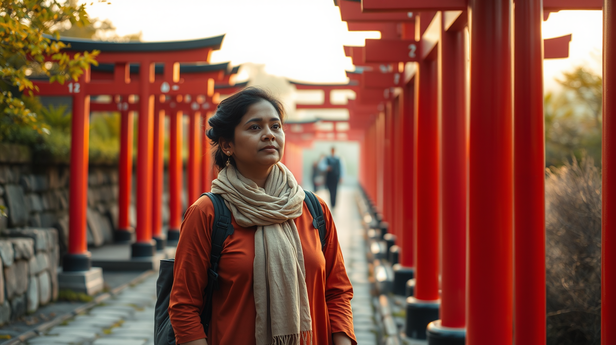
Kyoto and Osaka are 15 minutes apart by Shinkansen, 40 minutes by the cheaper Hankyu private rail line. Most first-timers base themselves in Osaka (cheaper accommodation, better street food) and day-trip into Kyoto. This works, but it means you are doing Kyoto's temples, Fushimi Inari, Arashiyama bamboo grove, Kinkaku-ji, in a single long day with everyone else who made the same calculation. The crowds at Fushimi Inari peak between 9 am and 2 pm. Arrive at 6 am or after 4 pm and the lower torii gates are quiet.
Hiroshima deserves a full day, not a rushed afternoon. The Peace Memorial Museum is not a tourist attraction in any conventional sense, it is two hours of sustained attention, and it earns it. Miyajima Island, 30 minutes by ferry from Hiroshima, holds the floating torii gate of Itsukushima Shrine. Both sites are on the JR network and covered by the pass.
Nara, 45 minutes from Osaka or Kyoto by train, is an easy half-day: the giant Buddha at Todai-ji, the free-roaming deer in Nara Park. The deer are genuinely bold, they will headbutt you for shika senbei (deer crackers) sold at park stalls for ¥200 a bundle. Budget the half-day, not a full one.
Building a 10-Day Itinerary That Doesn't Collapse
Ten days is the sweet spot for a first Japan trip from India. Fourteen days is better, but ten is workable if you resist the urge to add one more city every time you read a travel thread. A structure that holds: two days in transit and recovery (Japan's time difference from India is 3.5 hours, manageable but real), three days in Tokyo, one night in Hakone for Mount Fuji views (weather-dependent, book a ryokan, eat kaiseki, lower expectations if it's cloudy), two days in Kyoto, one day in Hiroshima and Miyajima, one day in Osaka before the flight home.
The budget breakdown for Indian travellers: flights are the biggest variable, typically ₹45,000-₹90,000 return depending on season and advance booking. A 7-day JR Pass runs ₹28,000. Accommodation in a clean business hotel or mid-range guesthouse averages ¥8,000-¥12,000 per night (₹4,500-₹6,800). Daily food and local transit, ₹2,500-₹4,000. A ten-day trip, excluding flights, typically lands between ₹80,000 and ₹1,10,000 per person. That is not cheap by Indian travel standards, but Japan's prices have stayed relatively stable for Indian visitors because the yen has weakened considerably against the rupee over the past few years.
The pass, the season, and the cities are each a separate decision. But they are not independent, a cherry blossom trip with a 14-day pass and Sapporo on the itinerary is a completely different financial and logistical object than a winter trip with a 7-day pass and Tokyo-Kyoto-Hiroshima. Fix the season first, because it sets the flight cost. Fix the cities second, because they determine which pass makes sense. The pass is the last decision, not the first.