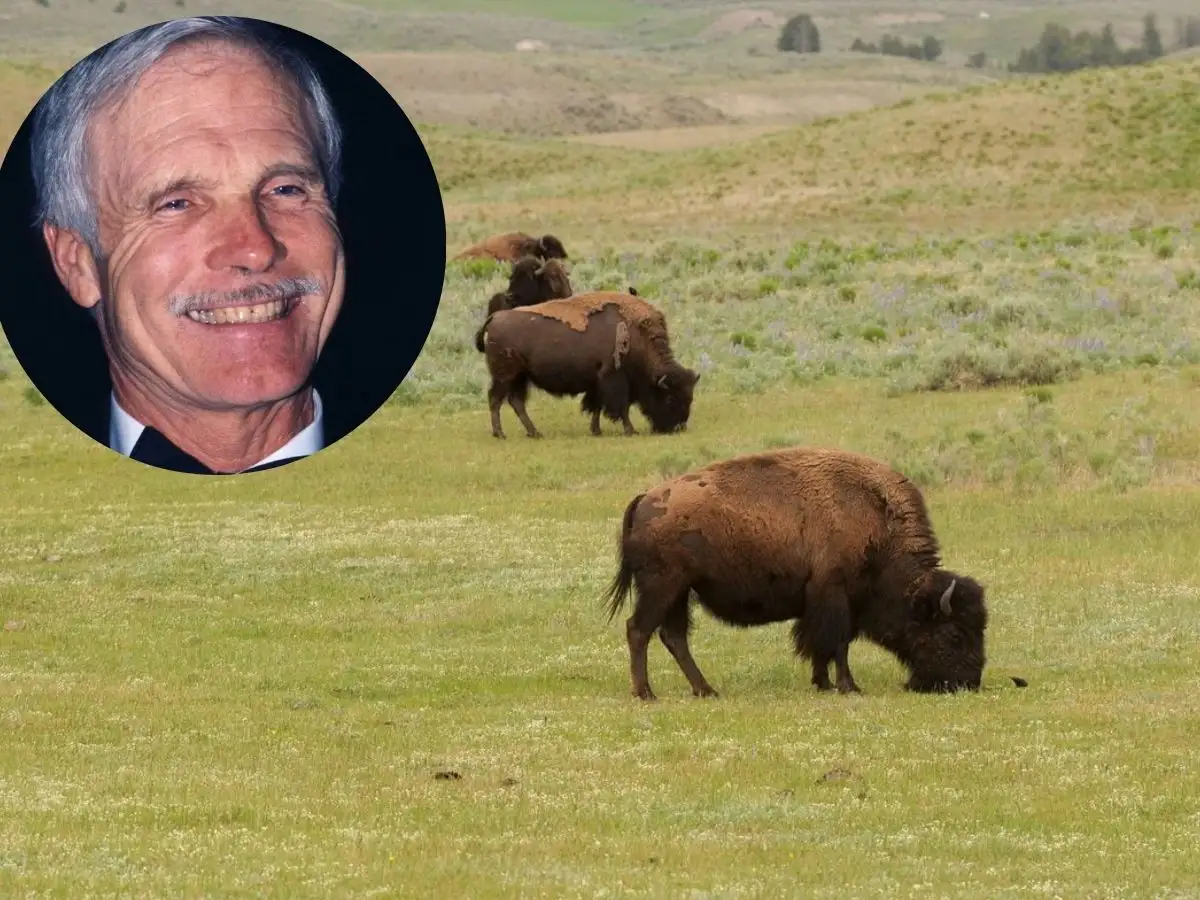
In 1989, media billionaire and CNN founder Ted Turner bought the enormous Flying D Ranch in Montana for about $21 million. Instead of continuing it as a traditional cattle operation, he removed the cattle, pulled out hundreds of miles of internal barbed-wire fencing and began transforming the property around bison.
Nearly four decades later, the ranch looks very different from the operation Turner acquired. It now supports about 4,500 bison across 113,613 acres of southwestern Montana.

Ted Turner’s unusual vision for the Flying D Ranch
The Flying D Ranch sits between the Gallatin and Madison rivers, south of Bozeman. Before Turner purchased it, the property was a major cattle ranch, according to Space Daily.
At its peak, the ranch supported an estimated 7,000 to 8,000 cattle. Years of grazing had taken a toll in some areas, with portions of creek bottoms and grasslands showing signs of heavy use.
Turner had a different idea for the vast Montana property. He wanted bison to become the dominant grazing animal. As part of that transition, cattle were removed and hundreds of miles of interior barbed-wire fencing were taken down, allowing bison to move more freely across the landscape.
Why Turner brought bison back
Bison once played a major role in North American grasslands. Their grazing patterns can differ considerably from those of cattle, and researchers have found evidence that those differences can influence vegetation and habitats.
Research from Kansas' Konza Prairie, for example, found that long-term bison grazing increased native plant species richness compared with ungrazed areas. A separate Montana study found differences between bison and cattle in how they used streams and surrounding vegetation.
That research does not mean every bison ranch will produce the same results. But it helps explain why Turner's decision was more than simply swapping one livestock species for another.
The fencing experiment did not go exactly as planned
Turner initially removed huge amounts of internal fencing so the bison could roam with fewer restrictions. But the animals did not distribute themselves perfectly across such a massive landscape.
Some areas became overgrazed while others were underused. As a result, some fencing eventually had to be brought back. The Flying D therefore did not become an entirely unmanaged wilderness. It remained a working ranch where the bison were privately owned and actively managed.
From cattle country to a bison operation
Today, the Flying D is part of a much larger bison enterprise connected to Turner Enterprises. The company says its herds across 13 ranches total roughly 45,000 bison, described as the world's largest private bison herd.