
Get all your news in one place.
100's of premium titles.
One app.
Start reading
Digital Camera World
Jamie Carter

ZWO Seestar S30 Pro Total Solar Eclipse Edition smart telescope review

ZWO Seestar S30 Pro Total Solar Eclipse Edition.

Smart telescopes like the Seestar S30 Pro have changed astrophotography and, arguably, urban astronomy. The Seestar S30 Pro Total Solar Eclipse Edition takes that same compact, automated imaging concept and packages it for one of the biggest astronomical events of the decade — continental Europe’s first total solar eclipse since 1999.

This is not a ground-up redesign for the August 12 event. Internally, it’s very close to the standard Seestar S30 Pro, combining a 30mm apochromatic refractor, motorized mount, dual cameras and image-processing software into a compact unit controlled entirely from a smartphone. Within minutes of powering on, it can align itself to the sky, slew to a specified target and begin stacking exposures to reveal galaxies, nebulae, star clusters and, of course, the sun and moon.

What changes here is the presentation. The Eclipse Edition adds a black-and-gold finish, a diamond-ring eclipse graphic, limited-edition numbering, themed packaging and a new magnetic solar filter. That makes it particularly appealing to eclipse chasers and collectors who want a travel-friendly telescope that easily fits in a camera backpack that’s ready for solar observing out of the box.

Specifications

The Seestar S30 Pro Eclipse Edition commemorates mainland Europe’s first total solar eclipse since 1999. (Image credit: Jamie Carter)

Sensor

Sony IMX585 (tele) / Sony IMX586 (wide)

Resolution

8.3MP (3840 x 2160)

Aperture

30mm / 1.18 inches

Focal ratio

f/5.3

Focal length

160mm / 6.3 inches

Optics

Quadruplet apochromatic lens with ED glass

Solar filter

Seestar magnetic solar filter

Storage

128GB eMMC

Connections

USB-C, Bluetooth and WiFi

Mount

Alt-azimuth (EQ mode supported)

Battery capacity

6,000mAh

Dimensions

210 × 140 × 80mm / 8.27 × 5.51 × 3.15 inches

Weight

1.65kg / 3.6 lbs

Price

The Seestar S30 Pro Eclipse Edition comes in a padded case with shoulder strap included (Image credit: Jamie Carter)

The standard Seestar S30 Pro is priced at US$699/£649/AU$1,000, while the Total Solar Eclipse Edition costs US$799/£719/AU$1,150. That makes this limited model US$100/UK£70/AU$150 more expensive. The Seestar S30 Pro includes a more basic solar filter, but is the teardrop-shaped solar filter provided with the Total Solar Eclipse Edition worth the extra money? It’s not — a third-party, 3D-printed solar filter made with Baader AstroSolar film is available for around US$32/UK£27/AU$52 and is of better quality. What you’re paying for with the Total Solar Eclipse Edition is a new black-and-gold finish, a numbered edition, eclipse-themed packaging, a custom app experience and an all-round collectible appeal. This is less a standard upgrade path and more a special-edition purchase for eclipse season.

For deep-sky imagers, its EQ mode — which compensates for the Earth’s rotation — is an option, though that does require the purchase of the Seestar TH10 Fluid Tripod Head (costing US$79) (or any equatorial wedge).

Design & Handling

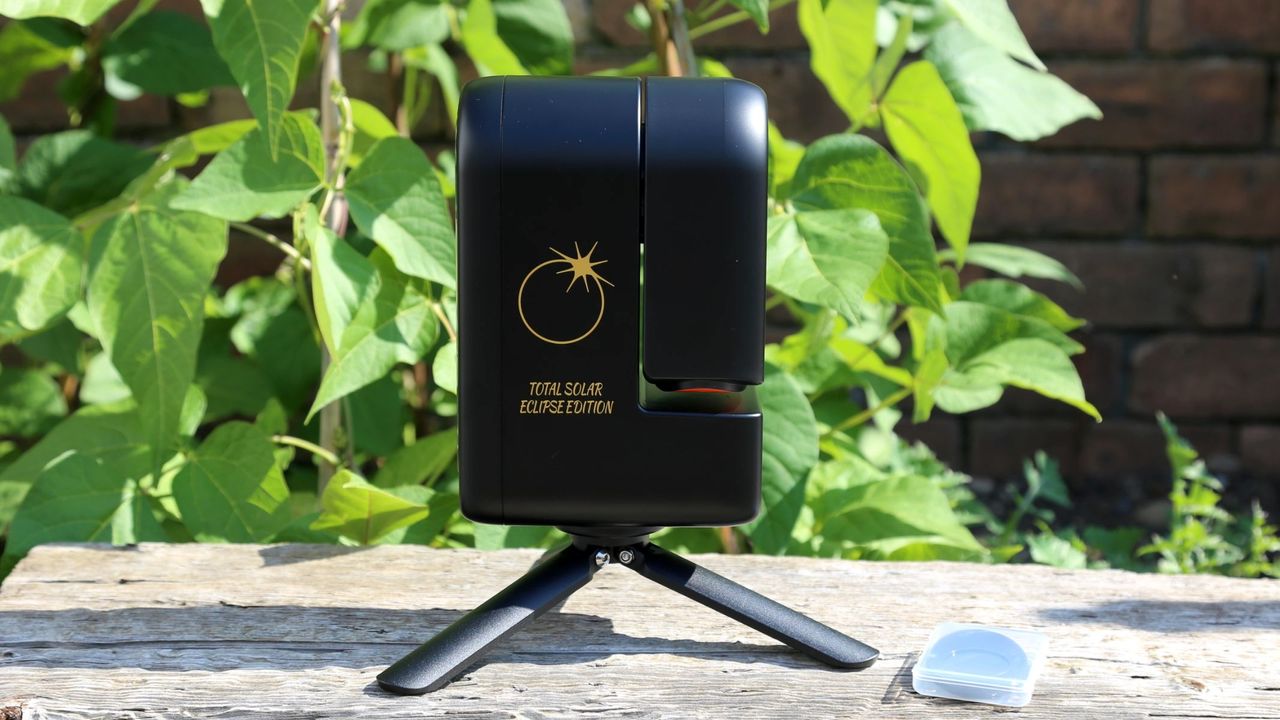
The Seestar S30 Pro Eclipse Edition is black, rather than the white standard edition. (Image credit: Jamie Carter)

At first glance, the Seestar S30 Pro Total Solar Eclipse Edition looks far more distinctive than the standard white model. While the regular Seestar S30 Pro has a clean, Apple-like appearance, this limited-edition’s black finish feels more appropriate for astronomical equipment. Many users will prefer the darker color, particularly on a device intended for night-sky and solar work.

The eclipse decoration is tastefully executed. The body features an image of an eclipsed sun at second contact — the “diamond ring” moment — with “Total Solar Eclipse Edition” written underneath in gold. There is also gold S30 Pro branding on the narrow side, while the Seestar name and logo are picked out in gold on the reverse. ZWO has extended the theme to bespoke packaging, so it feels like a complete commemorative edition rather than a standard model with a sticker applied.

Each device also comes with limited-edition numbering and a commemorative plaque, reinforcing the sense that this is aimed at collectors as well as users. There is also a device-locked themed app experience, with eclipse-specific visuals and connection animations. None of this changes image quality, but it does make the edition feel more special.

The Seestar S30 Pro Eclipse Edition ships with a solar filter included. (Image credit: Jamie Carter)

The practical design advantage is the official solar filter. It is teardrop-shaped, supplied in its own small case and attaches magnetically to the front of the telescope. It’s exactly the kind of accessory eclipse travelers need: compact, quick to fit and properly integrated.

The telescope itself remains highly portable. At 3.6 lbs (1.65kg), it’s small enough to fit in a camera backpack alongside a mirrorless body and a couple of lenses. The included tabletop tripod is solid, though users working from a backyard, balcony or crowded eclipse-viewing location will likely prefer to mount it on a full-size photographic tripod for better height and positioning.

Performance

The Seestar app has been upgraded and now contains lots of set up hints and tips. (Image credit: Jamie Carter)
There are plenty of safety warnings for solar imaging. (Image credit: Jamie Carter)

For night-sky imaging, performance is essentially that of the standard Seestar S30 Pro. After powering on and connecting through the smartphone app, the telescope automatically plate-solves the sky, determines its position, slews to a selected object, focuses and begins capturing short exposures. These are stacked in real time, gradually improving detail and reducing noise as the total integration time increases. The 8.3MP Sony IMX585 telephoto sensor gives more scope for cropping and post-processing than the original 2MP Seestar S30, while the Sony IMX586 wide-angle camera supports alignment and wide-field imaging modes.

The Total Solar Eclipse Edition’s real focus, however, is solar imaging. With the magnetic solar filter attached, the Seestar can locate and track the sun through the app, then capture still photos, video or timelapse sequences. A still photo is the quickest way to record sunspots and is saved directly to a smartphone. Timelapse mode is especially useful for eclipse work, with selectable intervals of 1-60 seconds, making it possible to document the changing partial phases with minimal intervention.

The sun as seen by the Seestar S30 Pro Eclipse Edition.CAPTION: (Image credit: Jamie Carter)
The sun through a homemade white-light solar filter attached to the Seestar S30 Pro Eclipse Edition. (Image credit: Jamie Carter)

For crisp solar results, though, technique matters. The Seestar’s autofocus needs a high-contrast feature to lock accurately, so the best approach is to tap directly on a prominent sunspot and perform autofocus there. That should be possible on Aug. 12. Focusing on the edge of the solar disk is tempting, but it can leave the center slightly soft. Manually increasing gain can also help the system lock focus more confidently.

The supplied solar filter is convenient and well integrated, but it is not the sharpest option available. It produces an orange view of the sun, and filters of this kind are generally not as fast as white-light filters. In practice, that can mean slower exposures and a little softness compared with a good white-light filter. We placed a homemade solar filter made with Baader AstroSolar film, which gave a noticeable improvement in the sharpness of both sunspots and the solar limb.

A homemade white-light solar filter on the Seestar S30 Pro Eclipse Edition. (Image credit: Jamie Carter)

The best workflow is not necessarily a series of still images of the sun, which would mean staring at a smartphone during the precious seconds of totality (when, of course, the solar filter must come off). Switching to video mode and capturing around 10-15 seconds of footage gives better material for post-processing. Video is saved to the Seestar’s internal memory and can be accessed by connecting a computer to the USB-C port, with ZWO’s ASI Studio software used to include, extract and stack the best frames to produce a cleaner, sharper final image.

For the 2026 total solar eclipse, the appeal is obvious. Eclipse photography is stressful because the critical phases happen quickly, particularly second contact, totality and third contact. A small automated telescope that can track the sun — perhaps while the photographer manages a separate camera and long lens — may be extremely useful. It will not replace a carefully planned high-resolution eclipse rig, but it makes a lot of sense as a guided, compact solar imaging companion. Just remember to remove the solar filter at second contact!

Functionality

If you plan to capture images of the partial phases of the solar eclipse — whether you’re going to be in the path of totality or not — get in place well ahead of first contact. That’s because the Seestar S30 Pro can take a little time to find the sun. In our tests, it immediately slewed away from the sun twice before giving up, then asked us to perform a calibration — a laborious process in which the entire telescope must be turned about 40 times before its sensors get a grip on where it is. However, once it was locked on to the sun, it stayed there.

The Seestar app is central to the entire experience. It acts as the controller, sky atlas and imaging interface, handling alignment, target selection, focusing, capture and processing. The telescope has very few physical controls, so anyone buying into the Seestar system needs to be comfortable with full smartphone operation.

For deep-sky imaging, the app offers the familiar automated workflow: select an object, allow the telescope to slew, and watch the stacked image build on screen. FITS export is available for users who want to process deep-sky images in software such as Siril, PixInsight, DeepSkyStacker or Photoshop. That gives the Seestar S30 Pro more longevity for users who start with one-button imaging but later want more control over the final result.

As with all app-dependent devices, there is a long-term caveat. Without the app, the telescope cannot meaningfully operate, so this is not the kind of optical instrument likely to be passed down for generations in the same way as a traditional refractor. It’s best thought of as a compact, capable and collectible imaging appliance for the solar eclipse and beyond.

Verdict

The Seestar S30 Pro Total Solar Eclipse Edition is best understood as a limited, eclipse-ready version of the standard Seestar S30 Pro. It does not bring a major optical or sensor upgrade, so anyone expecting a fundamentally different telescope will be disappointed. Its strengths are portability, automation, solar-readiness and its eclipse-themed presentation.

For eclipse chasers, the appeal is strong. Critically, it’s small enough to travel with, simple enough to operate quickly, and capable of tracking the sun while capturing stills, video or timelapse sequences. For collectors, the numbered black-and-gold finish gives it an appeal the standard white model does not have. For general astrophotographers, the decision is less clear. The standard Seestar S30 Pro plus a third-party Baader film solar filter may be the better-value route, especially if sharp solar detail matters more than collectability. The supplied magnetic filter is convenient, but not the last word in solar sharpness.

Features

★★★★★

The same strong automated imaging feature set as the S30 Pro, with 4K sensors, FITS export, EQ mode support, mosaic shooting, timelapse and RAW solar video capture.

Design

★★★★★

The black-and-gold eclipse styling is more attractive than the standard white finish, while the numbered edition, themed case and magnetic filter are well judged.

Performance

★★★★☆

Excellent for automated solar imaging, eclipse preparation and casual deep-sky work, though crisp solar results require sunspot-based autofocus, RAW video stacking and ideally a sharper Baader film filter.

Value

★★★★☆

The price premium is not justified by optical improvements alone, but the solar filter, limited finish and eclipse-ready package make sense for the right buyer.

Overall

★★★★☆

Alternatives

See our complete guide to the best smart telescopes

Sign up to read this article
Read news from 100's of titles, curated specifically for you.
Already a member? Sign in here
Related Stories
Top stories on inkl right now
One subscription that gives you access to news from hundreds of sites
Already a member? Sign in here
Our Picks
Fourteen days free
Download the app
One app. One membership.
100+ trusted global sources.