Have you ever noticed how anger rises fastest when your insecurity gets exposed? Not when someone insults you, but when someone silently challenges the image you have built about yourself. Thousands of years ago, a similar thing happened in the mysterious Daruk forest. Great sages who were proud of their knowledge believed they no longer needed God, wisdom, or growth. That is when the universe answered their ego in the most unexpected way. Lord Vishnu arrived as the enchanting Mohini, while Lord Shiva entered as a wandering beggar named Bhikshatana. What happened next changed the meaning of ego forever.

The Ego That Blinded The Sages
Vishnu and Shiva arrived in opposite forms to test human attachment and ego.
The sages of Daruk forest were highly knowledgeable and spiritually powerful. Over time, however, wisdom slowly turned into arrogance. They became convinced that they already knew everything worth knowing. In their pride, they believed they no longer needed devotion, humility, or even God himself. This is where their downfall truly began. Knowledge without openness became ego. Instead of growing spiritually, they became trapped inside their own superiority. The story becomes deeply relatable because even today people often mistake information for wisdom. The moment learning stops, insecurity quietly begins hiding behind confidence and pride.
Why Mohini And Bhikshatana Appeared Together
Vishnu and Shiva arrived in opposite forms to test human attachment and ego.
To break the sages’ illusion, the universe sent two opposite energies into Daruk forest. Lord Vishnu appeared as Mohini, a form of irresistible beauty and attraction. Lord Shiva appeared as Bhikshatana, a wandering ascetic with nothing to offer materially. Mohini represented everything people desire to possess, while Bhikshatana represented complete emptiness and detachment. The sages became attracted to Mohini instantly, but what truly disturbed them was seeing their wives drawn toward Bhikshatana’s peace and silence. That moment exposed a painful truth inner peace often becomes more attractive than wealth, power, or intellectual pride.
When Insecurity Turned Into Rage
The sages were not angry when they themselves became attracted to Mohini. Their anger erupted only when they saw others choosing something beyond their control. That is the dangerous nature of insecurity. It stays hidden until comparison awakens it. Unable to understand why their wives felt drawn toward Bhikshatana’s calm energy, the sages became consumed by jealousy. Instead of questioning themselves, they attacked the source of discomfort. Their wisdom disappeared under anger and ego. This ancient moment mirrors modern life perfectly because people often react most violently when their identity, importance, or superiority feels threatened.
Every Attack Became Shiva’s Strength
Blinded by rage, the sages used black magic and dark rituals against Bhikshatana. First, they sent a magical tiger to kill him. Shiva calmly tore its skin with a single nail and wore it as clothing. Then they sent a venomous serpent, but Shiva wrapped it peacefully around his neck. Finally, they created a terrifying demon called Apasmara, symbolising ignorance and spiritual darkness. Yet Shiva remained completely fearless. Every attack meant to destroy him became part of his divine appearance instead. This powerful symbolism teaches that spiritually awakened people transform negativity into strength rather than reacting emotionally.
The Moment Shiva Became Nataraja
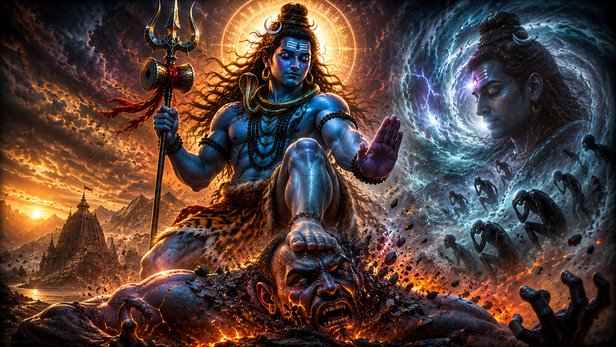
As Apasmara appeared, silence spread across the forest. Bhikshatana revealed his true form as Nataraja, the cosmic dancer. His matted hair opened into the universe itself, stars appeared, Ganga flowed from his locks, and divine energy filled every direction. Shiva placed one foot upon Apasmara, not to kill him but to keep ignorance under control. This is the deepest lesson of the story. Ignorance must exist because it keeps humans curious and willing to learn. The danger begins only when ignorance rises above awareness. Shiva’s dance symbolised balance between destruction, creation, wisdom, and spiritual awakening.
The Lesson Hidden Inside Shiva’s Dance
The Nataraja form is not just a beautiful image from mythology. It is a reminder about everyday life. Problems, failures, insecurity, and change constantly shake human beings emotionally. But Shiva’s dance teaches people not to freeze in fear or anger. Instead, they must keep moving with life’s rhythm while controlling ego and ignorance. One hand of Nataraja holds fire, another holds the damaru of creation, while his raised hand gives reassurance do not fear. The message is simple yet powerful: when people stop fighting life and start flowing with it, transformation becomes possible even during chaos.
Unlock insightful tips and inspiration on personal growth, productivity, and well-being. Stay motivated and updated with the latest at My Life XP.
Frequently Asked Questions (FAQs)
1. Who were the sages of Daruk forest?The sages of Daruk forest were powerful rishis known for their deep spiritual knowledge and rituals. According to Hindu mythology, they eventually became arrogant about their wisdom.
2. Why did Lord Shiva appear as Bhikshatana?
Shiva took the form of Bhikshatana, a wandering ascetic, to break the ego and false pride of the sages and teach them the value of humility.
3. Who was Mohini in this story?
Mohini is the enchanting form of Lord Vishnu. She symbolised attraction, desire, and worldly attachment in the Daruk forest story.
4. Why did the sages become angry with Shiva?
The sages became angry when they saw their wives drawn toward Bhikshatana’s peaceful and detached presence. Their insecurity and wounded ego turned into jealousy and rage.
5. What is the meaning of Bhikshatana?
Bhikshatana means “the wandering mendicant” or “divine beggar.” The form represents detachment from material possessions and complete spiritual freedom.







