If you go far enough back in time, Americans and Europeans are virtually of the same blood. Heck, they still are without the time travel, but other factors played a role in why there’s a certain kind of cultural and social divide. The big pond between the continents being one of them.
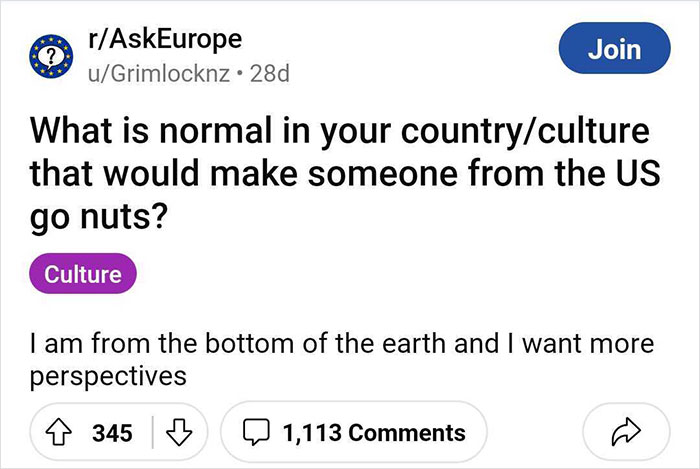
Still, differences ought to be celebrated and folks online choose to do that by pointing out what’s normal in Europe (and other places, really) but might look weird to the average American. As per this Reddit thread.
#1

Image credits: MTFinAnalyst2021
#2

Image credits: ninjomat
#3

Image credits: bullet_bitten
So, what is culture? In the most simple of terms, culture is everything that a group of people are and know.
In less simple terms, culture is a sort of an identity that a group of people—a community—has that manifests itself through things like language, religion, cuisine, social behaviors and habits as well as the arts.
#4

Image credits: cragglerock93
#5

Image credits: HeartCrafty2961
#6
Germany: Children in primary/grade school walk to school by themselves or in groups each morning, unsupervised.
We have ~~naked~~ nude areas at lakes and beaches. Or in parks, very rarely. .

Image credits: Myrialle
To make it even less simple, a huge chunk of what culture is deals with shared patterns of behaviors and interactions, cognitive structures and understanding learned through socialization. This further brings home the idea of culture being an identity all the while also explaining that it’s an organism of sorts—it grows, it develops, and it reproduces through being passed down to other generations.
#7

Image credits: anon
#8

Image credits: LongrodVonHugedong86
#9

Image credits: WyvernsRest
And there’s loads of these cultures. Each country has at least one, and if it’s a bigger or more ethnically diverse country, there can be more (in the thousands even). And that’s just one aspect. Cultures can form among regions, districts, or communities that can all focus on the various aspects of identity—communities based around political beliefs, religious ones, hobbies and interests, and the like.
#10

Image credits: publius_decius
#11

Image credits: Kikkervelf
#12

Image credits: WyllKwick
One of the key aspects that explain why there are so many cultures out there is the idea of ecology. In different parts of the world, people are surrounded by different physical and social conventions.
While we are all the same as a species, we all have mechanisms that allow us to adapt to our immediate surroundings in different ways.
#13

Image credits: Confident_Yam3132
#14

Image credits: CarangiBooks
#15

Image credits: ninaeatworld
The phenomenon is called adaptive phenotypic plasticity and it’s basically the idea of the same genes leading to different human traits depending on the environment.
And the body is going to keep it that way because evolutionary theories suggest natural selection favors flexible behaviors that are sensitive to such environmental changes. And if you pair that up with the idea that we are stronger and more fit to survive in groups, it only solidifies the role of culture in evolution.
#16

Image credits: peggyzyy
#17

Image credits: AminoKing
#18

Image credits: Matttthhhhhhhhhhh
As such, that which makes us all similar and psychologically tending towards the same things is expected of humans sharing similar ecological conditions.
To keep it clear, the idea of environmental conditions isn’t just weather patterns—it’s also things like the social, physical and a slew of other climates, conditions that force us to react in one way or another.
#19

Image credits: GeronimoDK
#20

Image credits: 1agomorph
#21

Image credits: SystemEarth
And all of this is important why? Because, tl;dr, we’re better off closer together.
By learning who the other is, we empower ourselves to learn more about what the world is like, and education never hurts anyone (getting hit by a book isn’t an argument against it, Tim).
As such, this way we build trust and respect, and if a particular place becomes rich in multiculturalism that way, it just makes it more interesting to live there.
#22

Image credits: Ostruzina
#23

Image credits: Honest-School5616
#24

Image credits: ordealofmedusa
This is also why we ought to support cultural diversity, and there’s a number of ways of doing it. First up, plunge into the pool of diversity as living in one rubs off on you. This is quite literally how culture works.
All the while avoid imposing values that others may have trouble accepting or it’s inconsistent with their own.
#25

Image credits: Tubafex
#26
#27

Image credits: dutchyardeen
A lot of what accepting other cultures is can be defined as education and understanding. So teach yourself and learn to understand the concepts that describe these other cultures. In turn, learn to respect and accept them, and will show a good example to others.
By proxy, push away the tide of ignorance and stop folks from exercising insensitivity, bias and prejudice. Being proactive in all of these things will solidify the experience.
#28

Image credits: 41942319
#29
Poland:
Married couples often refer to their parents in-law as just "mom" and "dad".
Everyone is sir/madam until you both decide otherwise. Calling adult person you just met "you" or their name is a big no-no.
Pasta or rice with strawberries and cream is a summer dessert.
Majority of people here would hate the idea of store staff smiling at them and offering help all the time.
Eating inside with your hat on is considered rude af.

Image credits: kompocik99
#30

Image credits: TheYoungWan
So, what are your thoughts on any of this? What are some differences that you think are worth mentioning here? Share your takes and stories in the comment section below!
Oh, and before I forget, there’s more where that came from.
#31
#32
#33
Crotia:
We learn how to drink really early in life. By the time we're legally allowed to, we have a tolerance and culture of drinking to we don't pass out so easily.
Kids don't drive. But these are boring examples.
How about supermarkets not working 24/7, not everyone speaking English, especially elderly who usually rather speak German or Russian, not having highways of US scale, people walking around towns, kids going to profession-specified high schools, foxes walking around towns like domestic animals and deers in people's yards.
>500 y/o buildings still in use, gas stoves, turkish coffee, 7-15 work hours, more than 2 parties on political scene, smoking being popular, majority using android devices...

Image credits: grounded_dreamer
#34
#35

Image credits: smokeandmirrorsff
#36
#37

Image credits: LudicrousPlatypus
#38

Image credits: andrejRavenclaw
#39
#40
#41

Image credits: tereyaglikedi
#42

Image credits: Vince0789
#43

Image credits: chunek
#44

Image credits: ElKaoss