Get all your news in one place.
100's of premium titles.
One app.
Start reading
The Conversation
The Conversation
Environment
Patricia J. Rettig, Head Archivist, Water Resources Archive, Colorado State University

Western river compacts were innovative in the 1920s but couldn't foresee today's water challenges

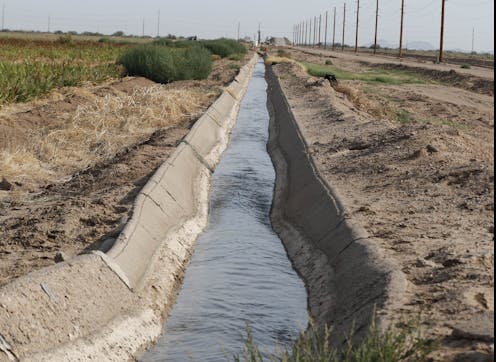
Colorado River water flows through a canal that feeds farms in Casa Grande, Ariz., on July 22, 2021. AP Photo/Darryl Webb

The Western U.S. is in a water crisis, from California to Nebraska. An ongoing drought is predicted to last at least through July 2022. Recent research suggests that these conditions may be better labeled aridification – meaning that warming and drying are long-term trends.

On the Colorado River, the country’s two largest reservoirs – Lake Powell and Lake Mead – are at their lowest levels in 50 years. This could threaten water supplies for Western states and electricity generation from the massive hydropower turbines embedded in the lakes’ dams. In August 2021 the federal government issued a first-ever water shortage declaration for the Colorado, forcing supply cuts in several states.
Sign up to read this article
Read news from 100's of titles, curated specifically for you.
Already a member? Sign in here
Related Stories
Top stories on inkl right now
One subscription that gives you access to news from hundreds of sites
Already a member? Sign in here
Our Picks
Fourteen days free
Download the app
One app. One membership.
100+ trusted global sources.