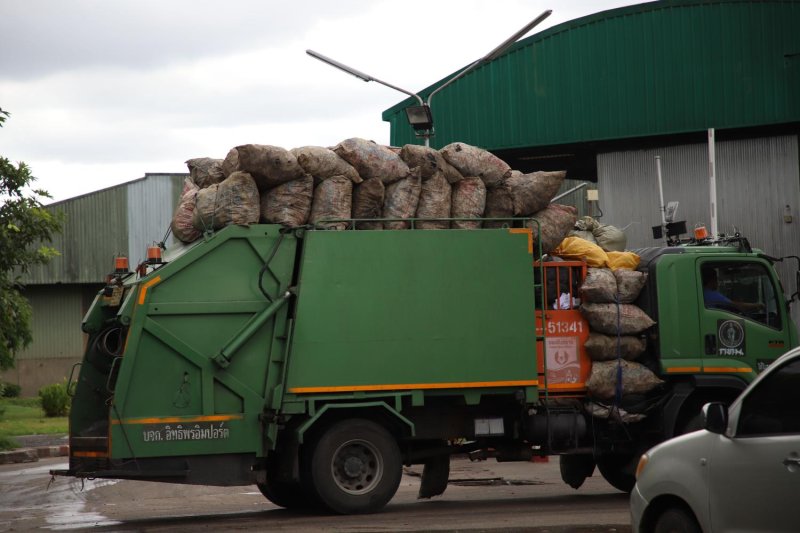
Waste management is one of the most essential public services a city can and must provide. When it breaks down -- even briefly -- thousands of tonnes of rubbish pile up fast. Foul odours spread across neighbourhoods. Worse still, disease can follow, turning a local nuisance into a public health disaster.
Yet despite affecting daily life, waste rarely gets the attention it deserves. With Bangkok's governor election on June 28, it remains a topic that few candidates are discussing seriously.
At the national level, data from the Pollution Control Department (PCD) shows Thailand generated around 27.76 million tonnes of municipal solid waste in 2025. Bangkok alone accounted for roughly 4.84 million tonnes. In other words, this single city, one of the country's smallest in land area, produces nearly one-fifth of all the waste generated nationwide.
The sheer volume, combined with Bangkok's status as a capital city, means it has run out of room to handle its own rubbish. The city now depends on landfill sites in neighbouring provinces, in Kamphaeng Saen district of Nakhon Pathom, and Phanom Sarakham district of Chachoengsao, to bury a portion of its waste.
Former governor Chadchart Sittipunt did introduce some notable waste policies. These included financial incentives such as reduced collection fees for households that sort their rubbish, along with more recycling drop-off points across the city.
Even so, total waste volumes remain stubbornly high. Food waste alone accounts for 30% to 40% of all rubbish generated. It continues to produce foul-smelling leachate and methane gas.
So the question returns: how will Bangkok manage this mountain of waste?
The On Nut waste-to-energy plant: a double-edged solution
One answer Bangkok has chosen is waste-to-energy. The city currently operates two such plants in Nong Khaem district. A third is under construction in On Nut and is expected to begin operations in late 2026.
The On Nut facility will use negative pressure technology to help reduce odour and methane leaks. However, several important questions remain unanswered. What happens if incoming waste volumes exceed the plant's actual processing capacity? How will waste accumulation in holding pits be managed? If food waste proportions rise, or moisture levels increase in storage areas, can the system maintain the combustion efficiency it was designed for?
There are also environmental concerns about how fly ash, bottom ash, and leachate from the burning process will be handled.
But the deeper concern is this: how can a waste-to-energy plant solve the waste problem when it actually needs waste to survive?
Denmark offers a useful example of this dilemma. The country has invested in waste-to-energy infrastructure for decades and now operates 26 incineration plants nationwide, with a combined treatment capacity of around four million tonnes of waste per year.
However, as recycling rates have increased and environmental policies have become more ambitious, the growth of domestic waste volumes has slowed. Some facilities have increasingly relied on imported waste to maintain operations and economic viability. The Amager Bakke plant in Copenhagen, one of Europe's most advanced waste-to-energy facilities, has become a symbol of both the strengths and limitations of the model. While it provides electricity and district heating, its long-term success still depends on a steady supply of waste. Other European countries are facing similar challenges, too.
Research by the Wuppertal Institute in Germany found that in 6 of the 32 countries studied, incineration capacity exceeded half of total national waste generation. The study warned that excessive incineration capacity could lock cities into systems that depend on a continuous supply of waste, even as governments pursue policies aimed at reducing it.
Researchers studying Gothenburg, Sweden, have called this "infrastructure lock-in". Once a city commits to a large-scale facility, the entire system becomes dependent on maintaining waste volumes to justify the investment. As a result, waste-to-energy plants can become obstacles to circular economy transitions. They risk turning into stranded assets before the end of their operational life.
For Bangkok, this may not be an immediate problem. But it is a policy question worth asking now: is the city investing in a system that will reduce waste, or one that will depend on waste for decades to come?
Three things the next governor should do
If Bangkok's next governor wants to tackle waste sustainably, it may be time to move beyond simply expanding disposal capacity. The focus must shift to reducing waste at the source.
First, stronger economic incentives are needed. For example, Shanghai made waste sorting mandatory in 2019, leading to a sharp rise in separation rates and a more than 20% improvement in power generation efficiency from better fuel quality. Taipei uses a pay-as-you-throw system, where residents pay according to the volume of unsorted waste they discard. Seoul charges residents for food waste by actual weight, making people directly aware of how much they are throwing away and driving significant reductions.
Second, environmental data from waste disposal facilities should be released to the public on a regular basis. This means air quality figures, fly ash and leachate management records, and inspection results. Transparency builds trust with residents living near the sites.
Third, the city should set clear targets for reducing the amount of waste entering disposal systems, not just targets for increasing disposal capacity. A sustainable city is not measured by how many incinerators it builds. It is measured by how much waste it avoids sending to them.
Corruption, flooding, and broken footpaths all deserve public attention before June 28. But waste management should be on that list too. Residents deserve to ask their candidates hard questions before walking into the voting booth.
A liveable city is not one that most cleverly hides its rubbish. It is one that generates the least of it in the first place. And the waste problem is not just an On Nut issue. It is a reflection of Bangkok's future as a whole.
Parichat Suknark, a PhD recipient in environment, climate change and sustainability, is a CFNT Researcher.