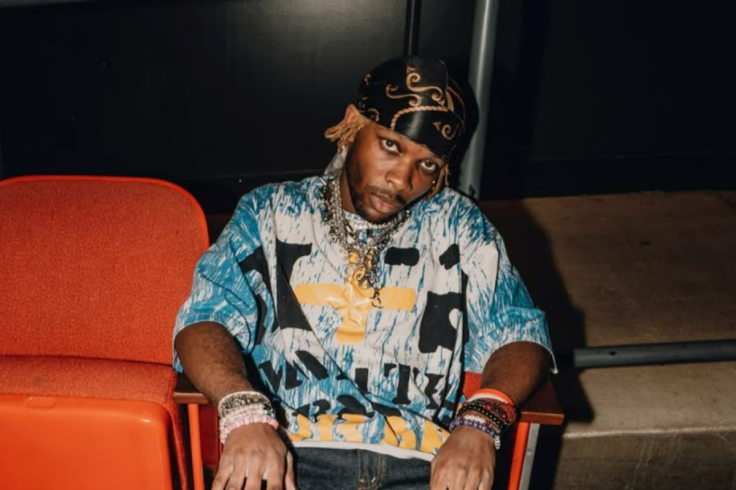
D4vd's former friend Aysia Collins says she directly confronted the rising singer in Los Angeles earlier this year about his alleged sexual relationship with 13‑year‑old fan Celeste Rivas, only to be reassured, she claims, that the girl was 19 and that everyone questioning him was 'harassing a friend.'
The news that has already horrified fans and bewildered investigators. In September, police discovered Celeste's decomposing and dismembered body in the boot of D4vd's Tesla, according to charging documents.
The 19‑year‑old musician, known for his viral hit Romantic Homicide, has since been charged with one count of murder, continuous sexual abuse of a child under the age of 14 and unlawful mutilation of human remains. He has pleaded not guilty. Nothing has been proven in court, and all allegations remain contested.
Friend Says D4vd 'Proved' Celeste Was An Adult
Collins moved in the same social circle as both D4vd and Celeste, part of the loose online‑to‑real‑life community orbiting the young star. She now says her initial instincts were that something was badly off.
According to Collins, she challenged the singer after rumours spread that he was involved with a girl who looked obviously underage. She says she told him bluntly that the relationship felt exploitative and illegal. In response, she claims, D4vd did not get angry but instead leaned into reassurance, insisting Celeste was 19 and that everyone was misreading the situation.
Collins says she did not simply accept that answer. She says she pressed him repeatedly for evidence and that, under that pressure, he produced what she describes only as 'proof' that Celeste was an adult. She has not publicly detailed what that proof was, or whether it was a document, a message, an ID or something else entirely.
What she does describe is the effect. Confronted with something she felt she could not easily discount, Collins says she began to doubt her own judgement and worry she was overstepping. She has since reflected that she pulled back, convincing herself she was policing a friend's private life rather than flagging possible abuse.
The alleged manipulation sits at the heart of why Collins now talks about him in such stark terms. Back in June, a few months after Celeste's body was found, she wrote online that D4vd was a 'psychopath' who had 'lied and betrayed everyone around him,' a denunciation that startled many fans who saw the pair as close.
Inner Circle Fractures Around D4vd Case
The discovery of Celeste's remains in the Tesla in September triggered a cascade of questions that still hang over the case. How long had she been missing. Who, if anyone, tried to intervene before it was too late. And what did those closest to the singer really know.
Collins is not the only one backing away. Another friend, Neo Langston, has also publicly distanced himself from D4vd in the months since the body was found. Langston has not gone into the same level of detail as Collins but has made it clear he no longer wants his name tied to the artist. It is a familiar pattern in high‑profile criminal cases, though no less jarring to watch play out among people barely out of their teens.
Prosecutors allege that the singer, whose real name has not been repeated in the latest reporting, engaged in 'continuous sexual abuse of a child under the age of 14' before Celeste's death. That charge, on its own, suggests they believe the relationship went on for some time rather than being a single incident. The murder count and the allegation of unlawful mutilation of human remains sit alongside it, raising the stakes far beyond a statutory sex‑crime investigation.
His legal team has so far stuck to the formal position. In court filings and through brief statements, they have entered a not‑guilty plea on all counts. They have not directly answered Collins' specific claims about alleged manipulation or the 'proof' she says he showed her, and there is no indication yet whether she will appear as a witness.
Nothing in Collins' account has been independently verified. She has not produced the supposed evidence she once found convincing, and the exact timeline of when she confronted him in relation to Celeste's death is still murky. For now, it is one more disturbing thread in a case full of them, part of a portrait of a young star whose private life may have been far darker than his carefully curated image suggested.
Meanwhile, are caught in an uneasy limbo. Some insist on his innocence until a jury decides otherwise. Others say Collins' story confirms their worst fears about how easily a charismatic figure can bend a friendship group to his version of reality, at least until the facts force their way into view.
Whether the court ultimately accepts the prosecution's narrative or not, Collins' decision to speak up underscores a more uncomfortable truth about proximity to fame. In her telling, it was not ignorance that kept people quiet around D4vd, it was doubt doubt about what they were seeing, about whether they had the right to challenge it, and about whether a friend's word could really be that far from the truth.