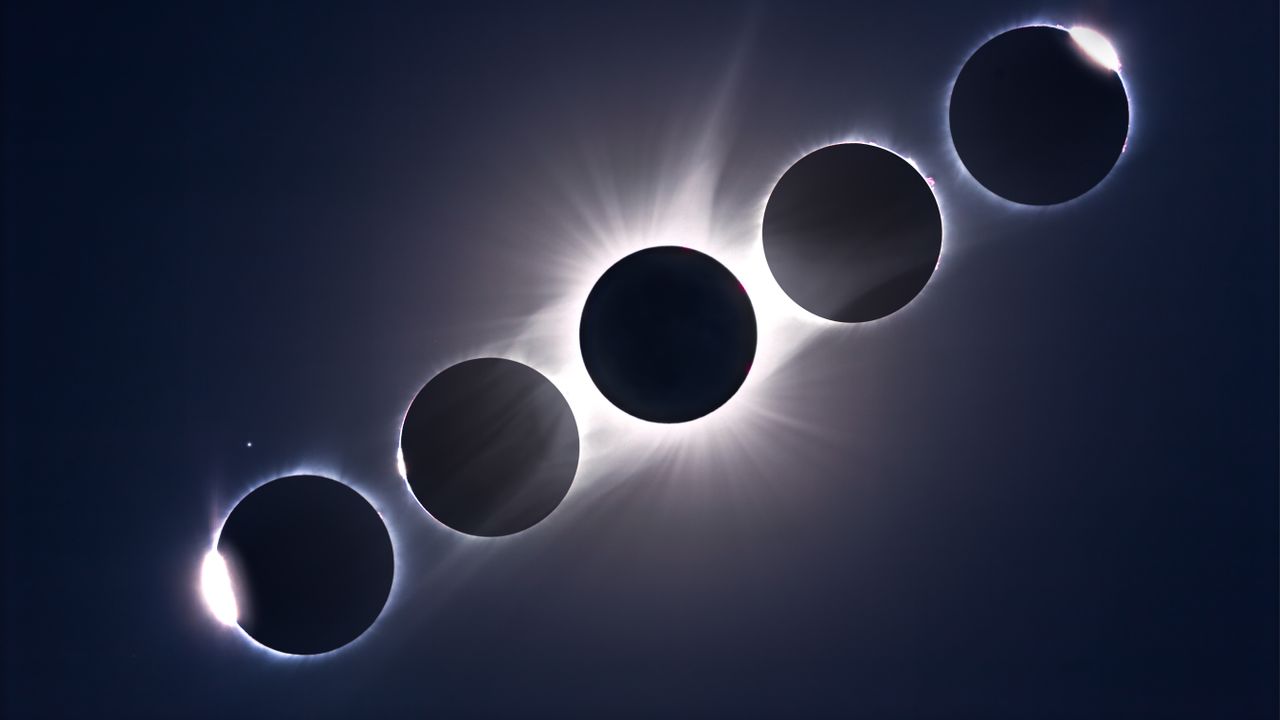
A composite of the August 21, 2017 total eclipse of the Sun, showing the second and third contact diamond rings and Baily’s Beads at the start left and end right of totality, flanking a composite image of totality itself The diamond ring and Baily’s Beads images are single images The totality images is a blend of 12 exposures from 1/1600 sec to 1 second, stacked as a smart object and combined using the Mean stack mode to blend the images Several High Pass filter layers were added to sharpen and increase the contrast in the coronal structures Regulus is the star at lower left Placement of the images only roughly matches the actual position and path of the Sun across the sky However, the time sequence runs from left to right All taken through the 106mm Astro-Physics Traveler refractor with a 085x reducer/flattener, yielding f/5 at 500mm focal length, wide enough to capture Regulus at left All with the Canon 6D MkII camera at ISO 100 Shot from a site in the Teton Valley, Idaho, north of Driggs. (Photo by: Alan Dyer/VW Pics/UIG via Getty Images).
I seldom shoot at night unless I’m waiting for a sunrise, but I’ll definitely be making the most of the astrophotography on offer this August. From the middle of the month through to the end, there are a host of galactic spectacles to capture with your camera, and NASA has kindly provided its top tips - which we’ve summarized here – to enjoy them.
There are four major events this month: a solar eclipse (August 12), the Perseid meteor shower (August 12-13), Venus shining bright after sunset (August 14-16), and a lunar eclipse (August 27-28). But no matter which event you’re gearing up to photograph, be sure to cast a quick eye over the following pointers to set yourself up properly.
Sign up to read this article
Read news from 100's of titles, curated specifically for you.