Get all your news in one place.
100's of premium titles.
One app.
Start reading
Cycling News
Cycling News
Sport
Stephen Farrand

Tour de France enters the Extreme Weather Protocol red zone but the show will go on

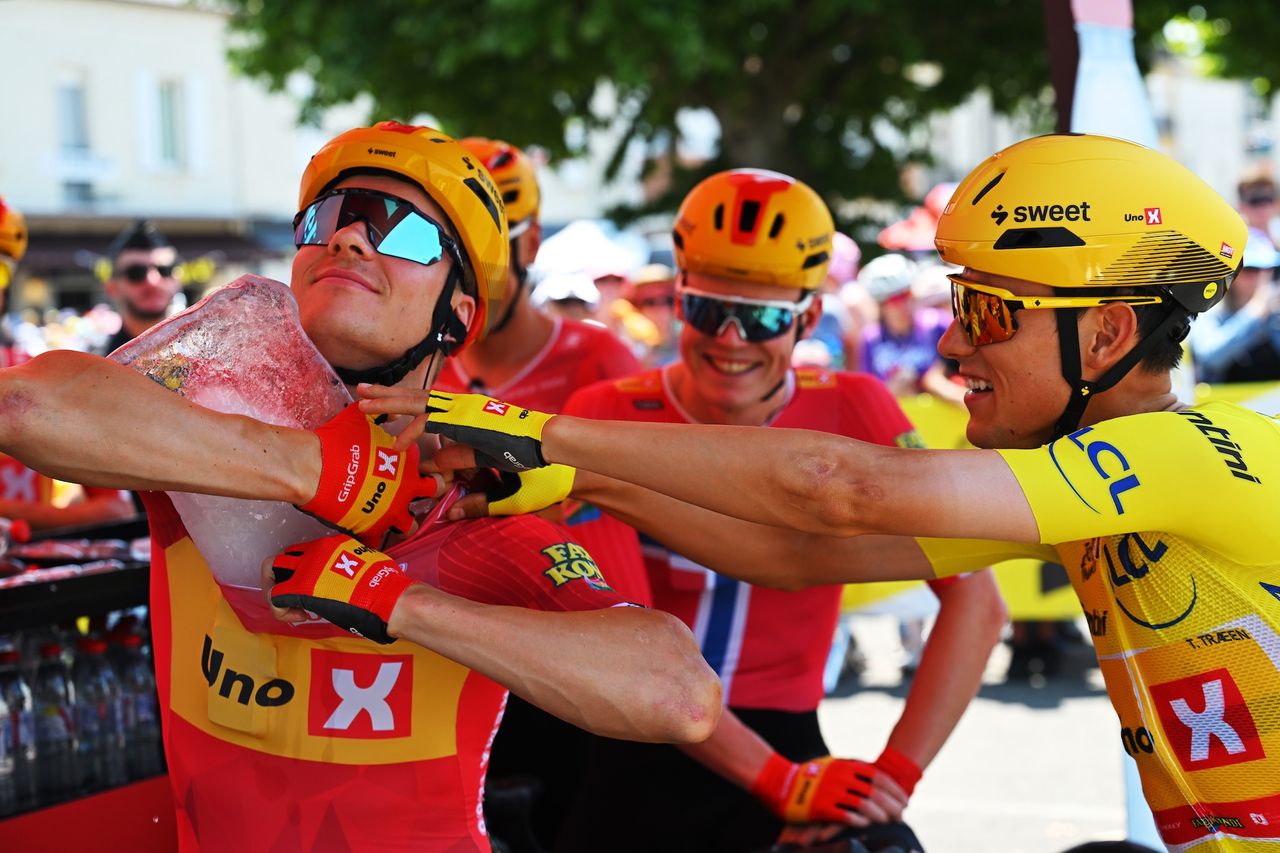
LANNEMEZAN, FRANCE - JULY 08: (L-R) Jonas Abrahamsen of Norway and Torstein Traeen of Norway and Team Uno-X Mobility - Yellow Leader Jersey refresh with ice prior to the 113th Tour de France 2026, Stage 5 a 158.3km stage from Lannemezan to Pau / #UCIWT / on July 08, 2026 in Lannemezan, France. (Photo by Tim de Waele/Getty Images).

The Tour de France riders face another day of racing in 'red zone' extreme heat when they head into the Pyrenees on Thursday. The race and the show that is the Tour de France, however, will go on, with most riders and teams accepting another day of suffering.

Stage 6 starts in Pau, on the hot plains of southwestern France, before climbing the Col du Tourmalet and finishing in the high valley town of Gavarnie-Gèdre close to the border with Spain, where thunderstorms are forecast for the afternoon. Local orange weather alerts are in place across the Hautes-Pyrénées region of France, with warnings that 'dangerous weather events are expected' and calls to be 'be very vigilant.'
LIVE

Tour de France stage 6 – follow the action

Cyclingnews has seen the UCI Extreme Weather Protocol forecasts for parts of the stage and there are multiple red zone forecasts. The calculations are made using a Wet Bulb Globe Temperature (WBGT) climatic index, that combines the air temperature, humidity, solar radiation and wind speed on human body temperature to understand the conditions the riders face during a race.

Several sections of road early in stage 6 will be above 28°C, the number designated in UCI regulations to be a 'high risk.' The air temperatures will close to 36C.

Red zone numbers can allow the modification of the stage start time, the neutralisation of a long section of the stage, such as a long climb exposed to the sun, and even eventual cancellation of the stage.

However none of these actions are expected to be taken to protect the riders from facing extreme heat on Thursday, when temperatures of up to 35°C are forecast at locations along the route, or later in the Tour.

Any decisions are made by the different stakeholders in the sport (the UCI, race organisers, teams and rider representative), plus the Safety Manager for the race. The rider's CPA association and the AIGCP teams association may request action be taken but they can be outvoted in any pre-stage meeting, obliging the riders to race on.

The rules for extreme heat state: "If stakeholders cannot reach a consensus by the end of the meeting, the organiser, in agreement with the President of the UCI Commissaires panel, shall decide the actions to be taken.'

Spectators lining up in the cooling water as riders pass at the Tour de France (Image credit: Getty Images)

“This is the Tour, and in the Tour, anything goes," former rider and now Soudal-QuickStep sports director Iljo Keisse told Nieuwsblad after giving out hundreds of bidons of water and ice to his riders on yet another day where temperatures were over 35 °C for much of the stage.

Veteran Soudal riders Dylan van Baarle and Jasper Stuyven were equally sceptical.

"ASO doesn't listen to the riders," Van Baarle was quoted as saying when asked on NOS if Tour de France organiser ASO would perhaps consider shortening stages.

Most other riders have accepted the suffering of this year's Tour and simply try to survive in the heat. They follow their team's cooling protocol of ice socks on their necks, drinking slushies to cool their core temperature, constantly spraying water on their bodies and then jumping into an ice bath post-stage and carefully rehydrating.

On Tuesday, the UCI announced that teams were allowed to hand out musettes filled with water bottles and ice on all categorised climbs.

Before Wednesday's fifth stage they also quietly agreed that the feed zone will be open from kilometre ten and will end six kilometres from the finish. That basically allows teams to feed from any point along the road, so that riders can collect bidons and ice from roadside team staff, without having to constantly drop back into the team car convoy."

"We know very well that it can be like this in France and Spain during the summer," Mads Pedersen (Lidl-Trek) said after winning stage 4 to Foix on Tuesday.

"It’s very difficult, but within the team we have a protocol to protect ourselves from the heat and adapt to the conditions. If the conditions were truly too bad, to the point of endangering the riders, we certainly wouldn’t have raced."

Kasper Asgreen (EF Education-EasyPost) is one of the three CPA riders association representatives at the Tour but told Cyclingnews that the team chats have been quiet.

There is no sign of a protest or even a go slow in the heat, just lots of cooling tactics on hand to try and manage it.

"The protection of the riders and the public is paramount for me," race director Christian Prudhomme said, promising more ice will be made available to the teams and riders.

The world’s biggest bike race deserves world-class coverage. Subscribe to Cyclingnews for unlimited access to our unrivalled reporting of the 2026 Tour de France. From Barcelona through to Paris, our experienced team will bring you breaking news, expert insight, and in-depth coverage from every stage as the battle for the yellow jersey plays out. Plus, access the Cyclingnews app to follow the action on the go! Find out more.

Sign up to read this article
Read news from 100's of titles, curated specifically for you.
Already a member? Sign in here
Related Stories
Top stories on inkl right now
One subscription that gives you access to news from hundreds of sites
Already a member? Sign in here
Our Picks
Fourteen days free
Download the app
One app. One membership.
100+ trusted global sources.