
Get all your news in one place.
100's of premium titles.
One app.
Start reading
Louder
Louder
Entertainment
Niall Doherty

How Led Zeppelin created the impossible-to-copy rhythmic swing of Black Dog. "I wrote it on a bit of paper on the train"

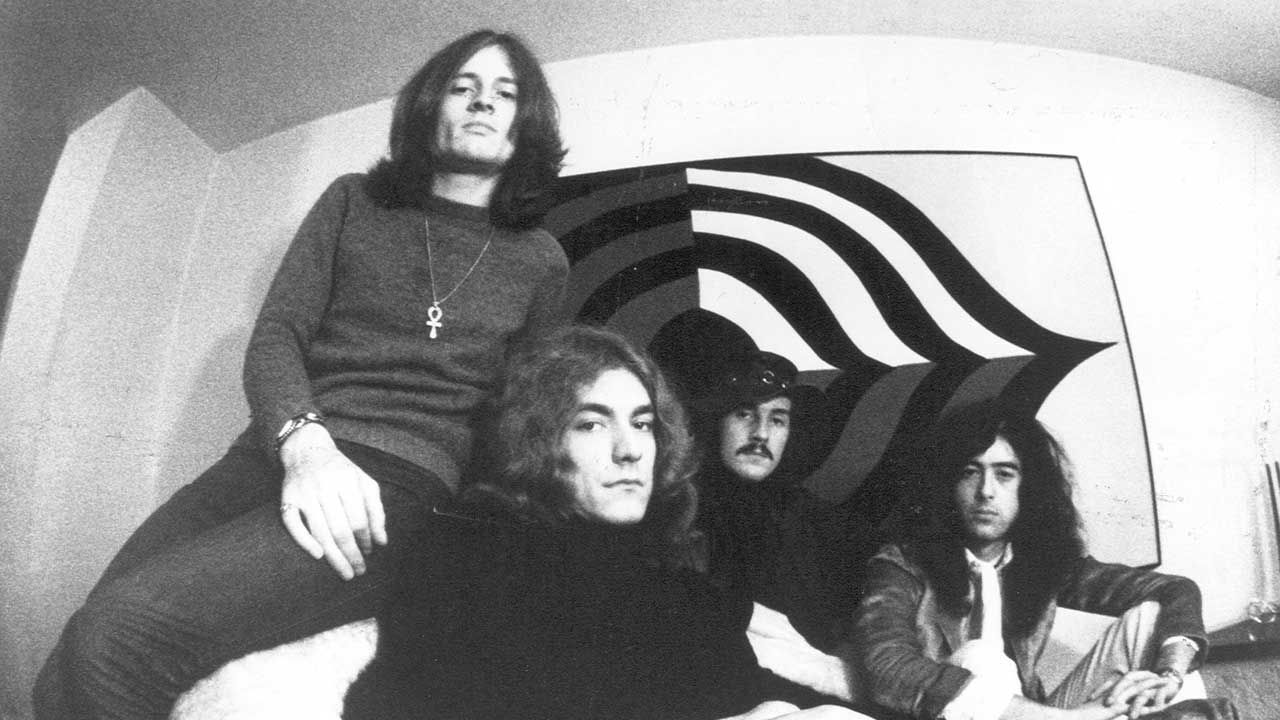
Led Zeppelin in 1971.

“It is good, isn’t it?” said Jimmy Page of Led Zeppelin’s fourth album. “You get the feeling of the creativity of this band. It’s just coming in with full force.”

That force was never more evident than on the album’s opening track, the mighty Black Dog. Based on a cartwheeling riff bassist John Paul Jones had been ‘inspired’ to develop after listening to the similarly shaped Tom Cat by Muddy Waters.

Jones had scrawled the idea down on a train home from a rehearsal at Page’s boathouse in Berkshire. “My dad had taught me this very easy notation system using note values and numbers,” Jones told Mojo in 2007, “so I wrote it on a bit of paper on the train.”

The track was named partly in punning reference to the source material, but mainly after an old black Labrador that hung around the gardens and kitchen at Headley Grange.

“He was an old dog,” explained Page, “You know when they get the white whiskers round the nose?” When he vanished one night, “we all thought he’d been out on the tiles [because] when he got back he was just sleeping all day. And we thought: ‘Oh, black dog’ – cos we just called him black dog – ‘he’s been out on the razzle.’”

The almost impossible-to-copy rhythmic swing of the track (4/4 time set against 5/4) was a key indication of how far ahead of the rock game Led Zeppelin really were. It took a few attempts for the band to lock into its irregular groove.

“It was originally all in 3/16 time,” Jones recalled in Classic Rock, “but no one could keep up with that.” Bonham, in particular, struggled the song’s shifting rhythms. “I told Bonzo he had to keep playing four-to-the-bar all the way through Black Dog,” Jones said. “If you go through enough 5/8s it arrives back on the beat.”

For Plant, Black Dog summed up one way that Led Zep could work speedily and efficiently. “Sometimes John Paul would contribute the leading part of a song and then it would be a pretty quick arrangement of bits and pieces so that the song fitted together rather quickly,” Plant said in Joe Smith’s 1988 book Off The Record. And while bands such as Grand Funk Railroad were touted as being successors to Zep’s heavyweight crown, their approach was devoid of the grace and timing of something like Black Dog.

While musos stroked their beards appreciatively over the peacocking riff and Plant’s a cappella vocals, based on Fleetwood Mac’s Oh Well – for those in the know about Page’s obsession with the occult, it was assumed the title referred to some Baskervilleesque hellhound, a belief underscored by lines like: ‘Eyes that shine, burning red/Dreams of you all through my head…

It was, of course, far more mundane than anyone actually imagined. But that didn’t matter – as Black Dog proved, even Led Zeppelin’s mundanity was more magical and mysterious than every other band’s. Although you might require a master's degree in maths and musical notation to appreciate that rhythm truly, Black Dog’s real thrills are much more visceral. It remains an explosive, daring opener to a classic record.

Sign up to read this article
Read news from 100's of titles, curated specifically for you.
Already a member? Sign in here
Related Stories
Top stories on inkl right now
One subscription that gives you access to news from hundreds of sites
Already a member? Sign in here
Our Picks
Fourteen days free
Download the app
One app. One membership.
100+ trusted global sources.