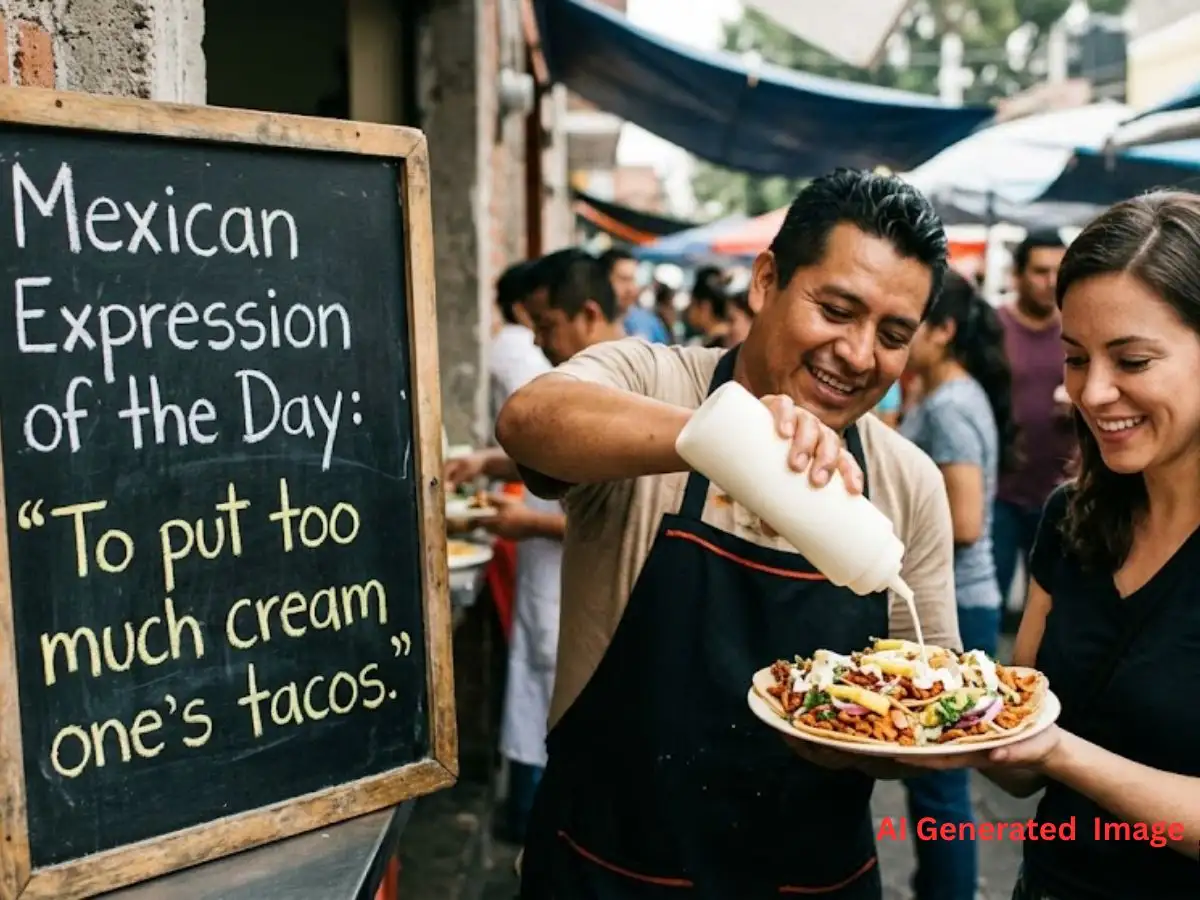
Mexican Expression of the Day: “Echarle mucha crema a sus tacos,” literally translated as “To put too much cream on one’s tacos,” is a Mexican Spanish expression used to describe someone who exaggerates their abilities, achievements or importance. The colourful phrase turns an ordinary reference to food into a humorous warning against excessive self-praise and embellishment.
The meaning behind “putting too much cream on one’s tacos”
The expression is not meant literally.
In Mexican Spanish, adding too much cream to one's tacos becomes a metaphor for adding too much praise to one's own accomplishments. Someone who “puts too much cream on their tacos” is presenting themselves as more impressive, capable or successful than they may actually be.
The expression can be used when a person boasts about what they have done or speaks with excessive confidence about their abilities.
Its humour comes from the contrast between an everyday food image and a familiar human behaviour.
Why the expression uses tacos and cream
Tacos are an everyday part of Mexican food culture, making them a familiar reference point for a phrase intended to be easy to understand and remember.
The cream in the expression represents something extra being added. Just as excessive topping can go beyond what is necessary, excessive self-praise can make a person's claims sound exaggerated.
The phrase therefore turns a simple culinary image into a metaphor for overdoing one's own presentation.
Rather than directly telling someone to stop boasting, the expression does so through humour.
A humorous way to describe boasting
Boasting is not always easy to confront directly.
Telling someone that they are exaggerating their achievements can sound confrontational. A humorous expression can make the observation less severe while still communicating the message.
“Echarle mucha crema a sus tacos” allows speakers to point out excessive self-praise without necessarily turning the situation into a serious confrontation.
Depending on the context and tone, it can be teasing, critical or simply amusing.
When the expression can be used
The expression can apply whenever someone appears to be overstating their achievements or abilities.
For example, a person might repeatedly describe themselves as the best at a particular task, emphasise their accomplishments at every opportunity or make their contribution sound considerably larger than it was.
In such circumstances, someone could use the expression to suggest that the person is adding too much embellishment to their own story.
The phrase does not necessarily mean that everything the person has said is false. The criticism is about how much they are emphasising or exaggerating it.
The difference between confidence and boasting
The expression also highlights an important distinction between confidence and excessive self-promotion.
Being confident can mean recognising one's abilities and being willing to acknowledge accomplishments. Boasting goes further by placing excessive emphasis on those qualities or presenting them in an exaggerated manner.
The expression is aimed at the latter.
Its message is not that people should hide their achievements. Instead, it suggests that there is a point at which confidence can become excessive and begin to sound less convincing.
Why food often appears in expressions
Food provides a rich source of imagery in everyday language because it is familiar and easy to visualise.
A phrase involving tacos and cream immediately creates a concrete picture. That makes an abstract idea such as exaggeration easier to communicate.
Many expressions rely on this kind of transformation. An ordinary action is given a figurative meaning that can be applied to human behaviour.
Here, the image of adding too much cream becomes a memorable way of describing someone who adds too much praise to their own story.
The value of humour
One of the strengths of the expression is that it delivers criticism without sounding excessively formal.
Instead of simply saying that someone is boastful, the speaker can use a playful food metaphor. The unusual imagery gives the observation a lighter tone.
That does not necessarily make the criticism less clear. In many contexts, humour can make a message easier to accept because it reduces the harshness of a direct accusation.
The expression therefore works both as a description and as a gentle social warning.
A lesson on keeping perspective
“Echarle mucha crema a sus tacos” ultimately encourages moderation in how people present themselves.
Achievements deserve recognition, but excessive self-praise can change how others perceive them. A person who allows their accomplishments to speak for themselves may appear more credible than someone who repeatedly exaggerates them.
The expression captures that idea through a distinctly colourful image.
Its enduring appeal comes from the simplicity of its message: do not add so much embellishment to your own story that the boast becomes bigger than the achievement itself.