
Get all your news in one place.
100's of premium titles.
One app.
Start reading
Fit & Well
Fit & Well
Health
Lou Mudge

The two upper-body dumbbell exercises everybody should do to correct muscular imbalances

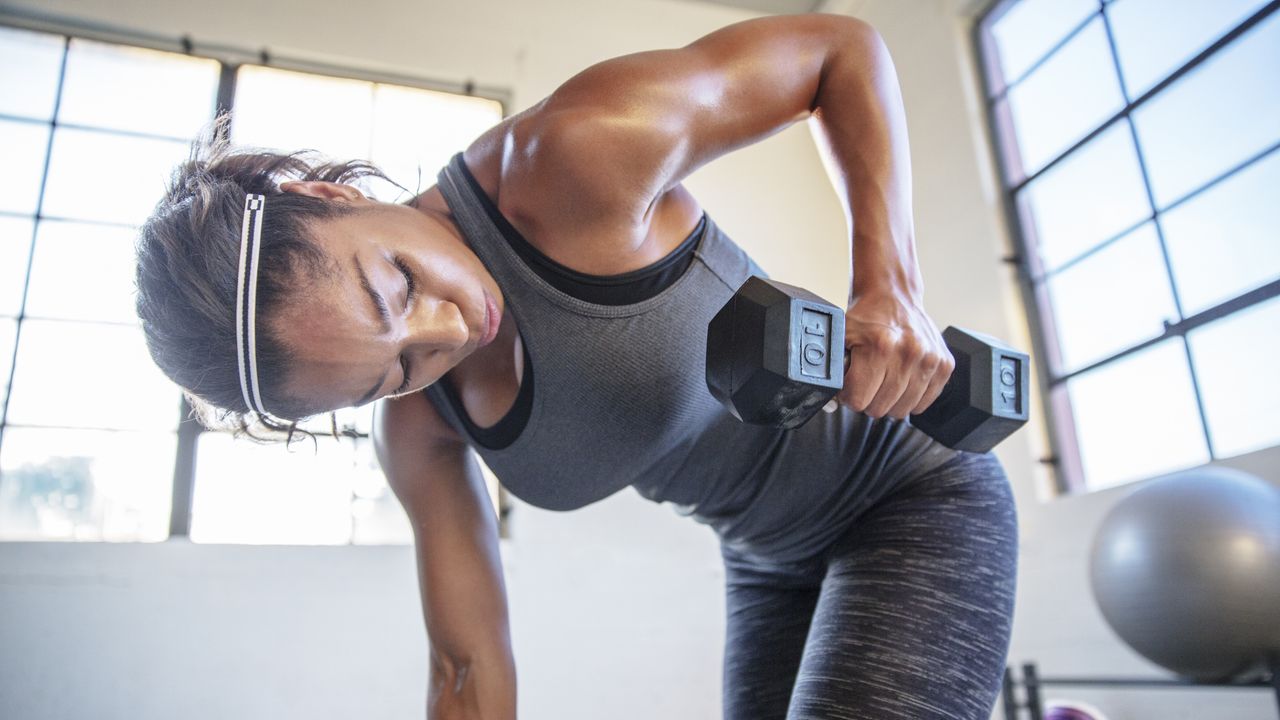
Woman exercising with a dumbbell in a gym.

Muscular imbalances are a fact of life. Unless you’re truly ambidextrous (mixed-handed), you probably have a dominant side that you rely on more than the other.

While imbalances are common, they can become a problem. If your body has to compensate for the imbalance, it might lead to injury with increased strain on muscles, joints and tendons on the side that works harder.

It may also limit your ability to strength train, with your weaker side holding your stronger side back during bilateral movements.

One of the best ways of tackling muscular imbalances is through unilateral movements.

If you complete all reps on your weaker side first and match them with your stronger side, you can work toward reducing muscle imbalances in the long term, according to Richard Bennett, strength and conditioning coach and owner of Calibre Performance.

He has shared the following two upper-body exercises, which he encourages you to incorporate into your regular workout routine.

As always, consult a physical therapist or healthcare provider for individualised advice and if you think a muscular imbalance may be impacting your daily life or training.

1. Dumbbell row

Sets: 3 Reps: 8-12 each side Rest: 60-90sec

“This exercise makes it harder for your dominant arm to take over the movement, as it might with a bilateral row.”

“The main muscles trained are the latissimus dorsi, rhomboids, trapezius and rear deltoids,” says Bennett. “The biceps and forearm muscles assist, while the trunk works to maintain a neutral position.”

“The supported position reduces the amount of lower-back fatigue, which can be useful when rowing is programmed alongside squats and hinges.”

How to do it:

  • Place your left knee and left hand on a weight bench, with your right foot firmly on the floor.
  • Hold a dumbbell in your right hand with your arm extended.
  • Maintain a neutral spine and engage your shoulders and hips so they remain stable against the pull of the weight.
  • Pull your right elbow toward your hip, lifting the dumbbell to your ribs.
  • Lower with control until your arm is fully extended.
  • Complete all your repetitions on one side, then switch sides.

2. Single-arm dumbbell bench press

Sets: 3 Reps: 8-12 each side Rest: 60-90sec

“This exercise engages your pectoralis major, anterior deltoid and triceps. Your trunk stabilizers work to prevent your body from rotating toward the loaded side,” says Bennett.

“As the resistance is only on one side, your trunk must prevent rotation while your upper body produces force. This gives the exercise an additional stability demand.”

How to do it:

  • Lie on a weight bench holding a dumbbell in your left hand by your left shoulder, with your feet flat on the floor.
  • Have your right arm extended out to your side in the air for counterbalance.
  • Engage your core , pressing your lower back into the bench.
  • Extend your arm straight up to press the dumbbell overhead.
  • Bend your elbow to lower the dumbbell with control, avoiding any rotation in your body.
  • Pause at the bottom of the movement, maintaining tension in your balancing arm.
  • Complete all your repetitions on one side, then switch sides.

Form tip:

  • Keep your elbow roughly 30-45° away from your torso rather than flaring it directly sideways.
Sign up to read this article
Read news from 100's of titles, curated specifically for you.
Already a member? Sign in here
Related Stories
Top stories on inkl right now
One subscription that gives you access to news from hundreds of sites
Already a member? Sign in here
Our Picks
Fourteen days free
Download the app
One app. One membership.
100+ trusted global sources.