
Get all your news in one place.
100's of premium titles.
One app.
Start reading
The Conversation
The Conversation
Lucien Heurtier, Postdoctoral Research Associate, King's College London

The Higgs particle could have ended the universe by now – here’s why we’re still here

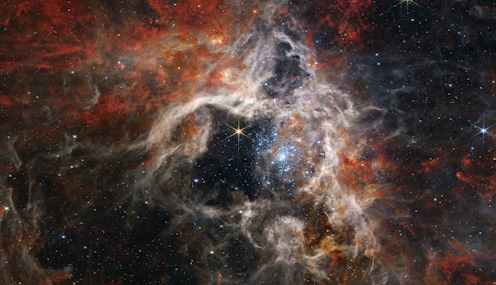
Tarantula nebula – a starforming region – seen by the James Webb Space Telescope. Nasa, ESA, CSA, STScI, Webb ERO Production Team, CC BY-SA

Although our universe may seem stable, having existed for a whopping 13.7 billion years, several experiments suggest that it is at risk – walking on the edge of a very dangerous cliff. And it’s all down to the instability of a single fundamental particle: the Higgs boson.

In new research by me and my colleagues, just accepted for publication in Physical Letters B, we show that some models of the early universe, those which involve objects called light primordial black holes, are unlikely to be right because they would have triggered the Higgs boson to end the cosmos by now.

Sign up to read this article
Read news from 100's of titles, curated specifically for you.
Already a member? Sign in here
Related Stories
Top stories on inkl right now
One subscription that gives you access to news from hundreds of sites
Already a member? Sign in here
Our Picks
Fourteen days free
Download the app
One app. One membership.
100+ trusted global sources.







