
Get all your news in one place.
100's of premium titles.
One app.
Start reading
Times Life
Times Life
Aishwarya Kapoor

The Bhadrapada Chaturthi Moon You Must Not Look At, and the Syamantaka Story That Explains Why

The night the sky becomes a trap

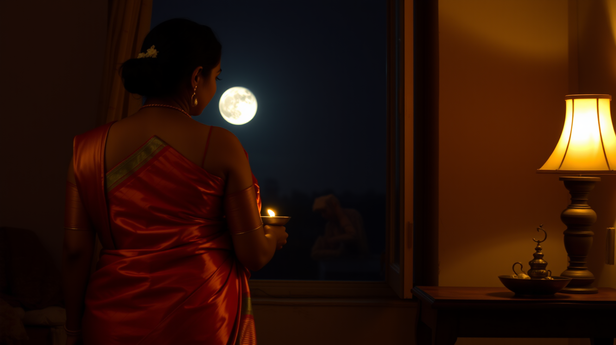
Every other night of the year, the moon is an invitation. Poets address it. Mothers point it out to children. Lovers use it as a witness. But on the fourth night of the bright fortnight in Bhadrapada, the night Hindus call Ganesh Chaturthi, the moon is something you do not look at. Not because it is ugly. Because it will follow you.

The prohibition is specific and old. It appears in the Bhagavata Purana, and it has survived every generation not through enforcement but through the particular anxiety that comes with a story that feels true. If you look at the moon on this night, the tradition says, you will be falsely accused of something you did not do. The accusation will come from nowhere. It will be believed. And it will take a long time to undo.

That is not a vague curse. That is a storyline. And it has a source.

The jewel that started everything

The Syamantaka was not an ordinary gem. The Bhagavata Purana describes it as a jewel given by Surya, the sun god, to a Yadava chieftain named Satrajit. Its power was precise: worn by a righteous person, it produced eight bhara of gold daily and kept famine, disease, and calamity at a distance. Satrajit wore it around his neck and arrived in Dwaraka glowing so intensely that the citizens mistook him for Surya himself.

Krishna, seeing the jewel, suggested gently that it would be better placed with King Ugrasena, the elder of the Yadavas. Satrajit refused. He took it home. He gave it instead to his brother Prasena, who wore it out hunting, and was killed by a lion, who then carried the jewel into the forest before being killed in turn by Jambavan, the bear-king, who took it to his cave and gave it to his daughter as a toy.

Prasena disappeared. The jewel disappeared. And the rumour that filled the silence was immediate and ugly: Krishna had wanted the Syamantaka. Krishna had been refused. Prasena was now gone.

How an innocent man becomes guilty

The accusation against Krishna in the Bhagavata Purana is worth sitting with, because it is not the accusation of an enemy. It comes from ordinary people drawing the most available conclusion. Satrajit did not hate Krishna. He simply told people what he knew: his brother had gone out with the jewel and had not come back, and Krishna had recently asked for it. The community did the rest.

Krishna responded by doing what the falsely accused almost never get to do in real life, he traced the jewel himself. He followed Prasena's trail into the forest, found the lion's remains, followed Jambavan's trail into the cave, and fought Jambavan for twenty-eight days before the bear-king recognised him as Rama reborn and surrendered both the jewel and his daughter Jambavati in marriage.

Krishna returned the Syamantaka to Satrajit publicly. Satrajit, stricken with shame, offered his daughter Satyabhama and the jewel both to Krishna in restitution. The accusation was cleared. But it had happened. Even to Krishna, it had happened.

Why the moon carries the blame

The Bhagavata Purana's account of the Syamantaka connects the moon to this story through a specific incident. On the night of Bhadrapada Chaturthi, the moon had mocked Ganesha, laughing at the elephant-headed god when he fell from his mount and spilled the modaks he was carrying. Ganesha, humiliated, cursed the moon: anyone who sees you on this night will face false accusation, the way I have been made to look ridiculous.

The moon's laughter was not malicious. It was thoughtless. But the Purana treats thoughtlessness and malice as producing the same result when the target is someone who cannot easily defend himself. Ganesha's curse was not revenge. It was a law of consequence: you used your visibility to harm. Your visibility now harms those who seek it.

The Syamantaka story is the curse's proof of concept. It is what happens when the mechanism activates. Krishna, who saw the moon that Chaturthi night, became the subject of a false accusation that took twenty-eight days of combat and a public reckoning to dissolve. The moon did not steal the jewel. The moon did not start the rumour. But the moon was the condition under which the story became possible.

This is why the taboo is not framed as superstition in the texts. It is framed as information. Bhagavad Gita 4.18 speaks of seeing inaction in action and action in inaction as the mark of true understanding, the idea that what appears to be nothing (a glance at the moon, a casual laugh) can carry the full weight of consequence. The Chaturthi moon taboo is one of the oldest applications of that principle in lived Hindu practice.

What the taboo is actually protecting

The families who cover their windows on Chaturthi night, or who step carefully from the car to the door without looking up, are not all certain they believe in curses. Many of them will tell you they do it because their mothers did it, and their mothers' mothers before that. That explanation is usually offered apologetically, as if continuity were a lesser reason than conviction.

But the story underneath the taboo is not asking for belief. It is asking for recognition. False accusation is one of the most specific human injuries, specific because it is nearly impossible to disprove, because the denial sounds exactly like what a guilty person would say, because even after the truth emerges the original story tends to stick in corners of memory. Krishna cleared his name completely and Satrajit publicly apologised, and the Bhagavata Purana still records that the rumour happened. The record of the wound survives the healing.

The moon on Bhadrapada Chaturthi is a reminder that exposure has a cost. Not every night. Not every glance. But on this one night, the sky is asking you to remember what it felt like to be accused of something you did not do, or to watch someone else go through it, and to stay inside.

The taboo and the Syamantaka story are finally the same lesson told in two registers: one cosmic, one social. Ganesha's curse set the condition. Krishna's ordeal demonstrated the stakes. What they share is the knowledge that reputation is fragile in a way that jewels are not, and that the most powerful protection is sometimes simply the decision not to look.

Sign up to read this article
Read news from 100's of titles, curated specifically for you.
Already a member? Sign in here
Related Stories
Top stories on inkl right now
One subscription that gives you access to news from hundreds of sites
Already a member? Sign in here
Our Picks
Fourteen days free
Download the app
One app. One membership.
100+ trusted global sources.