Get all your news in one place.
100's of premium titles.
One app.
Start reading
Times Life
Times Life
Aishwarya Kapoor

The Ancient Vedic Breathwork Practice That Rewires the Anxious Mind Better Than Therapy

You Have Been Breathing Wrong Your Entire Life

Not incorrectly, exactly. But shallowly. Quickly. In the chest, not the belly. When anxiety arrives, your breath shortens before your mind has even named what it's afraid of. The body knows first. This is the thing pranayama understood before there was a word for the autonomic nervous system: the breath is not a symptom of your mental state. It is the lever that controls it.

The Mundaka Upanishad describes prana as the force that holds the self together, not metaphorically, but functionally. Ancient Vedic practitioners weren't writing poetry when they said the breath was the bridge between body and mind. They were mapping something that a 2018 study published in Science by researchers at Stanford University's Bhargava Lab confirmed: a cluster of neurons in the brainstem called the pre-Botzinger complex directly links breathing rhythm to states of arousal, attention, and fear. Slow the breath, and these neurons stop firing distress signals into the amygdala. The anxiety doesn't dissolve. It simply stops being fed.

What Nadi Shodhana Actually Does to a Frightened Mind

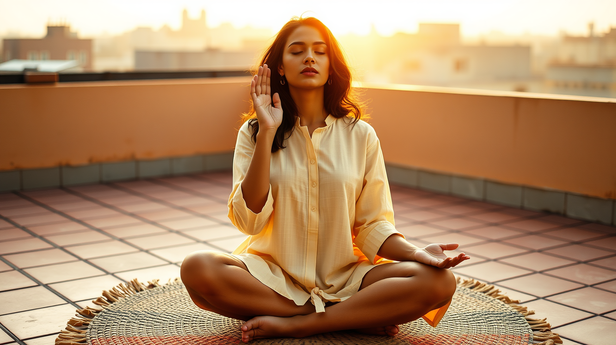
Alternate nostril breathing, nadi shodhana pranayama, looks, to an outsider, like a minor eccentricity. One nostril closed, then the other, in a slow count. It is easy to dismiss as ritual. The dismissal is a mistake.

The practice works on the principle that the left and right nostrils are not symmetrical in function. Breathing predominantly through the right nostril activates the sympathetic nervous system, the fight-or-flight branch. The left nostril activates the parasympathetic, rest and digest. Nadi shodhana alternates between them in a controlled rhythm, forcing both hemispheres of the brain into a kind of negotiated balance. The Hatha Yoga Pradipika, one of the foundational texts of classical yoga, describes this as the purification of the nadis, the subtle energy channels the Vedic system understood as the body's internal wiring. The language is different from neuroscience. The mechanism it describes is not.

For someone whose anxiety runs as a background hum, the kind that doesn't spike into panic but never fully quiets, this matters. Therapy can name what you're afraid of. Nadi shodhana can change the physiological state in which you process that fear. These are different interventions. One works on narrative. The other works on breath, which is to say, on the body's most direct line to the mind.

The Bhagavad Gita Already Knew This

In Chapter 4, verse 29, the Gita describes apana-prana-gati-ruddhva: the practitioner who offers the outgoing breath into the incoming, and the incoming into the outgoing. This is pranayama described as a form of yajna, of sacred offering. Krishna is not giving Arjuna a relaxation technique. He is describing a practice that stills the mind enough to act without the distortion of fear.

Arjuna's problem on the battlefield of Kurukshetra is, at its core, an anxiety problem. He is paralysed. His breath, one imagines, is shallow and fast. What the Gita offers him, and what it offers anyone sitting with dread at four in the morning in a flat in Mumbai or Bengaluru, is not comfort. It is a method. The breath as the point of entry into a mind that has otherwise become unreachable.

This is where modern therapy and the Vedic tradition part ways in an interesting direction. Cognitive behavioural therapy works with thought patterns. It asks the anxious mind to examine itself, to locate the distortion, to argue back. This is useful. But it requires the mind to be calm enough to think clearly, and anxiety, by definition, is the condition in which clear thinking is least available. Pranayama enters before the thought. It changes the ground on which the thought will form.

Why the Awareness Itself Is the Practice

The most misunderstood part of pranayama is that the breathing is not the point. The awareness of the breathing is the point.

When you sit with Bhramari, the humming bee breath, where the exhalation becomes a sustained nasal hum, the vibration activates the vagus nerve, which runs from the brainstem through the chest and into the abdomen. Vagal activation is the body's own off-switch for the stress response. But the practice only works if you are actually attending to the sensation: the vibration in the skull, the warmth of the exhale, the moment the hum fades. The healing is not in the technique. It is in the quality of attention the technique demands.

This is what the Yoga Sutras of Patanjali mean by pratyahara, the withdrawal of the senses inward. Not suppression. Redirection. The anxious mind scatters outward, toward every possible threat, every imagined future. Pranayama gives it one specific, physical thing to do. The mind narrows. The nervous system follows.

A 2013 study in the International Journal of Yoga found that regular pranayama practice significantly reduced perceived stress and anxiety scores in college students after just eight weeks. The reduction wasn't marginal. The researchers noted changes in cortisol levels alongside the self-reported scores. The body was measurably different, not just the mood.

The ancient Indian practice didn't wait for cortisol to be discovered to know this. It built the method first and left the explanation for later.

When the breath slows, the mind does not simply feel calmer. It becomes structurally capable of things it could not do while it was frightened, of sitting with uncertainty, of choosing rather than reacting, of recognising that the fear and the self are not the same thing. That gap, between the fear and the self that observes it, is what pranayama creates. Therapy can describe the gap. The breath can open it.

Sign up to read this article
Read news from 100's of titles, curated specifically for you.
Already a member? Sign in here
Related Stories
Top stories on inkl right now
One subscription that gives you access to news from hundreds of sites
Already a member? Sign in here
Our Picks
Fourteen days free
Download the app
One app. One membership.
100+ trusted global sources.