
Get all your news in one place.
100's of premium titles.
One app.
Start reading
AAP
AAP
Business
Lloyd Jones

Startup aims at green hydrogen to power heavy industry

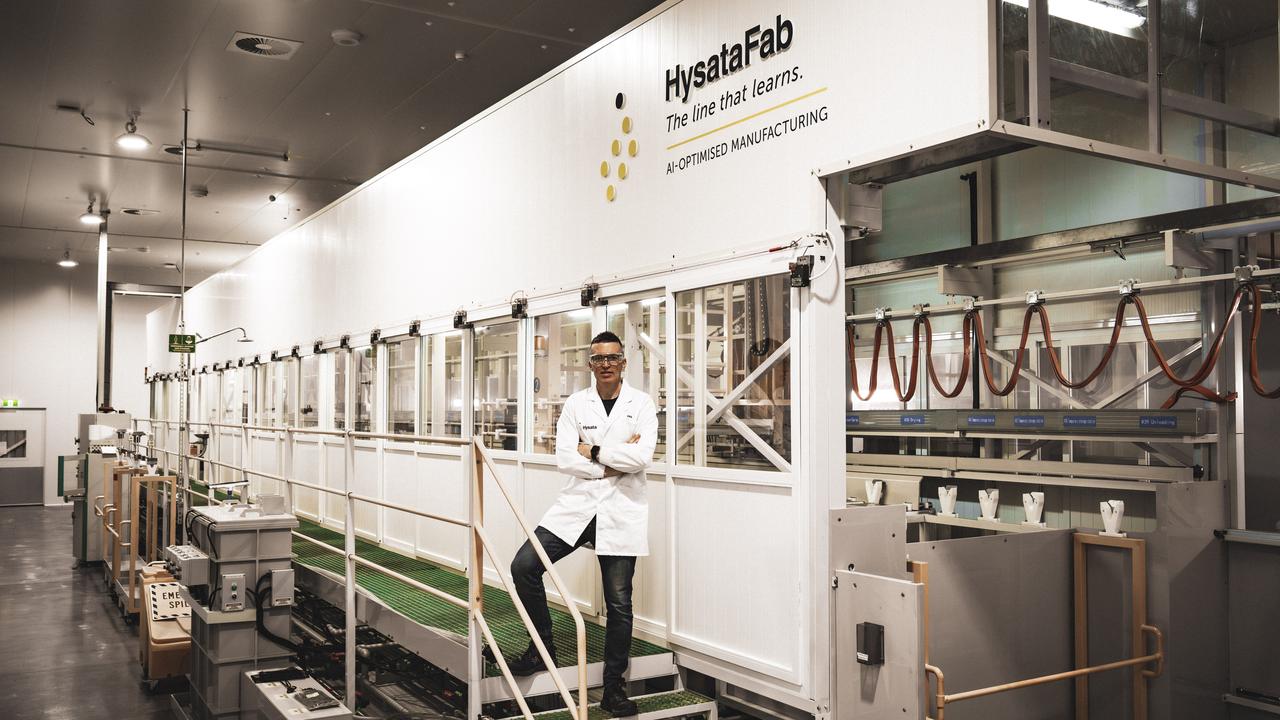
Hysata boss Paul Barrett aims to turbocharge the production of green hydrogen for heavy industry. (PR IMAGE PHOTO)

An Australian startup aiming to make green hydrogen work for heavy industry has launched an AI-optimised production line making electrolysers to split hydrogen from water.

Hysata has opened the first part of its manufacturing platform, called HysataFab, at its 8500-square-metre headquarters in Port Kembla, south of Sydney.

The company celebrated its fifth birthday in July with its first heavy industry export customer and though the deal is still under wraps, it expects to deliver a large-scale electrolyser in the first half of 2027.

Electrolysers split hydrogen and oxygen from water using electricity generated from clean sources, but the amount of power used can make the process uneconomic.

Hysata Chief Executive Officer Paul Barrett.
Hysata chief executive Paul Barrett says his company makes the most efficient electrolysers. (PR IMAGE PHOTO)

The Hysata electrolysers were designed in conjunction with the University of Wollongong.

Hysata maintains it makes the most efficient electrolysers in the world, and its production line efficiency will be boosted by artificial intelligence monitoring the process, learning from it and making improvements.

In a project worth almost $100 million at Port Kembla, three production lines will be housed covering electrode, membrane and cell and stack manufacture, with the electrode line opened on Friday.

Additional investment will expand the factory to 200 megawatts of capacity, making it the largest electrolyser manufacturing facility in the southern hemisphere.

Hysata chief executive officer Paul Barrett said the company had two compounding efficiency advantages - more hydrogen per megawatt and more product per line, leading to cheaper hydrogen.

"We built Hysata to get more hydrogen out of every unit of electricity. We are now doing the same thing to manufacturing, getting more product out of every line," he told AAP.

Steel slabs at a steelworks (file image)
Green hydrogen has been touted as a way to help decarbonise sectors such as steelmaking. (Dean Lewins/AAP PHOTOS)

Hysata electrolysers used 20 per cent less energy than any of the incumbent technologies and that was getting the company traction in global markets, Dr Barrett said.

The company's heavy use of data collection and AI tools to monitor and learn from that data enabled the company to "sweat the manufacturing equipment" to maximise efficiency, he said.

Green hydrogen was critical to decarbonising sectors that cannot simply electrify, such as shipping, aviation, steelmaking and other heavy industry, Dr Barrett said.

After generating headlines in the early 2020s, investment in renewable hydrogen has slowed, with several major Australian developments cancelled.

The prospects of hydrogen-fuelled cars and homes were undercut by the superior economics of electrification.

"The hype has gone and we can no longer seriously talk about hydrogen heating every home or powering every passenger car, and frankly nor should we," Dr Barrett said.

Hydrogen should be seen as a chemical feedstock to make value-added products such as ammonia for fertiliser, green steel production and low-carbon fuels for aviation and shipping, he said.

"There are fantastic opportunities globally for electrolysers and we're proud to be doing it in Australia."

Sign up to read this article
Read news from 100's of titles, curated specifically for you.
Already a member? Sign in here
Related Stories
Top stories on inkl right now
One subscription that gives you access to news from hundreds of sites
Already a member? Sign in here
Our Picks
Fourteen days free
Download the app
One app. One membership.
100+ trusted global sources.