
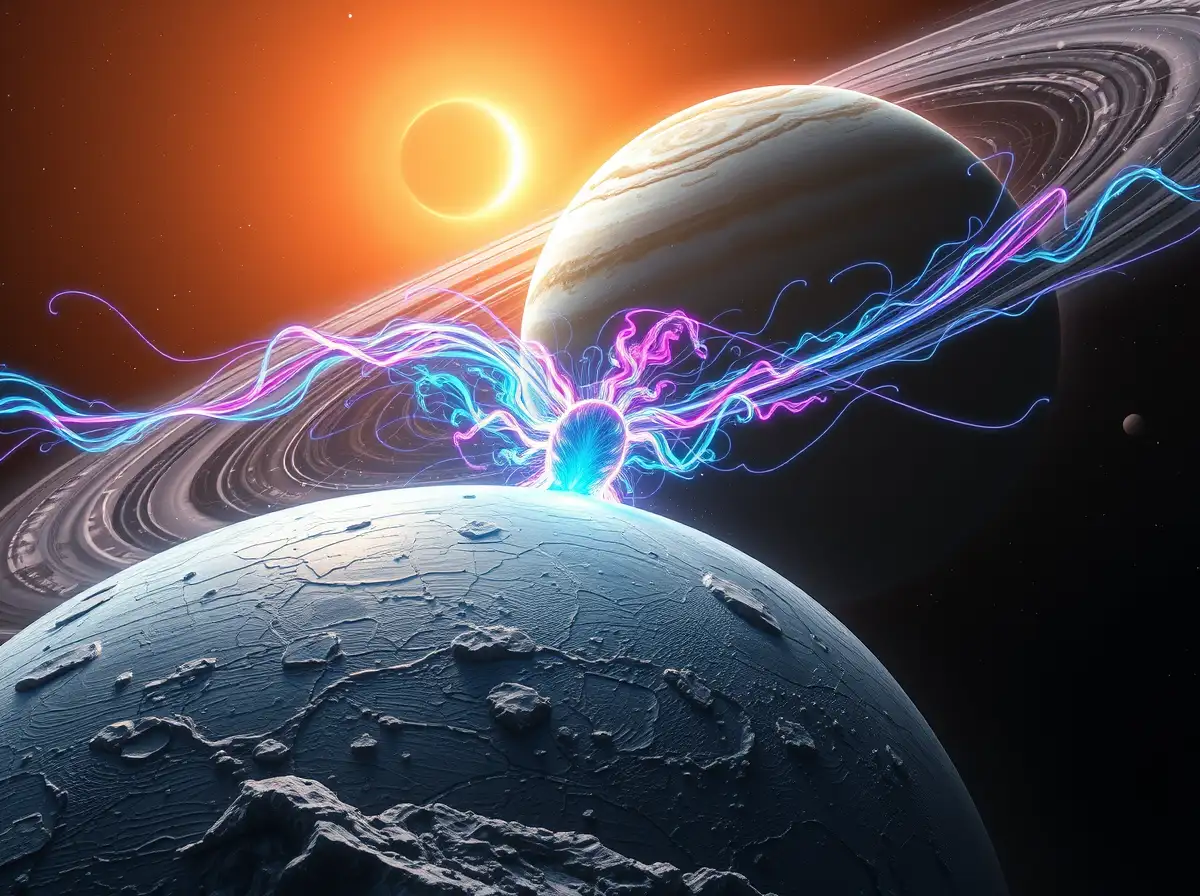
Jupiter's largest moon has long challenged the simple idea of what a moon is supposed to be. Ganymede is not merely a frozen object circling a giant planet. It is larger than Mercury, has a layered interior, contains an enormous amount of water and ice, and generates its own intrinsic magnetic field. Those characteristics make it one of the most intriguing worlds in the Solar System and raise fascinating comparisons with Earth. NASA's Galileo spacecraft provided a major breakthrough in understanding Ganymede when it detected the moon's magnetic field during close encounters beginning in 1996. Decades later, scientists continue to investigate what makes this distant world so remarkably complex.
The comparison with Earth needs an important qualification. Ganymede is not an Earth-like planet, and its environment would be extremely hostile to humans. Its surface gravity is only around 15 percent that of Earth, its atmosphere is extremely thin, and the moon remains embedded within Jupiter's powerful radiation and plasma environment. Yet several characteristics inside Ganymede are strikingly familiar to planetary scientists. Like Earth, the moon has undergone internal differentiation, separating into layers that include a metallic core, a rocky region and an outer system dominated by water and ice, as per a report on Space Daily.





