
Get all your news in one place.
100's of premium titles.
One app.
Start reading
Times Life
Times Life
Aishwarya Kapoor

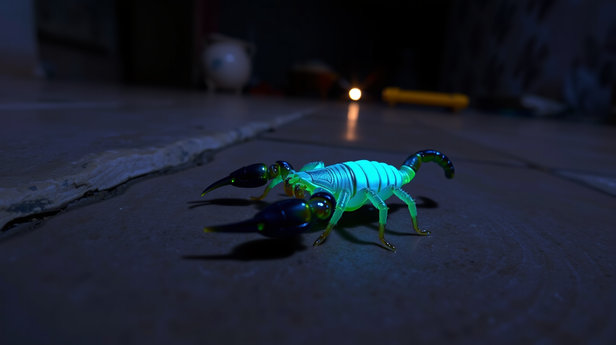
Scorpions in Indian Homes Glow Under Ultraviolet Light, Here Is Why and Which Species Are Venomous

The Glow Is in the Exoskeleton, Not the Venom

Shine a UV torch on any scorpion and it lights up blue-green in the dark. The source is a set of beta-carboline compounds and coumarins embedded in the hyaline layer of the scorpion's cuticle, the thin, hard outer shell beneath the waxy surface coat. These molecules absorb ultraviolet radiation and re-emit it as visible light in the 500 to 530 nanometre range, which the human eye reads as blue-green. The fluorescence is so reliable that entomologists and herpetologists routinely use handheld UV lamps to survey scorpion populations at night in the field.

What the glow is actually for remains an open question in biology. Hypotheses include using moonlight or starlight to detect ambient UV levels as a proxy for light intensity, which would help a nocturnal animal decide whether to stay hidden. A 2011 study published in Animal Behaviour by Carl Kloock and colleagues found that scorpions actively avoid UV light sources in controlled conditions, suggesting the fluorescence may function as a photon-collection system that feeds into a whole-body light-sensing mechanism. The cuticle, in other words, may act as a distributed eye. Scorpions have existed for roughly 430 million years; the fluorescence predates any human use of UV torches by a considerable margin.

Freshly moulted scorpions do not glow. The compounds responsible develop as the new cuticle hardens and darkens over several days. A pale, non-fluorescing scorpion is almost certainly a recent moult, softer, more vulnerable, and temporarily less able to regulate water loss.

Which Scorpion Species Enter Indian Homes

India has over 60 described scorpion species. The ones most likely to walk across a bathroom floor or emerge from a shoe belong to a handful of genera. Heterometrus species, the large, black forest scorpions common across the Western Ghats, Odisha, and the northeastern states, are the ones most Indians picture when they think of a scorpion. Adults reach 12 to 15 cm. They look intimidating. Their sting is painful, comparable to a bee sting, but not medically dangerous to a healthy adult. Heterometrus spinifer and Heterometrus swammerdami are the species most frequently encountered in homes near forested areas.

Charmus indus, a smaller, pale-yellow scorpion, turns up in drier parts of Rajasthan and Gujarat. Lychas tricarinatus, a slender species, is found across peninsular India and is commonly encountered inside homes in Karnataka and Tamil Nadu. Both are low-venom scorpions. The sting causes local pain and swelling but rarely requires anything beyond basic first aid.

The species that changes the medical calculus entirely is Hottentotta tamulus, the Indian red scorpion. It is smaller than Heterometrus, typically 5 to 8 cm, and ranges from reddish-brown to orange. It is found across Maharashtra, Andhra Pradesh, Telangana, parts of Gujarat, and Sri Lanka. In epidemiological terms, it is the most medically significant scorpion in Asia.

Why Hottentotta Tamulus Is a Medical Emergency

The venom of Hottentotta tamulus contains a cocktail of sodium channel toxins that trigger a massive autonomic storm. The toxins force voltage-gated sodium channels in nerve cells to stay open, causing simultaneous activation of the sympathetic and parasympathetic nervous systems. The result is a surge of catecholamines, adrenaline and noradrenaline, followed by cardiovascular collapse. In clinical terms: pulmonary oedema, hypertension that can flip to hypotension, and myocardial dysfunction.

A landmark study published in the Annals of Emergency Medicine by Dr. H.S. Bawaskar and P.H. Bawaskar, conducted over decades in Mahad, Maharashtra, documented case fatality rates of 8 to 30% in untreated paediatric cases in rural settings. Children and elderly patients are at highest risk because the venom dose relative to body mass is greater and cardiovascular reserve is lower. The Bawaskar protocol, prazosin, an alpha-blocker, combined with supportive care, transformed outcomes in Maharashtra hospitals and is now standard treatment across India's scorpion-endemic districts.

The Indian red scorpion does not announce itself with size. People often mistake it for a common household scorpion and delay seeking care. Time from sting to treatment is the single most predictive variable in outcomes.

Practical Safety in Scorpion-Prone Indian Homes

Scorpions are nocturnal and shelter in dark, cool, undisturbed spaces during the day. Inside homes, that means inside shoes left on the floor, under bedding that touches the ground, behind stored firewood, inside folded clothes, and in gaps around plumbing entry points. Shaking out footwear before putting it on is not paranoia in Maharashtra, Andhra Pradesh, or any district where Hottentotta tamulus is documented.

A UV torch, available for under Rs 200 at most hardware stores, is genuinely useful for a nighttime sweep of the floor, corners, and walls in high-risk areas. The fluorescence is visible from several feet away and works on all Indian species. Sealing gaps in door frames and around pipes reduces entry points. Reducing clutter and ground-level debris removes the microhabitats scorpions prefer.

If a sting occurs, the priority is identifying the scorpion if possible, photograph it rather than handle it, and reaching a hospital immediately if the victim is a child, elderly, or shows any symptoms beyond local pain. Symptoms of systemic envenomation from Hottentotta tamulus include excessive sweating, salivation, cold extremities, rapid or irregular heartbeat, and difficulty breathing. These can appear within 30 to 60 minutes of the sting.

The UV glow and the medical danger belong to the same animal, one is a 430-million-year-old biological accident of cuticle chemistry, the other is a precisely evolved predatory weapon. Knowing which species is on your floor is what separates a mildly unpleasant night from a drive to the emergency ward.

Sign up to read this article
Read news from 100's of titles, curated specifically for you.
Already a member? Sign in here
Related Stories
Top stories on inkl right now
Our Picks
Fourteen days free
Download the app
One app. One membership.
100+ trusted global sources.