
Australians love to gamble, but if you're going to try your luck, please don't get lured in by illegal online gambling sites.
That's the message from one of Australia's biggest telecommunications companies, which is ramping up its fight against "scambling".
Scambling, or scam gambling, is one of the fast-growing threats faced by people going online, where they already lose about $2.2 billion a year to hundreds, if not thousands, of different financial swindles.
These gambling games, which mirror casinos, poker machines and even scratchies, have been illegal in Australia since 2021, but that hasn't stopped scammers reaching their targets.
Telstra has blocked close to 1800 high-risk gambling-themed domains since the start of 2026, stopping more than two million attempted visits by people lured in by promises of big wins or prizes.
"It's definitely ramping up," Telstra cybersecurity expert Darren Pauli says of scambling activity.
But what's really worrying Australia's biggest telco is a recent shift in when these scammers go into action.

And the timing was deliberate, Mr Pauli said.
Telstra found that 63 per cent of scam messages are sent between 6pm and midnight, peaking between 7pm and 9pm, followed by a second surge between 2am and 4am.
"If people are going to put a bet on, that's probably when sports are on, everyone's relaxing and your guard is down," Mr Pauli said of the peak risk period.
The second surge appears to be aimed at shiftworkers winding down or even insomniacs looking for a distraction.
"Certainly, your mind is not as sharp as it could be ... (the scammers) had years working out when people are not at their sharpest mentally, so they kind of know what works," Mr Pauli said.
Here's broadly how the scam works.
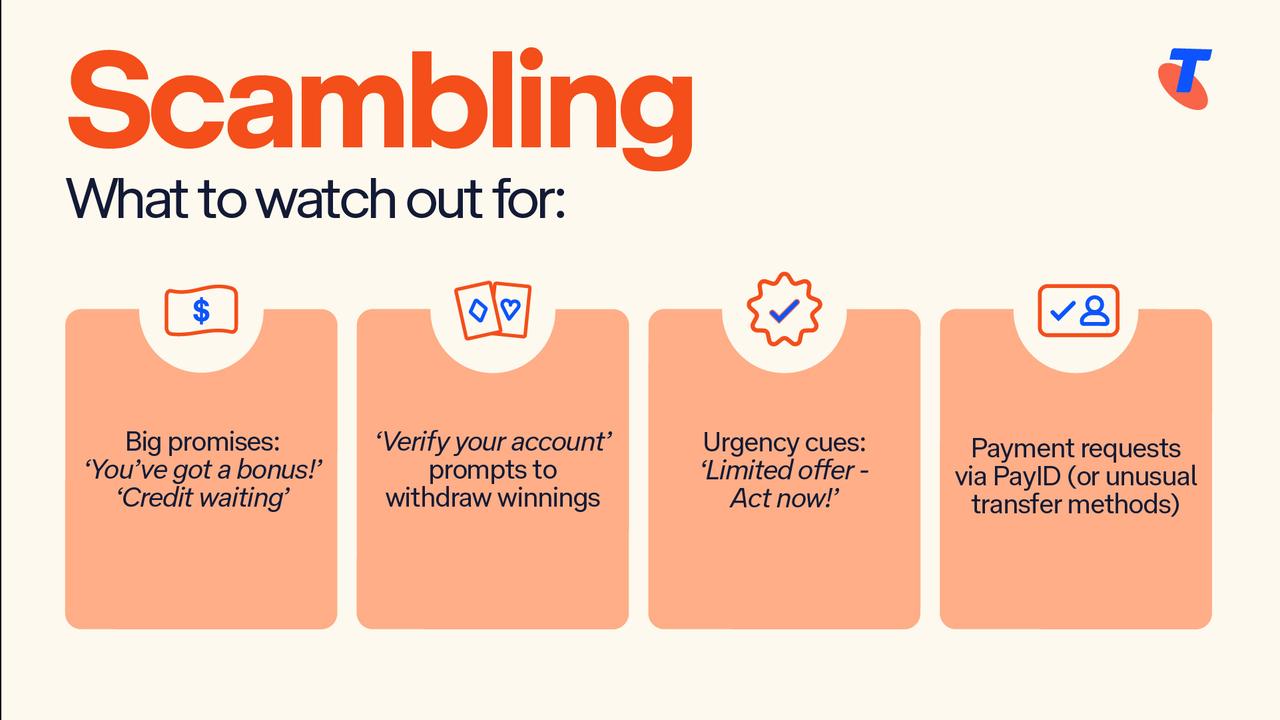
An online gambling promotion pops up on SMS, social media, messaging apps, chat groups or from people you're connected to, offering prizes and wide odds to get you to click through to an often colourful, but dodgy, website.
Then you're asked to transfer funds using an alternative payment system, such as PayID, to play.
Soon you'll be doing great, and you might be asked to put even more money in.
But when you try to cash in, you can't and there's no way to get it back because the platforms operate overseas - beyond Australian law.
At the same time, your personal details, including your bank accounts or driver's licence number, have been put at risk, leaving you exposed.
"It's more than the money, it's identity (theft), which is tremendously painful down the track," Mr Pauli said.
"It can take weeks or months for that to percolate, and for someone to use it, open a line of credit or something in your account."
And while there's not enough information on exactly how much is lost to scambling, the scammers are certainly making an effort.
"Another way to think of it is that we wouldn't be seeing the increases that we are if it weren't paying dividends," Mr Pauli said.
So beware, and if you do get caught, notify your bank immediately.
National Gambling Helpline 1800 858 858