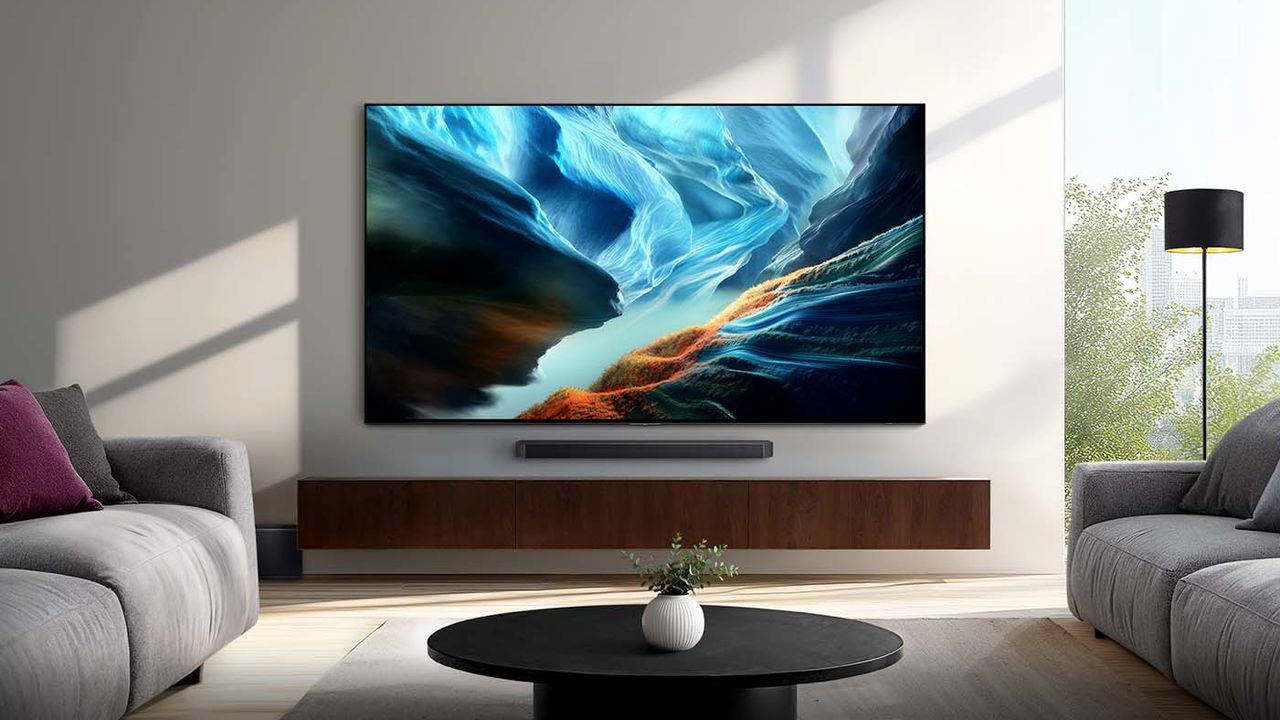
The S90H is Samsung’s newest mid-range OLED TV, and the successor to one of the best OLED TVs of 2025, the Samsung S90F. Naturally, it’s got big shoes to fill.
Last year, the S90F’s quantum dot-enhanced display was one of its primary benefits. It’s one of the features that sets the S90F apart from its primary competitor — the LG C5 — since quantum dots allow for better overall color volume than what we measured on the C5’s standard WOLED panel.

This year, however, it would appear as though Samsung has traded the S90’s QD-OLED panel for a run-of-the-mill WOLED display. This could have a pretty significant impact on the S90H’s performance year over year — and perhaps an impact on how some folks will shop for an OLED TV in 2026 and beyond.
The QD-OLED advantage

In some regions, the 55- and 65-inch versions of the S90F represent the last mid-range Samsung OLEDs to come with quantum-dot color.
Choosing between QD-OLED and WOLED wasn't something any of us had to worry ourselves with until relatively recently, when Samsung Display began manufacturing quantum dot-enhanced OLED displays. At first, you could only find the technology within Samsung's flagship OLED series. In recent years, it trickled down into the brand's mid-range tier.
This was great news for people who were hesitant to splash out on a top-shelf TV, but who nevertheless wanted to enjoy the key benefit of quantum dot-enhanced OLED displays: added color volume.
Unlike WOLED displays, which rely on white light and color filtering to produce color, QD-OLED displays energize quantum dots with blue light — no color filter required. It's a much more efficient process, resulting in brighter, more voluminous color than what you'll typically see on comparably priced, WOLED-equipped TVs.
Last year, we saw the QD-OLED advantage on display when we tested both the LG C5 (WOLED) with the 65-inch Samsung S90F. Both sets delivered about 1,200 nits of HDR highlight brightness in their most-accurate picture modes, but the S90F covered about 89% of the BT.2020 color gamut while the C5 clocked in at about 76%.
This year, things have changed. According to a recent report at DisplaySpecifications, the entire S90H series will leverage WOLED displays. This means that, in some regions, the 55- and 65-inch versions of the S90F represent the last mid-range Samsung OLEDs to come with quantum-dot color.
If you're interested in buying a new, Samsung-branded, quantum dot-enhanced OLED display this year, you'll have to spring for one of the TV-maker's top models. (In other words, start saving up for the Samsung S95H.)
Interestingly, though, the S90H will be the first mid-range OLED to feature Samsung's glare-free display. Until now, this feature was only available on the brand's flagship-level models.
It's as though Samsung has traded the S90 Series' quantum-dot color for the matte-style display. You'll have to decide for yourself if that's a worthwhile trade, but for my money, I'd rather have quantum dots in my back pocket.
Samsung S90H: outlook

The jury won't be out on the Samsung S90H until we finish putting it through its paces in our testing lab. However, we recently tested and reviewed its primary competitor, the LG C6, and saw no significant improvement in the C6's color volume year over year. Just as the C5 covers about 76% of the BT.2020 color space, so too does the all-new C6.
If the S90H is using a similar WOLED-style panel as the C6, I expect a very similar test result on Samsung's side. WOLED-equipped TVs have certainly seen incremental improvements to HDR brightness in recent years, but without the high-level engineering typically reserved for flagship OLEDs (like the LG G5), it's been difficult for them to make the jump to the benchmark set by QD-OLED.