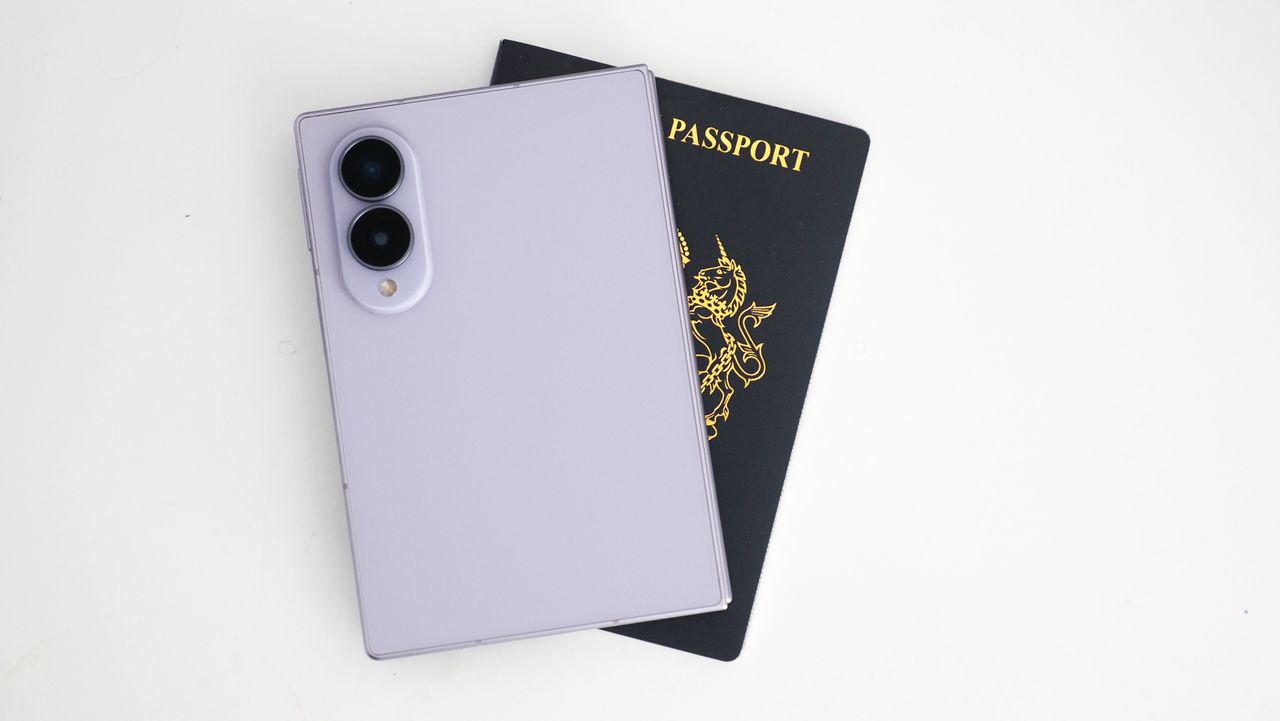
After seven generations of folding phone releases, Samsung did something dramatic with its eighth-gen model – changing the Galaxy Z Fold 8's display aspect ratios so dramatically that it has created an all-new experience and a first for Android phones.
I was dubious initially, because the folded device's almost-passport-sized exterior display looked so squat and wide that I couldn't fathom how it would enhance my experience. Yet here I am, a full working week later of using the Z Fold 8 nonstop, and I'm fully on side with this new format.

That's partly down to it solving one of my criticisms inherent in folding phones (and I've tried pretty much all of them): that I would rarely unfold any, given how 'normal' the exterior display would usually feel in use. The Z Fold 8's addition of a 4:3 aspect ratio panel within has changed that for me.
The Galaxy Z Fold 8 is no iterative upgrade over the Galaxy Z Fold 7 – for that, you'll need to look to the also-new Galaxy Z Fold 8 Ultra (here's the two compared) – but a landmark step towards folding phones' wider acceptance and, if rumours are true, a precursor to Apple's expected arrival in this space later this year.
Price & Availability
But with a price tag that remains an obvious hurdle, is wider acceptance ever going to be feasible? You might need to factor in increasing your monthly contract costs to accommodate here.
The Z Fold 8 is up for pre-order now, ahead of its 4 August on-sale date, and retails from £1,699 / $1,899 / AU$2,699 for the 256GB model with 12GB RAM. Only the 1TB storage variant offers 16GB RAM.
That is £/$200 less than the £1,899 / $2,099 Z Fold 8 Ultra (which is AU$2,999 in Australia), so it's not the most expensive foldable in Samsung's line-up or, indeed, in the market overall. But it's still pricier than most typical Android flagships.
What's New?
- Lightest Fold yet, at 201g
-
Totally new aspect ratio displays
- 5.5-inch external, 10:16 ratio
- 7.6-inch internal, 4:3 ratio
- Flex Titanium tech
-
Samsung's first-ever silicon-carbon battery
- 4300mAh, 45W charging
-
Dual camera system, not triple, without optical zoom
- 50MP main and 50MP wide
Samsung has been in the folding phones game for longer than any other maker, with a new model arriving annually since 2019. But the Galaxy Z Fold 8, the eighth-generation handset in the range, changes the playbook.
That's clearly visible in the gallery above, where I've photographed the Z Fold 8 next to the Z Fold 8 Ultra – the latter being more in line with the previous Z Fold 7 model that released last year.
This radically different size and shape is also paired with the lowest weight of any Samsung foldable to date, while also marking Samsung's first foray into using a silicon-carbon battery type (Si-C) for greater capacity from this new form.
In opting for a new aspect ratio, however, Samsung has cut back on the cameras – it's a dual rear offering, lacking the optical zoom of the Ultra – which seems a sensible cost-saving move. These lenses do protrude quite dramatically from the rear, though, so the dreaded 'desk wobble' is still a bother.
Displays
-
5.5-inch external AMOLED display, 10:16 aspect ratio
- Wider and shorter than Z Fold 8 Ultra
- 3000 nits peak brightness
- 1264 x 1848 resolution
- 120Hz refresh
-
7.6-inch internal AMOLED display, 4:3 aspect ratio
- Flex Titanium Technology for anti-crease
- Anti-reflective coating finish
- 1828 x 2584 resolution
- 120Hz refresh
I've already established that the displays differ from what's come before, but there's plenty going on behind the scenes, too, in what Samsung calls Flex Titanium technology. I interviewed a Samsung exec about how tricky this was to deliver – and it's an interesting read on the challenges faced.
Flex Titanium is designed to further negate the much-maligned 'crease' down the centre of the foldable panel – by using a titanium plate behind the panel to benefit from its rigidity. Getting sheet metal to actually fold, however, took some clever engineering to create a layer thin enough, with micro-etched and laser-cut patterns to enable the folding process.
I found the Z Fold 8 satisfyingly 'snaps' into position when unfolded, the crease barely visible from a front-on viewpoint and only marginally present when viewing at more acute angles. That 'snappy' operation means you can't position this foldable in anything but fully open or closed positions, unlike with the Ultra.
Good work on the crease, but the Z Fold 8 doesn't address one of my other general frustrations with folding phones: fingerprints! Samsung hasn't made further headway into negating how the natural oils prevalent in human skin sit on a folding display's surface. It just looks worse than on any standard glass panel.
The Z Fold 8's folding panel is finished with an anti-reflective coating, though, so it does at least battle sunlight better for an improved viewing experience when outdoors. The bright nature of this panel also helps in cutting through any would-be reflections for clear visuals all of the time, while a 120Hz refresh rate ensures smooth, flowing visuals.
The biggest new feature to get used to with the Z Fold 8, however, is this unfolded display's 4:3 aspect ratio. You just don't see that in Android devices. But you do elsewhere: as that's precisely the form of Apple's iPad line. I maintain that this is unusual for an Android device, but as I've learnt over the past working week, I've grown to really enjoy it.
It's better for reading, it's better for some games, and it's certainly better for content consumption. I've actively found myself moving between external and internal panels more than with any folding phone before, which is certainly a positive.
Less positively, however, is that Android, and the apps this system inherently runs, just aren't always designed for on-the-fly aspect ratio adjustment – so when an app is open, and you unfold the device to benefit from it on the larger display, you'll typically have to restart said app.
That's not true of all apps, mind, with Gmail loading your inbox plus selected email in a dual format. WhatsApp is similar, with Chats loaded and the selected conversation opening into the right-hand portion of available space. Samsung's One UI 9 software also permits multiple apps to be open at once.
This multitasking feature needs to be activated, but you can easily swipe with two fingers from the side to create a split-screen view. It's even possible to swipe diagonally from the corner of an open app and redraw its position as a floating window (some apps enforce a fixed aspect ratio). It's actioned well and not fiddly, unlike some competitors' software (Oppo's ColorOS springs to mind).
Hardware & Performance
- Colours: Graphite, Cream, Lavender, Pistachio (Samsung exclusive)
- Qualcomm Snapdragon 8 Elite Gen 5 'for Galaxy', 12GB RAM
- 4800mAh Si-C battery type, 45W charging
- 256GB / 512GB / 1TB storage options
Samsung did tell me that the Flex Titanium technology actually frees up space in this design, as does the adoption of the new battery technology, so there's 7% more graphite for thermal dissipation in this design compared to the previous-gen Z Fold 7.
That said, in its folded form this phone can run hot – and when the system decides that it's crossed a threshold, I've seen automated screen dimming and likely performance throttling. It has been particularly warm in the UK where I'm testing, however, so such preventative measures are hardly a surprise – and certainly not a deal-breaker in overall performance.
There's no doubting the Z Fold 8's abundant specification, which includes Qualcomm's top-tier 'for Galaxy' overclocked processor. Whether multitasking, as I described above, or playing full-screen games, the experience is fluid and every bit the flagship.
It'll be interesting to see how Samsung evolves its One UI 9 software offering, as there's the promise of 7 years of updates for the latest features and security patches. The software at time of testing is in beta (which might explain the lack of a 5-across app grid), but the more that Samsung can leverage this screen real estate, the better.
I've been pleased with the introduction of that Si-C battery type, too, with its 4800mAh capacity proving good enough to last through a day with ease. No, it's not the highest capacity, per some competitors, but it's more than good enough – I've managed 16-hour days unplugged with 6 hours of screen time and still gone to bed with 15% remaining.
Streaming time might be the most valid figure to consider in relation to this foldable, though. Samsung specifies continuous playback up to 26 hours. If you're using Wi-Fi, with Bluetooth headphones connected and are cranking the display's brightness, however, then I've found an hour of YouTube to cut 9% battery – so more like 11 hours total. That's with no concessions, though, so it's a decent innings.
There is one point to note on this battery type, however, as we reported ahead of the device's on-sale date. While the earlier Z Fold 7 claimed 2000 charge cycles, the Z Fold 8 drops that to 1200 – which is a 40% dip. That suggests the longevity after some years may be challenged.
Cameras
-
Dual rear cameras:
- Main: 50-megapixel
- Wide: 50MP
-
Selfie cameras:
- Both: 10MP, f/2.2
A phone's cameras tend to be the biggest sign of its flagship status these days. The Z Fold 8 doesn't go quite as far as the Ultra model here, however, dropping any optical zoom lens and relying on tried-and-tested 50-megapixel cameras in wide and ultra-wide forms.
It's the Ultra model, in its altogether different format, that gets the more sophisticated camera setup (including a 200-megapixel main), therefore. But Samsung's well-established photographic prowess is still on fair display in the Z Fold 8 – much as I do miss having a more capable zoom – thanks to decent processing and resolution.
You can certainly crop into images easily, providing a sort of 'zoom equivalent' – the exec interview and on-stage photos in my gallery above, for example, are heavily cropped, yet still retain enough core detail. Even low-light images come out well, much as the processing can leave some subjects looking a little softer as a result.
The suite of Galaxy AI features on board also delivers plenty of tools to manipulate images with ease. These have been established over the last couple of years of Galaxy flagship launches, though on the video front this generation adds My FanCam, which can crop video focus to a specific social platform aspect, as you please.
Verdict
Much as the Galaxy Z Fold 8's passport-sized form could have proved a floundering move for Samsung, having used this unique Android device for a full working week, I think it's opened new borders – and represents the future of foldables.
The high asking price and limited camera setup don't guarantee overnight success with the masses, mind, and there's scope for both Google's Android and Samsung's One UI software to bring yet more beneficial features to the device's two display formats.
But in terms of practicality, core hardware and raw power, Samsung has delivered a new kind of folding phone experience that feels as fresh and fun as it does mature. I've found the Galaxy Z Fold 8 to transform the foldable experience for the better and set a new bar.
Also Consider
There's nothing directly comparable with the Z Fold 8's aspect ratio, but if you want more camera and more screen – albeit in a taller and narrower form – then the Z Fold 8 Ultra is your most obvious option.
Elsewhere in the market, Honor's competitive pricing with the Magic V6 makes a strong case, despite software quirks. Or for a more 'standard' external display, Google's Pixel 10 Pro Fold is the most obvious pick.