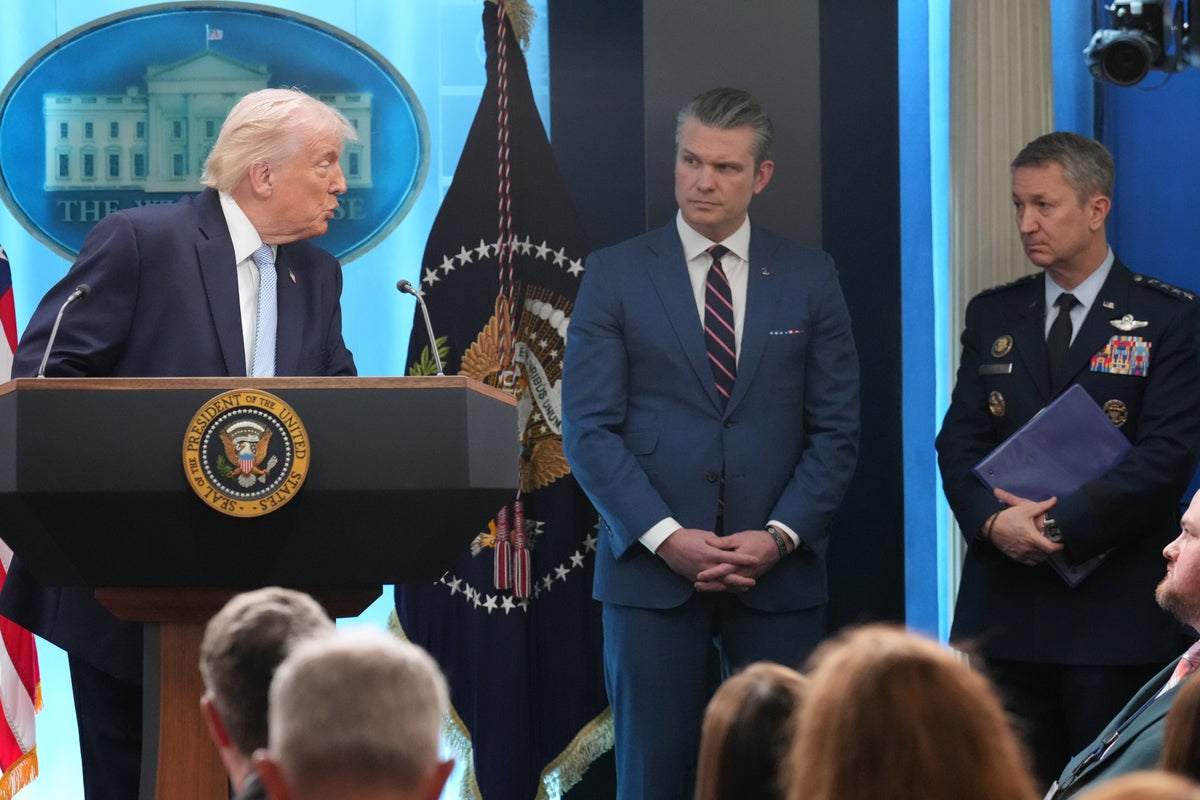
The United States relied on dozens of aircraft, hundreds of personnel, secret CIA technology and a dose of subterfuge to rescue a two-man F-15E fighter jet crew downed deep inside Iran, a risky mission that President Donald Trump and his top defense aides detailed Monday.
U.S. forces rescued the pilot within hours of the jet going down late Thursday, surging helicopters, midair refuelers and fighter aircraft deep into Iran after confirming his location, Trump said in a valedictory news conference at the White House, describing the military operation in an unusual level of detail.
The second aviator aboard the aircraft — the weapons systems officer — was rescued nearly two days later.
An A-10 Warthog, which was the attack aircraft primarily responsible for keeping in contact with the downed pilot on the ground, was hit by enemy fire while engaging Iranian forces, said Gen. Dan Caine, chairman of the Joint Chiefs of Staff.
The A-10 was “not landable,” Caine told reporters, but the pilot continued fighting before flying to a friendly country and ejecting. He was quickly rescued and is doing fine, Caine said.
The rescue of the F-15 pilot occurred before the Iranians could marshal a comprehensive search of their own, but finding and bringing home the weapon systems officer was an even more complicated endeavor.
The officer, who rode in the backseat of the F-15 flying under the call sign Dude-44 Bravo, was injured but followed his training to get as far from the crash site as possible. He managed to climb mountainous terrain and hide inside a cave or crevice. He contacted U.S. forces Saturday.
When a plane crashes in hostile territory, “they all head right to that site, you want to be as far away as you can,” Trump said.
CIA Director John Ratcliffe said the spy agency used “exquisite technologies that no other intelligence service” possesses to locate the aviator. At the same time, the CIA mounted a deception operation to mislead Iranians who also were trying to find him.
Ratcliffe said the search and rescue operation was “comparable to hunting for a single grain of sand in the middle of a desert.”
The CIA declined to respond to questions Monday about the kind of technology used to locate the airman.
Protected by an “air armada” of drones, strike aircraft and more, rescuers moved in on Sunday to pick up the weapons officer and bring him home.
Many of the dozens of aircraft that were part of the operation were there for deception, Trump said.
“We were bringing them all over, and a lot of it was subterfuge,” Trump said. “We wanted to have them think he was in a different location.”
Back in Washington, national security officials coordinated on a call, keeping the phone line open for nearly two days straight.
“From the moment our pilots went down, our mission was unblinking," Defense Secretary Pete Hegseth said. “The call never dropped. The meeting never stopped, the planning never ceased.”
___
Cooper reported from Phoenix, Arizona. Amiri reported from New York. Associated Press writer Josh Boak contributed to this report.
MAGA stars roasted online for sharing fake AI photo of airman after Iran rescue
A timeline of the Nancy Guthrie disappearance and investigation
Iran-US war latest: Trump ‘not at all’ worried about war crimes
The one Republican senator who can put the kibosh on Trump’s top nominees
Crohn’s breakthrough as scientists find trigger that could help develop treatments
Cases of virus that can cause fatal diarrhea on the rise in California