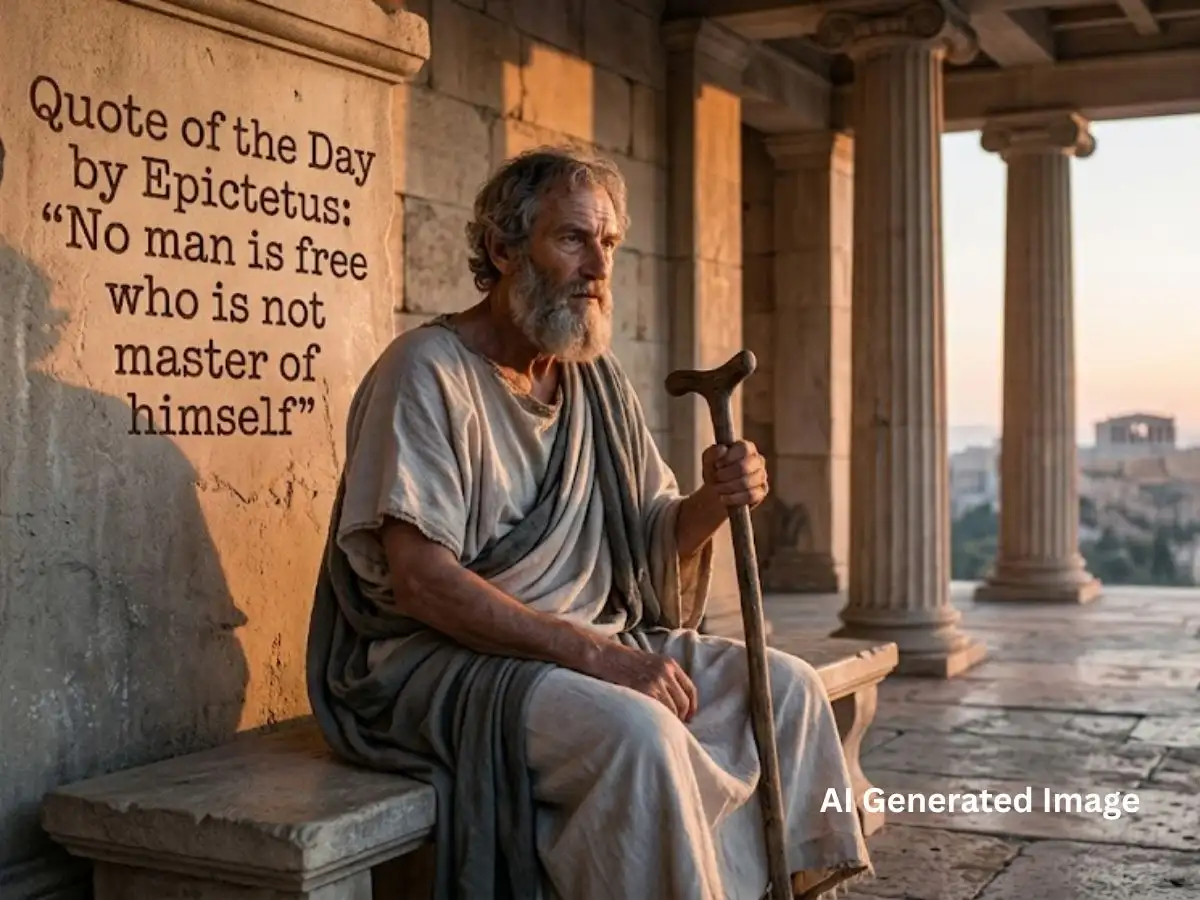
True freedom is not only about having the ability to make choices. For Stoic philosopher Epictetus, freedom also depends on a person's ability to govern their own thoughts, impulses and actions. His quote, “No man is free who is not master of himself,” presents self-mastery as an essential part of living independently and deliberately.
The idea challenges the common understanding of freedom as simply being free from external restrictions. A person may have considerable freedom in the outside world while remaining controlled by anger, fear, impulsive desires or unhealthy habits. Epictetus' observation shifts attention inward, suggesting that genuine independence begins with learning to direct one's own behaviour.
Quote of the Day: “No man is free who is not master of himself”
Today’s quote by Epictetus: “No man is free who is not master of himself.”
The statement reflects a central theme of Stoic philosophy: people have greater control over their responses than over external events. For Epictetus, mastering oneself means developing the discipline to decide how to respond rather than allowing every emotion or impulse to dictate one's actions.
“No man is free” without self-control
The opening of the quote makes freedom dependent on an internal quality. External circumstances can influence a person's life, but the Stoic idea emphasises the importance of controlling one's own reactions.
Someone who cannot resist every impulse may find that their choices are repeatedly shaped by immediate desires. Likewise, a person who is easily ruled by anger or fear can struggle to act according to reason. In this sense, a lack of self-control can become another form of limitation.
What “master of himself” means
“Master of himself” does not mean suppressing every emotion or attempting to control everything around oneself. Rather, it points to self-discipline and conscious decision-making.
The principle encourages people to pause before reacting, examine their impulses and choose actions that reflect their considered judgment. Self-mastery therefore involves awareness as well as restraint. It is the ability to recognise an emotion or desire without automatically allowing it to determine what happens next.
Epictetus on freedom and inner discipline
Epictetus, who lived during the first and second centuries, taught that a person's attitude and responses were central to a life of freedom. Stoic philosophy distinguishes between things within our control and things outside it, directing attention toward the former.
From this perspective, external circumstances cannot always be changed, but one's response to them can often be examined and disciplined. The quote therefore connects freedom with responsibility: greater control over oneself can create greater independence from passing impulses and emotions.
The life lesson behind “master of himself”
The enduring lesson is that freedom involves more than removing external restrictions. It also requires understanding what controls us from within.
A person who can reflect before reacting, resist destructive impulses and act according to deliberate values has greater command over their choices. Epictetus' quote consequently presents self-mastery not as a limitation on freedom, but as one of its foundations. The more consciously a person directs their own actions, the less their behaviour is governed by every passing impulse.