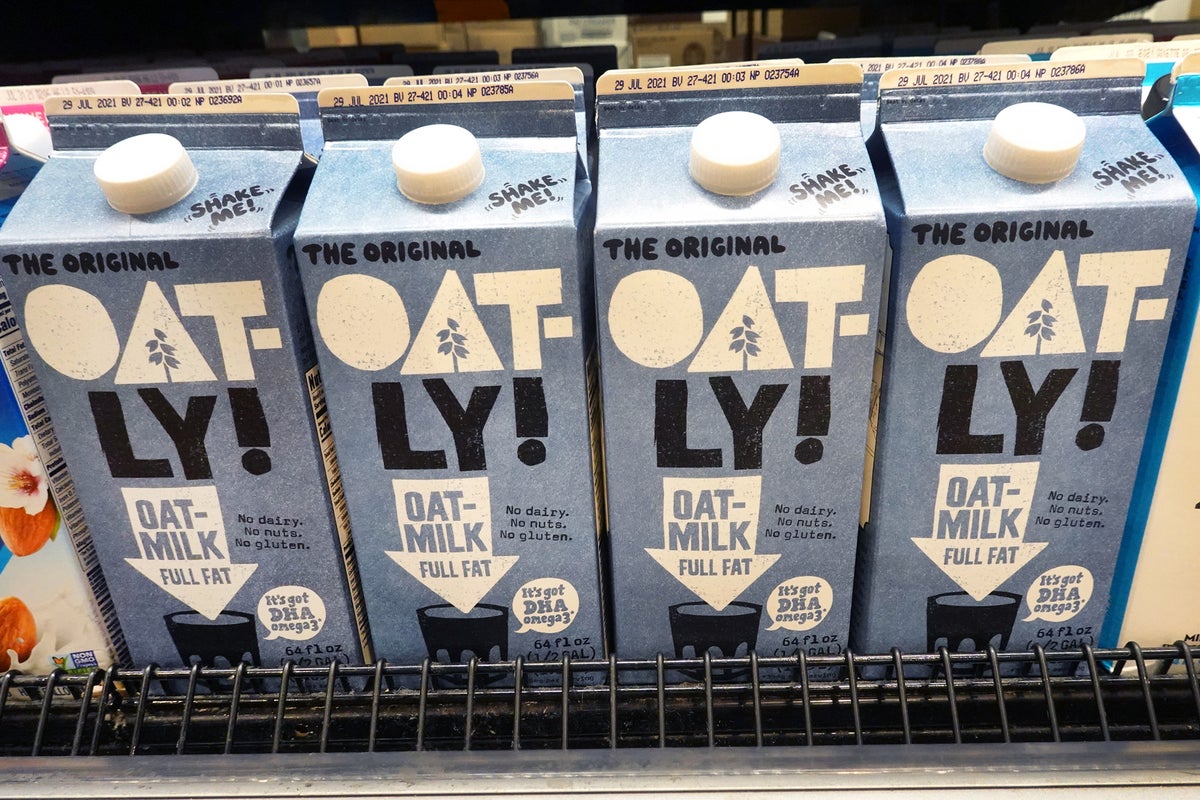
Oatly, the prominent oat drink manufacturer, has suffered a big legal setback after the Supreme Court unanimously ruled against its use of the word "milk" to describe some of its plant-based products.
The Swedish company's long-running dispute with Dairy UK, the trade association representing the British dairy industry, centred on the validity of Oatly's "Post Milk Generation" trademark.

The legal battle questioned whether the term "milk" could legitimately be applied to oat-based alternatives.
The case saw a series of reversals: the Intellectual Property Office initially deemed the trademark invalid, a decision challenged successfully by Oatly in the High Court in 2023.
However, the victory was short-lived, as the Court of Appeal overturned the High Court's ruling in 2024. Oatly went to the UK's highest court last December.
Its legal team contended that the trademark explicitly conveyed the absence of dairy milk in its offerings.

Conversely, lawyers for Dairy UK argued that the phrase failed to clarify the product’s milk-free nature, instead referring to a specific demographic of consumers.
On Wednesday, a panel of five justices delivered a unanimous verdict, confirming the invalidity of the trademark.
In a ruling backed by Lords Hodge, Briggs and Stephens, Lords Hamblen and Burrows said: “We consider that it is far from clear that that trademark is describing any characteristic of the contested products.
“Rather, on its face, it is focused on describing the targeted consumers and, in particular, those younger consumers who may be said to belong to a generation for whom there are, in contrast to past generations, widespread concerns about the production and consumption of milk.
“Insofar as it is describing a characteristic quality of the product, it is doing so in an oblique and obscure way and is certainly not doing so ‘clearly’.”
The law states that the “designations” of “milk” and “milk products” can only be used for certain products, with Oatly applying in 2019 to trademark the phrase “Post Milk Generation” in 2019 for use on t-shirts and a variety of oat-based products, including milk, yoghurt and custard.
The trademark was registered in April 2021, but Dairy UK then applied for the trademark to be declared invalid, which was confirmed by the IPO in January 2023.
Oatly took the case to the High Court, with Mr Justice Richard Smith allowing the company’s challenge in December 2023.
In a ruling, he found that the phrase “post milk generation” did not purport to market products “as any particular product, let alone as milk”.
But in November 2024, the Court of Appeal overturned the High Court decision, finding that oat-based food and drink was not a permitted “designation” of milk.
In a ruling, Lord Justice Arnold, sitting with Lord Justice Snowden and Lord Justice Jeremy Baker, said that the “decisive problem” with the trademark was that it “does not clearly describe a characteristic quality of the goods in question”.
He said: “It may be understood as alluding to the fact that the goods are non-dairy products, but it does not clearly describe any such characteristic.”
The Supreme Court agreed, with Lords Hamblen and Burrows stating: “Even if ‘post milk generation’ were to be regarded as referring to the milk-free characteristic of the contested products, that characteristic is not being described ‘clearly’.”
Following the ruling, Bryan Carroll, general manager for Oatly UK & Ireland, said the company was “deeply disappointed” by the ruling, which he said “creates unnecessary confusion and an uneven playing field for plant-based products”.
He said: “In our view prohibiting the trademarking of the slogan ‘Post Milk Generation’ for use on our products in the UK is a way to stifle competition and is not in the interests of the British public.”
U.S. citizens and legal residents sue over aggressive immigration raid at Idaho horse racing track
Trump’s DOJ wants to throw out Steve Bannon’s contempt case
Migrants languish in US detention centers amid dire conditions and prolonged waits
One in three Brits clueless about where their oat milk is sourced, study finds
Popular milk alternative may be more harmful than helpful, experts say