Get all your news in one place.
100's of premium titles.
One app.
Start reading
Space
Space
Science
Robert Lea

NASA X-ray spacecraft discovers supernova wreckage at the heart of the Milky Way

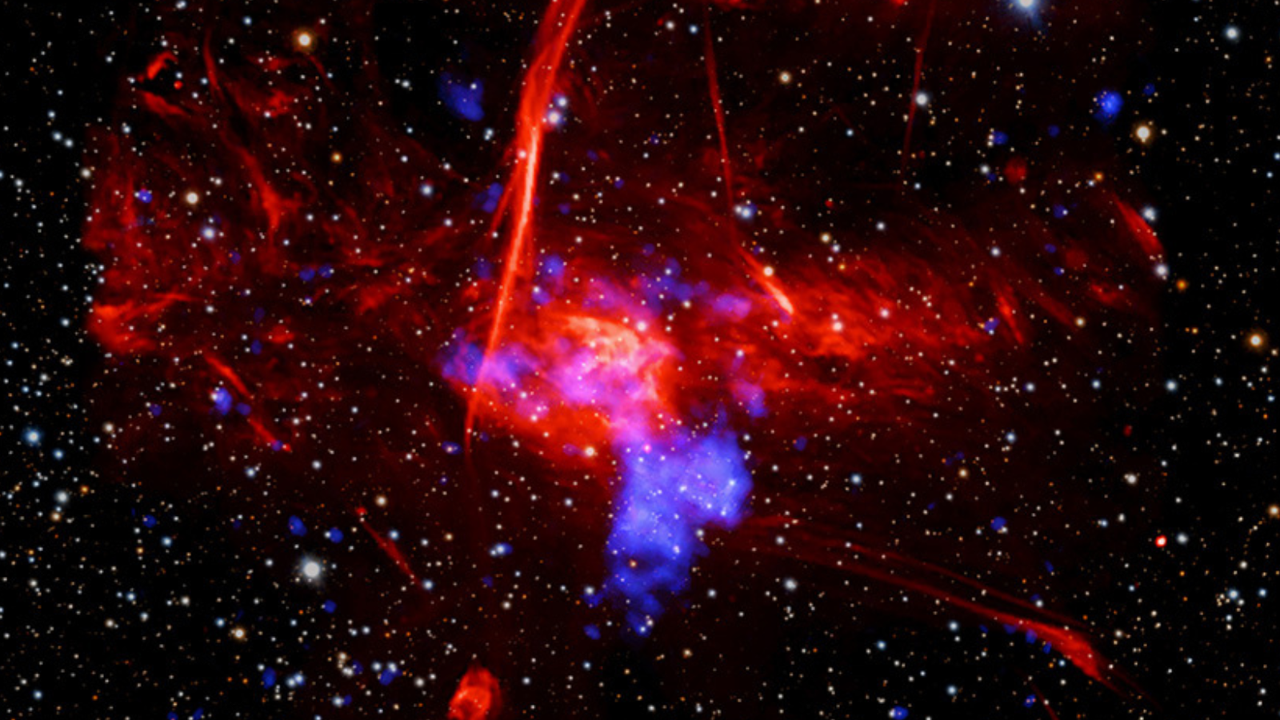
Supernova wreckage found near the heart of the Milky Way in Sagittarius C.

NASA's Chandra X-ray spacecraft has detected the supernova wreckage of a dead star near the supermassive black hole that sits at the heart of the Milky Way, around 26,000 light-years from Earth.


The team behind the discovery believes the star that died to create this wreckage erupted around 1,700 years ago. This represents the closest supernova debris found to our central supermassive black hole, Sagittarius A* (Sgr A*).

The supernova wreckage sits within a bubble of ionized hydrogen gas, which is a bright source of radio waves, and has been dubbed Sagittarius C (Sgr C). The wreckage was detected by Chandra and the XMM-Newton X-ray space telescope as a "blob" of X-rays. The shell of ejected material appears to be moving at a staggering 2 million miles per hour (3.2 million kilometers per hour).

Sagittarius C the location of this supernova wreckage is highlighted in blue in this image from Chandra, XMM-Newton, PanSTARRS and MeerKAT. (Image credit: X-ray: NASA/CXC/UCLA/Z. Zhu et al.; ESA/XMM-Newton; Optical: PanSTARRS; Radio: MeerKAT; Image Processing: NASA/CXC/SAO/L. Frattare and P. Edmonds)

Supernova wreckage like this is important for the chemical enrichment of galaxies, including the next generation of stars and planets.

That's because when massive stars like the progenitor star of this debris explode, the heavy elements they have forged from hydrogen and helium are jettisoned into their surroundings.

Eventually, these elements mix with surrounding clouds of interstellar gas and dust. Later, cool and dense regions in these molecular clouds collapse under their own gravity, forming new stars. The envelopes of material around these infant stars eventually form clumps that gather more and more mass to become planets.

A close image of Sgr C created with the addition of data collected by the James Webb Space Telescope. (Image credit: X-ray: NASA/CXC/UCLA/Z. Zhu et al.; ESA/XMM-Newton; Optical: PanSTARRS; Radio: MeerKAT; Infrared (JWST): NASA/ESA/CSA/STScI; Image Processing: NASA/CXC/SAO/L. Frattare and P. Edmonds)

There is still some ambiguity surrounding this wreckage, however. The team behind the observation didn't find increased amounts of the elements that would have been blasted out by the exploding star.

This could be because this debris has already mixed with the surrounding gas and dust. Alternatively, it could suggest this X-ray blob isn't the result of a supernova explosion at all, but rather comes from gas heated by the hot massive stars in this region of the Milky Way.

The team behind this research doesn't consider this explanation likely. That is because this X-ray emission is around ten times brighter than the typical emissions from clusters of hot massive young stars.

The team's research was published in The Astrophysical Journal.

Sign up to read this article
Read news from 100's of titles, curated specifically for you.
Already a member? Sign in here
Related Stories
Top stories on inkl right now
One subscription that gives you access to news from hundreds of sites
Already a member? Sign in here
Our Picks
Fourteen days free
Download the app
One app. One membership.
100+ trusted global sources.