As the first explosions rang out across Kyiv overnight on Monday, images began to circulate on social media showing flames rising above the Kyiv-Pechersk Lavra church complex, a UNESCO World Heritage site.
For millions of Ukrainians seeking shelter across the country — including an estimated 42,000 people who spent the night in the capital’s metro stations — the sight of the cathedral under attack came as a particularly painful shock.

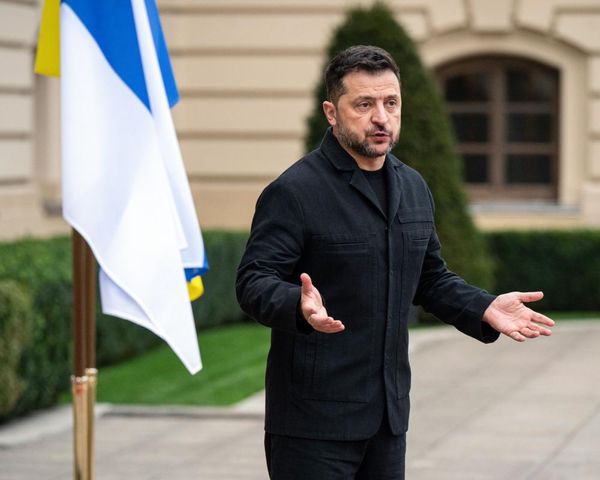
Ukrainian President Volodymyr Zelenskyy described the attack on the historic cathedral as “one of Russia’s most serious crimes against Christian culture to date” and urged G7 leaders meeting in France to increase their pressure on Moscow.
“It is very important that there be a response from the G7 countries, which are now gathering for their summit – and that this response be decisive and substantive: more pressure on the aggressor and more support for Ukraine’s air defence, especially anti-ballistic capabilities,” the Ukrainian president said.
Zelenskyy visited the scene on Monday morning together with Prime Minister Yuliia Svyrydenko and other members of his government, as rescue efforts continued and the bells of the Lavra again rang out across Kyiv, despite the damage the church had suffered.
“A brutal assault on our people and our heritage. This is the true face of Russia’s Orthodox values," Svyrydenko said.
"We ask for prayers for the salvation of the shrine from destruction. Another Russian crime against humanity, against history, against Christianity,” she added.
Ukraine's crucial historic, religious and cultural relic
Head of the Orthodox Church of Ukraine Metropolitan Epiphanius was among the first to confirm the Russian strike on the cathedral on social media, when he posted on X that the roof of the complex's Dormition Cathedral caught fire during the attack.
He condemned the strike as another Russian crime “against humanity, against history, against Christianity” and appealed for prayers to save the site.
"We ask for prayers for the salvation of the shrine from destruction. Another Russian crime against humanity, against history, against Christianity."
The Kyiv-Pechersk Lavra, also known as the Monastery of the Caves, is a sprawling complex of monasteries and churches, including some underground, built between the 11th and 19th centuries.
Some of the churches at the UNESCO-listed World Heritage site are connected by a labyrinthine complex of caves spanning more than 600 meters.
Ukraine would be “urgently initiating” procedures within UNESCO and other international mechanisms to ensure “immediate and adequate responses to this state barbarism," Foreign Minister Andrii Sybiha said on X.
The attack on the Lavra, a site dating to the era of Kyivan Rus, is among the most significant assaults on Ukrainian cultural heritage since Russia’s full-scale invasion began.
French Foreign Minister Jean-Noel Barrot said the attack was the “equivalent, for us French, of a bombing of Notre Dame,” referring to the iconic Paris cathedral.
French President Emmanuel Macron said the attack only strengthened the determination of Ukraine’s allies to pursue a ceasefire and work toward peace.
“Just as nothing can justify the war of aggression that Russia has been waging against Ukraine for more than four years, nothing can justify this attack on our shared universal heritage,” Macron wrote on social media.
Russian strike 'deliberate' hit against Ukraine's history
As Russia struck the Kyiv Pechersk Lavra, staff scrambled to evacuate ancient icons, artworks and other religious relics from a site that houses some of Ukraine’s most revered shrines.
For many Ukrainians, the Lavra is far more than a monastic complex — it is a living link to Kyivan Rus, the first eastern Slavic state, and a symbol of an unbroken historical and spiritual tradition rooted in Kyiv rather than Moscow.
The cathedral, its churches and surrounding monastic buildings stand on bluffs above the right bank of the Dnipro, a centuries-old place of pilgrimage that concentrates Ukraine’s religious life, scholarship and cultural memory in a single complex.
Any strike on the site is therefore experienced not simply as damage to bricks and frescoes, but as an assault on that continuity and on Ukrainian identity itself, which is why it resonates so deeply, far beyond the capital.
One of Ukraine’s most prominent human rights defenders and a co-recipient of the 2022 Nobel Peace Prize Oleksandra Matviichuk said Russia **"**deliberately struck the Lavra — built during the era of Kyivan Rus’, when Moscow itself did not yet exist — with a Russian drone.”
“The church in Russia has been taken over by the security services. That is why Russian priests support the war and bless the missiles and drones that strike Christian churches,” Matviichuk added.
“We will rebuild the Lavra. And those who support the Russian state, which is fighting against God and the churches, will be held accountable for their actions.”