Get all your news in one place.
100's of premium titles.
One app.
Start reading
The Conversation
The Conversation
Caroline Lynn Kamerlin, Professor of Chemistry and Biochemistry, Georgia Institute of Technology

Molecular ‘fossils’ offer microscopic clues to the origins of life – but they take care to interpret

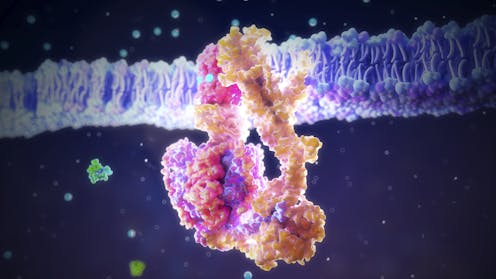
ATP synthase is an enzyme that has been using phosphate to generate life’s energy for millions of years. Nanoclustering/Science Photo Library via Getty Images

The questions of how humankind came to be, and whether we are alone in the universe, have captured imaginations for millennia. But to answer these questions, scientists must first understand life itself and how it could have arisen.

In our work as evolutionary biochemists and protein historians, these core questions form the foundation of our research programs. To study life’s history billions of years ago, we often use clues called molecular “fossils” – ancient structures shared by all living organisms.

Sign up to read this article
Read news from 100's of titles, curated specifically for you.
Already a member? Sign in here
Related Stories
Top stories on inkl right now
One subscription that gives you access to news from hundreds of sites
Already a member? Sign in here
Our Picks
Fourteen days free
Download the app
One app. One membership.
100+ trusted global sources.