Get all your news in one place.
100's of premium titles.
One app.
Start reading
The Conversation
The Conversation
Andrea Kasinski, Associate Professor of Biological Sciences, Purdue University

MicroRNA is the master regulator of the genome − researchers are learning how to treat disease by harnessing the way it controls genes

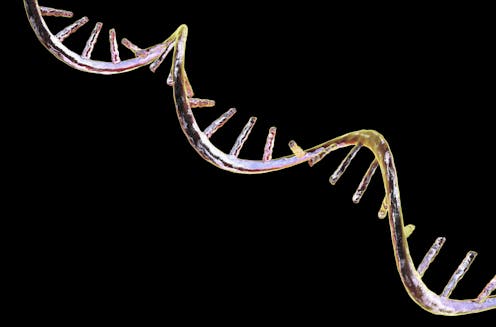
RNA is more than just a transitional state between DNA and protein. Kateryna Kon/Science Photo Library via Getty Images

The Earth formed 4.5 billion years ago, and life less than a billion years after that. Although life as we know it is dependent on four major macromolecules – DNA, RNA, proteins and lipids – only one is thought to have been present at the beginning of life: RNA.

It is no surprise that RNA likely came first. It is the only one of those major macromolecules that can both replicate itself and catalyze chemical reactions, both of which are essential for life. Like DNA, RNA is made from individual nucleotides linked into chains. Scientists initially understood that genetic information flows in one direction: DNA is transcribed into RNA, and RNA is translated into proteins. That principle is called the central dogma of molecular biology. But there are many deviations.

Sign up to read this article
Read news from 100's of titles, curated specifically for you.
Already a member? Sign in here
Related Stories
Top stories on inkl right now
One subscription that gives you access to news from hundreds of sites
Already a member? Sign in here
Our Picks
Fourteen days free
Download the app
One app. One membership.
100+ trusted global sources.