
Investors checked out on Marriott International (NYSE: MAR), sending the stock down nearly 7%, after the company delivered its Q2 2026 earnings report. The company had a bottom-line beat with adjusted earnings per share (EPS) coming in at $3.19, ahead of expectations of $3.08.
But the topline was a miss with revenue of $7.07 billion, coming in shy of estimates of $7.19 billion. It should be noted that revenue exceeded the $6.74 billion recorded in the same quarter in 2025.
Investors are conditioned to sell first and ask questions later. With a day or two of hindsight, MAR is likely to look considerably more attractive than it did heading into the report.
Behind the Miss, the Fee Machine Kept Humming
One reason why investors should give MAR a second look is the company’s fee business. The revenue miss tells only part of the story. Marriott's high-margin fee business is where the real signal lives. Gross fee revenues rose 13% to $1.578 billion. Franchise fees alone jumped 19% to $1.02 billion, driven by room growth, RevPAR gains, and stronger co-branded credit card income.
That fee strength pushed Adjusted EBITDA to $1.592 billion, up 13% year over year. Adjusted net income climbed to $844 million from $728 million. Reported net income was essentially flat at $766 million, weighed down by one-time items that investors may be overlooking.
Two charges explain much of the gap between reported and adjusted results. A $68 million impairment tied to the sale of a U.S. & Canada hotel was recognized in depreciation expense. A $27 million property-related litigation accrual also dented owned and leased results. Strip those out, and underlying profitability looks considerably healthier than the headline suggests.
The K-Shaped Travel Recovery Shows Up Again
Marriott's quarter is a textbook case of K-shaped demand playing out geographically. Worldwide RevPAR rose 3.4%, but the U.S. & Canada did the heavy lifting with 5% growth. International RevPAR actually declined 0.5%, dragged down by one region in particular.
The Middle East saw RevPAR plunge over 35%, reflecting ongoing regional conflict. That single region overwhelmed solid gains elsewhere. Europe grew, Greater China rose over 3%, and the Asia Pacific climbed more than 5% on strong leisure demand.
This bifurcation matters for the bear case. If Middle East disruption persists, it could continue to drag on blended international numbers even as core markets remain resilient. Investors betting on a clean global recovery story should note this isn't one.
Management Raised Guidance Despite the Stock's Reaction
Here's where the sell-first reaction looks especially disconnected from the numbers.
Marriott raised its full-year RevPAR growth outlook to 3%-3.5%, up from prior guidance. That's not a sign of a company bracing for weaker demand ahead.
The development pipeline also hit a record, reaching roughly 4,200 properties and 629,000 rooms. Conversions drove over a third of signings in the first half.
A growing pipeline typically signals owner confidence in Marriott's brand economics, not developer hesitation.
Marriott Bonvoy's loyalty base grew past 295 million members. New long-term co-branded card agreements with JPMorgan Chase and American Express should further extend fee growth.
These deals are structural tailwinds, not one-quarter blips.
Technical Picture Reflects the Skepticism
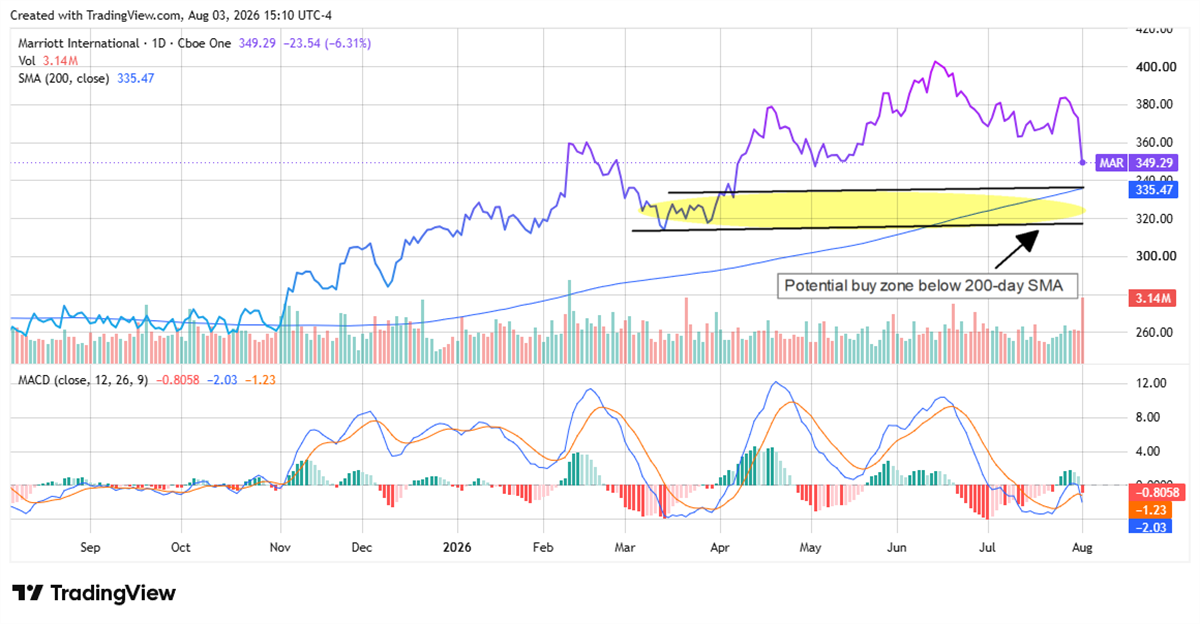
The chart confirms what the price action suggests: sentiment, not fundamentals, drove the drop. MAR's MACD line sits at -0.81, below its signal line at -1.23, a bearish crossover that emerged into earnings. RSI-adjacent momentum has clearly cooled from June's highs near $400.
Shares are now testing support just above the 200-day SMA, currently near $335. That moving average has provided a reliable floor through most of 2026. A close below it would open the door toward the next support zone.
For a company raising guidance and growing fees at double-digit rates, the technical damage looks overdone. That gap between price action and fundamentals is exactly the setup value-oriented investors watch for.
MAR May Be Giving Investors the Entry They’ve Waited For
Whatever the reason for the post-earnings pullback in MAR stock, investors who’ve been on the sidelines should pay attention. The only thing wrong with Marriott has been the price investors are paying, which is elevated compared to the S&P 500 and its historical average.
The next key level to watch is the 200-day simple moving average (SMA) around $335. Below that, key support sits around $314, a level that held twice in 2026. If MAR retests that area, the stock would offer about 23% upside to the consensus price target near $387.
The article "Marriott’s Earnings Drop May Be Missing the Bigger Fee Growth Story" first appeared on MarketBeat.