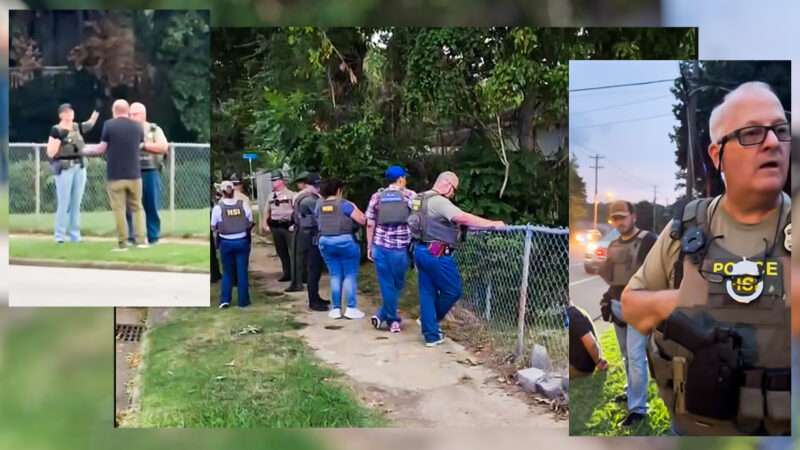
Newly released videos show a police task force in Memphis, Tennessee, arresting a well-known local activist who's also the lead plaintiff in a First Amendment lawsuit alleging illegal retaliation by the force.
The American Civil Liberties Union (ACLU) says videos of the August 26 arrest of Hunter Demster by officers in the Memphis Safe Task Force, along with other recent instances of intimidation, are yet more evidence of a continuing harassment campaign against people who try to exercise their First Amendment right to record law enforcement in public.

The ACLU released the video, along with a declaration by Demster, as supplemental material in a lawsuit filed in mid-May alleging First Amendment retaliation by the Memphis Safe Task Force—a task force of local, state, and federal agencies that has occupied Memphis since last September at the order of President Donald Trump and Tennessee Gov. Bill Lee.
Demster, who cofounded a local group that monitors the task force's activities, and eight other Memphis residents allege in declarations that they have been violently arrested, surveilled at their houses, pulled over under false pretenses, and jailed for trying to film the force. The complaint alleges that agents also abuse Tennessee's "Halo Law," which bars bystanders from approaching within 25 feet of police and first responders when ordered to retreat, to threaten observers and stop them from filming.
"The Task Force has tried to punish and intimidate me for exercising my First Amendment rights, but I will not let them chill my speech," Demster said in a press release. "It is not only concerning, it is also deeply frightening how their retaliation has escalated—all because I show the world what's going on in Memphis. I have every right to record and observe what goes on in my own neighborhood, and I will not be intimidated into surrendering my free speech."
The new videos show Demster attempting to film a scene on August 26 in which numerous task force members were gathered.
Two federal Homeland Security Investigations (HSI) officers start walking toward Demster and ordering him to back up. When Demster insisted he was already 25 feet away, the officers told him that the 25-foot boundary extends to wherever they move.
"So, every time you walk towards me, I have to walk back 25 feet?" Demster asked.
"It's the law," one officer responded.
"It's not the fucking law," Demster said.
"We're securing the perimeter," the officer said.
"Then put up some fucking tape," Demster said.
"We don't have tape, sir," the officer responded.
"I am more than 25 feet back," Demster said. "You can go fuck yourself. Arrest me, then. I'm not breaking the fucking law. Y'all are breaking the law. Go read it."
After Demster refused several more times to budge, three agents pinned him to the ground, handcuffed, and arrested him.
Additional video shows that while Demster was under arrest, Lucas Cameron-Vaughn, legal director of the ACLU of Tennessee, arrived at the scene and attempted to speak to Demster and the agents. However, he was also ordered to back up 25 feet and threatened with arrest.
"Task Force agents used Tennessee's Halo Law as a moving barrier to push Mr. Demster farther and farther from the scene he was documenting,"Cameron-Vaughn said in a press release. "When I identified myself as his attorney and tried to speak with him after his arrest, agents threatened me with arrest too. No one should face intimidation, surveillance, or arrest for peacefully recording law enforcement activity in their own community. The court must act to protect our clients' First Amendment right to observe and document what public officials do in public."
Demster was eventually released at the scene.
Demster's declaration also says that, after the incident, task force agents went to his home on August 30 and September 3 and took pictures and video of him there.
In earlier declarations filed in the lawsuit, Demster estimated that task force members invoked the "Halo Law" somewhere between 40 and 50 times to threaten him with arrest and move him well beyond the range where he could film anything.
Several other states such as Florida, Louisiana, Indiana, and Arizona have passed similar "buffer zone" laws in recent years. The bills' sponsors say that first responders shouldn't be harassed while on duty. However, civil liberties groups argue the laws have a chilling effect on the public's ability to document police activity. Arizona's law, for instance, was struck down by a federal judge in 2023 for being unconstitutionally too broad.
The lawsuit, filed by the ACLU, the ACLU Foundation of Tennessee, Selendy Gay PLLC, and BraunHagey & Borden LLP, is seeking a preliminary injunction blocking the task force officers from intimidating, assaulting, or arresting people for recording. The proposed injunction would also ban them from invoking a new state law against videographers that requires bystanders to stay 25 feet away from police.
The lawsuit is a major legal challenge to what the ACLU and organizations such as the libertarian Cato Institute argue is an unofficial and unconstitutional Department of Homeland Security (DHS) policy that treats recording the police like criminal activity. (In fact, as evidence of this, the ACLU lawsuit cites a previous DHS statement to Reason that following or recording federal law enforcement officers "sure sounds like obstruction of justice.")
Although the Supreme Court hasn't directly addressed the issue, nine federal circuit courts have firmly upheld the right to record and monitor the police, so long as one doesn't physically interfere with them.
However, over the past two years, videos from around the country—from Oregon to Maine to the Florida Keys—have shown federal immigration agents arresting or threatening to arrest people for filming them.
"Task Force agents should not be staking out our clients' homes simply for recording their activities in public," Scarlet Kim, senior staff attorney with the ACLU's Speech, Privacy, and Technology Project, said in a press release. "Nor should they abuse the Halo Law to interfere with our clients' First Amendment right to record. The Task Force's unrelenting campaign of harassment against Mr. Demster and our other clients for simply documenting their activities is terrifying and a gross violation of their constitutional rights. The court must step in to protect them."
The post Memphis Task Force Caught on Video Arresting Activist Already Suing It for First Amendment Retaliation appeared first on Reason Magazine.