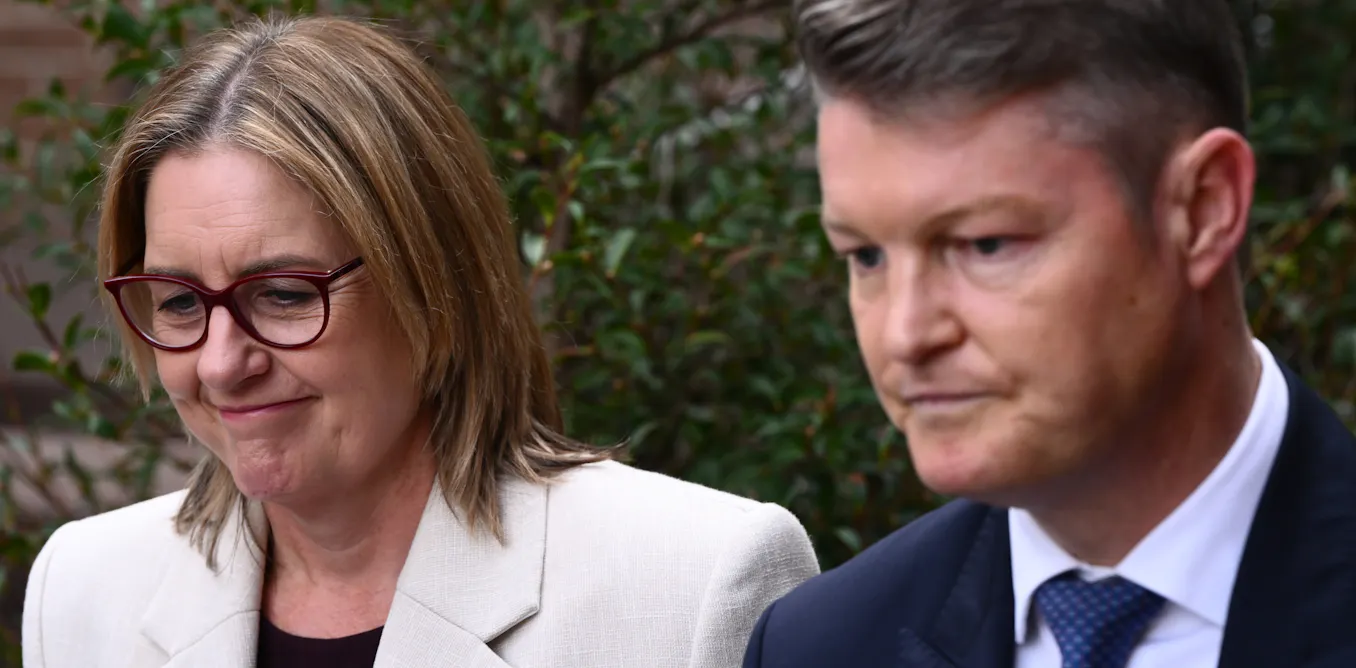
As Ben Carroll replaced Jacinta Allan as Victorian premier four months before the state election, a Newspoll had Allan at -46 net approval, but Labor only trailed the Coalition by 52–48.
Legislation that reforms the Victorian upper house by scrapping group voting tickets is set to pass parliament this week.

There have also been four federal polls released since Monday. The combined vote for One Nation and the Coalition is 47% in YouGov and Essential, 47.5% in Morgan and 49% in Spectre.
Victoria’s new premier and Newspoll
Jacinta Allan resigned as premier in the wake of dismal polling and an ongoing corruption scandal. The Victorian state election is in late November.
Carroll’s unanimous endorsement by caucus avoided a Labor leadership election process involving Labor members that would have taken at least four weeks.
Despite Allan’s net approval of -46, Newspoll only had Labor behind the Coalition by 52–48, with One Nation’s 19% of primary votes lower than in other recent Victorian polls. With Allan out, Labor has a chance to win the election.
A Newspoll, conducted July 23–26 from a sample of 1,035, gave the Coalition 31% of the primary vote (down five since the November Newspoll), Labor 28% (steady), One Nation 19% (not previously asked for), the Greens 13% (down one) and all Others 9% (down 13).
After preferences, the Coalition led Labor by 52–48, a one-point gain for the Coalition. With Allan’s very low approval ratings, preference flows were likely to have favoured the Coalition more than Newspoll assumed.
Allan’s net approval was down four points to a dire -46, with 71% dissatisfied and only 25% satisfied. Her 71% dissatisfied is the worst for any premier in Newspoll’s history.
Liberal leader Jess Wilson’s net approval was +8. Wilson led Allan by 51–32 as better premier.
Asked which party they’d prefer to govern after the election, 41% selected Labor, 35% the Coalition and 18% One Nation. Asked for a preference between Wilson and the Coalition in alliance with One Nation or Allan and Labor, respondents opted for the former by 48–42.
Group voting tickets set to be scrapped
For the upper house, all 40 seats will be up for election this November in eight five-member regions by proportional representation with preferences. In previous elections, Victoria had used the discredited group voting ticket system, where parties rather than voters direct preferences on above the line ticket votes.
Labor is proposing legislation that will scrap group voting tickets and replace it with a system where voters will be asked to number at least five boxes above the line. This is similar to the Senate system, which asks for at least six numbers. As with the Senate, there are savings provisions so that “1” only votes will still be formal.
Analyst Kevin Bonham is following the progress of this legislation. With the Coalition’s support, it should pass both houses by tomorrow and be implemented at the election. The 2022 Victorian election will be the last Australian election that used them.
Federal YouGov poll
A national YouGov poll for News 24 (formerly Sky News), conducted July 21–28 from a sample of 1,519, gave Labor 28% of the primary vote (steady since the mid-July YouGov poll), One Nation 25% (down one), the Coalition 22% (up two), the Greens 13% (up one), independents 6% (steady) and others 6% (down two).
One Nation is down five points from a late June peak of 30%, while the Coalition is up five points from a late June low of 17%.
By respondent preferences, Labor maintained unchanged leads of 56–44 against One Nation and 53–47 against the Coalition.
Anthony Albanese’s net approval was steady at -18 (56% dissatisfied, 38% satisfied). Angus Taylor’s net approval was steady at -16 (49% dissatisfied, 33% satisfied). Albanese led Taylor as better PM by 43–37 (45–34 previously). He led Pauline Hanson by 52–37 (54–35 previously).
On multiculturalism, 37% said it was good for Australia and continues to be, 46% that it was good, but is becoming a problem and 10% that it has not served Australia well.
Essential poll
A national Essential poll, conducted July 22–26 from a sample of 1,060, gave Labor 31% of the primary vote (up one since the late June Essential poll), One Nation 25% (down one), the Coalition 22% (down one), the Greens 12% (up two), all Others 6% (up one) and undecided 4% (down one).
No Labor vs One Nation two-party estimate was provided. By respondent preferences, Labor led the Coalition by 48–47 including undecided (48–46 to the Coalition previously). By 2025 election preference flows, Labor would have led by over 53–47.
Weak respondent flows to Labor and a low Others vote are features of Essential’s polls. In Morgan’s polls, Labor has performed better by respondent than last election preferences. Right-wing Others at the 2025 election have probably mostly moved to One Nation, so Labor should be doing better from the remaining Others’ preferences.
Albanese’s net approval was down one point to -14 (52% disapprove, 38% approve). Taylor’s net approval slumped ten points to a new low of -11 (44% disapprove, 33% approve).
By 57–39, respondents were confident in Australia’s public health system. By 36–28, they did not support a new data centre being built in their local area.
Morgan poll
A national Morgan poll, conducted July 20–26 from a sample of 1,643, gave Labor 27.5% of the primary vote (steady since the July 13–19 Morgan poll), One Nation 25.5% (up three), the Coalition 22% (down one), the Greens 14% (steady) and all Others 11% (down two).
By respondent preferences, Labor led One Nation by 53.5–46.5, a 1.5-point gain for One Nation. They led the Coalition by 54–46, a two-point gain for the Coalition. By 2025 election preference flows, Labor led the Coalition by 52.5–47.5, a 0.5-point gain for the Coalition.
Spectre poll
A national Spectre poll, conducted July 11–23 from a sample of 1,434, gave Labor 28% of the primary vote (steady since the early April Spectre poll), One Nation 26% (steady), the Coalition 23% (down one), the Greens 12% (steady) and all Others 11% (up one).
By respondent preferences, Labor led One Nation by 54–46, a two-point gain for Labor. They led the Coalition by an unchanged 51–49.
Albanese’s net approval was up eight points to -14, Hanson’s down five points to -1 and Taylor’s down ten points to -7. The Greens’ net approval was up two points to -10 and Treasurer Jim Chalmers’ was up one point to -11.
This article was originally published on The Conversation. Read the original article.