
Get all your news in one place.
100's of premium titles.
One app.
Start reading
Latin Times
Latin Times
Politics
José Gutierrez

Judge to Trump's Visa Freeze: 'Not Your Call to Make' — 75 Countries Just Got Their Shot Back

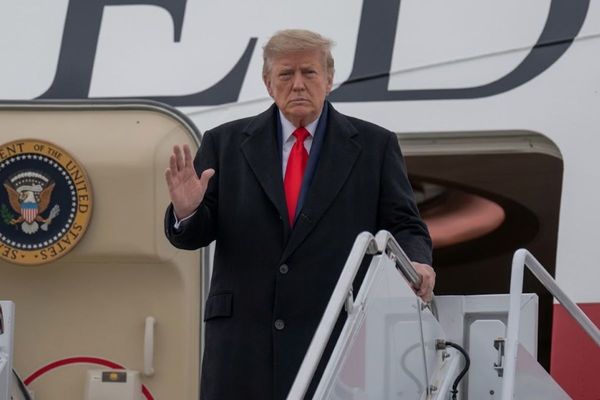
US Secretary of State Marco Rubio looks on as President Donald Trump speaks during a Cabinet meeting at Camp David in Maryland, on July 31, 2026. (Credit: Photo by Aaron Schwartz / AFP via Getty Images)

A federal judge in Manhattan has thrown out a Trump administration order that had halted green-card-track visa processing for people from 75 countries, ruling that the State Department reached well past its legal authority. In a 61-page opinion issued Friday, U.S. District Judge Jeannette A. Vargas of the Southern District of New York — appointed to the bench by former President Joe Biden — concluded that the internal directive ordering the freeze could not coexist with the system Congress built for deciding who receives an immigrant visa.
How the Freeze Was Built

The pause began in January, when the department stopped issuing family- and employment-based green-card visas to applicants from nearly 40% of the world's countries, arguing that people from those nations were disproportionately likely to end up drawing on public assistance once inside the U.S. The roster read almost like a cross-section of the developing world: Brazil, Colombia, Haiti, Somalia and Russia sat alongside Balkan nations such as Bosnia and Albania and South Asian countries including Pakistan and Bangladesh, among dozens of others across Africa, Latin America, the Middle East and the Caribbean.

The selection method itself came out during litigation: the department leaned on Council of Economic Advisers data measuring what share of immigrant households from each country received some form of public assistance, drawing the line at 30% — though court filings show a handful of nations that crossed that threshold were left off the list anyway, exempted for foreign-policy reasons unrelated to the stated economic rationale. Notably, the freeze touched only permanent-residency visas tied to family sponsorship or job offers; tourist and student visas were never part of it.

Why the Court Sided Against Washington

Vargas's central objection was that the policy dressed up a nationality-wide ban as an individualized screening tool, when the law requires the opposite. A consular officer is only supposed to reject someone as a likely "public charge" after weighing that specific person's finances, age, health, skills and family circumstances — not their passport. Yet the cable Secretary of State Marco Rubio sent to every diplomatic post instructed officers to deny applicants from the listed countries even after they had produced evidence rebutting the concern. In Vargas's own words, that made denial a foregone conclusion — "the outcome is predetermined," she wrote — regardless of what any individual applicant could show.

The judge tied that finding to a nondiscrimination clause Congress wrote into immigration law in 1965, which bars visa decisions based on an applicant's nationality, and to a separate provision that removes the secretary of state from any role in adjudicating individual cases.

An Old Travel-Ban Ruling, Set Aside

Government attorneys tried to lean on a 2018 Supreme Court decision, Trump v. Hawaii, which had upheld the third version of Trump's first-term travel ban restricting entry from several mostly Muslim-majority nations. Vargas didn't buy the comparison. That earlier case, she reasoned, was about the president's power to decide who may physically cross the border — a question of entry. This case asked something narrower: whether the government can refuse to issue a visa at all once Congress has already spelled out the criteria for granting one. That distinction, more than anything else, is what unraveled the freeze.

The lawsuit was brought by the Catholic Legal Immigration Network and African Communities Together, alongside a group of individual plaintiffs directly affected by the freeze. Six U.S. citizens testified that the policy had stalled relatives in Ghana, Jamaica, Guatemala and Ethiopia from obtaining family-based visas. Five Colombian nationals pursuing employment-based visas — including an engineer, an architect and an endocrinologist trained at Harvard — rounded out the case; one had already received a denial notice that cited the policy by name.

The administration didn't lose across the board. Vargas agreed with one of the government's arguments: the cable wasn't the type of formal regulation that legally required a public comment period before taking effect.

What Happens Next

Vargas has ordered both sides to submit proposals by September 11 on how to resolve what remains of the case, and the administration still has the option of appealing to the Second Circuit. The State Department had not issued a public reaction to Friday's ruling as of this writing. It has, however, defended the policy before — when the lawsuit was first filed back in February, Principal Deputy Spokesperson Tommy Pigott told reporters that "a visa is a privilege not a right."

This ruling lands in the middle of a broader run of court fights over the administration's immigration agenda. A separate ban covering 39 countries, which took effect January 1, was struck down by another judge in June, and a pause on diversity-visa issuance took hold in late December. Immigrant-rights advocates have pointed out that the restrictions have landed hardest on applicants from Africa, Latin America, the Caribbean and the Middle East — a pattern likely to keep drawing legal challenges regardless of how this particular case is ultimately resolved.

Sign up to read this article
Read news from 100's of titles, curated specifically for you.
Already a member? Sign in here
Related Stories
Top stories on inkl right now
One subscription that gives you access to news from hundreds of sites
Already a member? Sign in here
Our Picks
Fourteen days free
Download the app
One app. One membership.
100+ trusted global sources.


