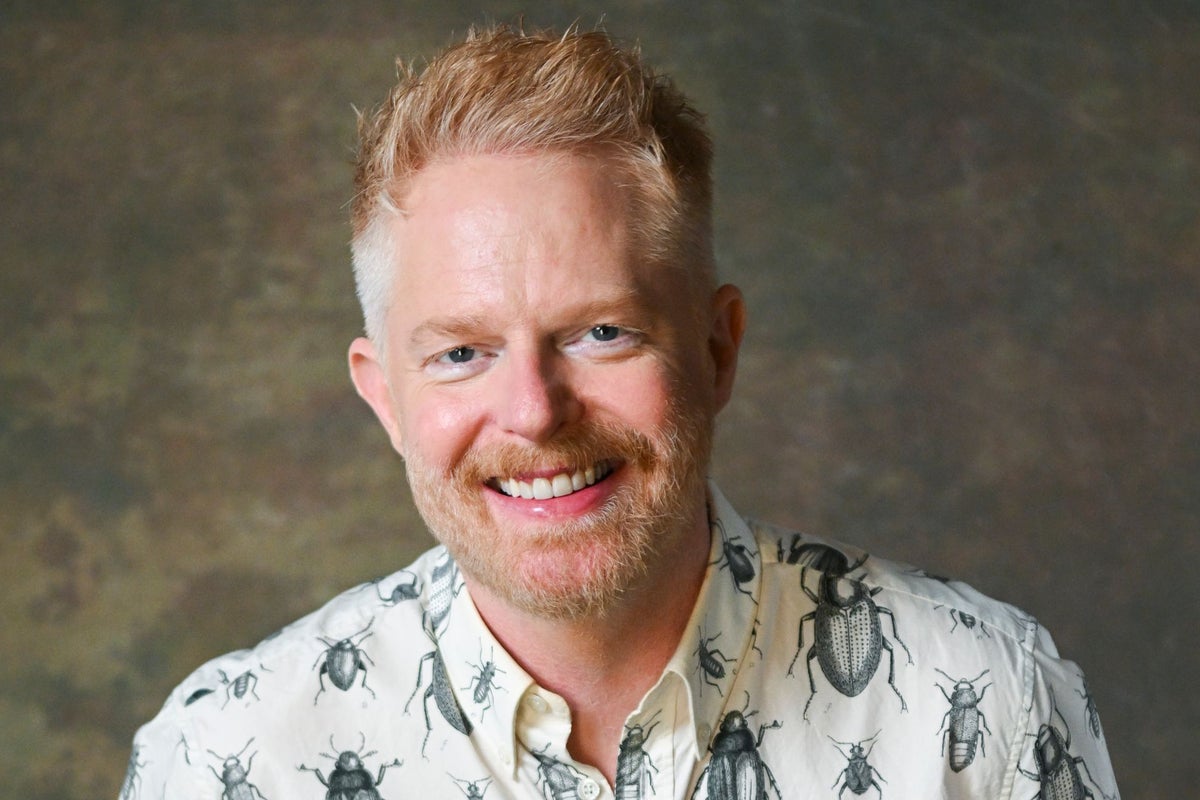
When I was a kid, 50 years old just seemed like… you're done,” says Jesse Tyler Ferguson. “Of course, now that I am 50, I don’t feel that way at all.”
The Modern Family star hit the half-century mark some 11 months ago, but you wouldn’t necessarily guess it. Really, he’s always had a slightly nebulous relationship with age. When he was first cast in the hit sitcom, back in 2009 – as the fussbudgety lawyer Mitchell Pritchett, doting husband and comic foil to Eric Stonestreet’s histrionic Cam and adoptive father of Vietnamese infant Lily – Ferguson thought he looked too young to play a parent. His solution was to carpet his youthful cheeks with facial hair. (It worked, more or less.) Now, older, wiser, and with just a little less red in his follicles, Ferguson seems like he’s belatedly living the life he spent years pretending to on screen. “I’m an older dad, with these two young kids at home,” he explains. “I don’t have the option to feel old.”
We meet in an airy rehearsal room somewhere in Southwark, a space filled with props from the show. A gaudy animal-print cloth is draped over a coffee table; a fur coat lurks in the corner like an understuffed hunting trophy; in the centre of the room is a very large, deep sofa, on which Ferguson sits about a metre away from me. It’s a mise en scene fit for a waning diva – and perfect, therefore, for Truman Capote, whom Ferguson is about to portray at the Menier Chocolate Factory theatre in a revival of the 1989 play Tru. Written by Jay Presson Allen, Tru is set towards the end of Capote’s life, long after the acerbic writer had found celebrity with works like In Cold Blood and Breakfast at Tiffany’s – and finds Capote unhappy and strung-out on substances, his famous caustic wit turned acrid.
Ferguson first performed the role off-Broadway earlier this year, and says it’s a “gift” to be able to go even deeper into Capote’s mind. “He’s a really layered, fascinating character,” he says. “He had so many interesting quirks. Obviously everyone knows about his very strange speaking voice but there was also just so much psychologically going on with him.”
Other prominent actors have taken on Capote, and that nasal, high-registered drawl of his, before – including Mad Men’s Robert Morse, back when Tru was first staged, and the late Philip Seymour Hoffman, who won an Oscar for the 2005 biopic Capote. “One thing about these celebrated performances of Truman Capote was that none of these men who have played him have been gay,” Ferguson says. “Truman Capote was, you know, a very open, out homosexual. So there’s a layer of personal story there, about how it felt to be someone who had to hide who they were, to tiptoe around people, and then came to New York and blossomed more as a person. I feel like there are parallels between Capote's journey and mine, just in terms of coming out as a gay man.”
There are probably easier places to grow up as a gay teen than where Ferguson spent his childhood – Alburquerque, New Mexico, the area now most recognisable to British people as the setting for the TV show Breaking Bad. Think hot, dry, desert. “It’s a beautiful state,” he says. “But culturally, it felt a bit like a wasteland. There wasn’t a tonne happening. As someone who was interested in the arts, I found it a little difficult to be raised there. It was somewhere I knew I was not going to live forever.”
Ferguson’s parents – his father a microbiologist and his mother a nurse – were uninvolved in the arts, but nonetheless nurtured his interests. (“It felt like it was this thing they didn’t always fully understand.”) Neil Patrick Harris went to a rival school nearby, and would, Ferguson says, hoover up the lead roles in community theatre. “I was around the same age and [often] up for the same roles, and usually he would get them and I wouldn’t. Because he was very talented – but also a celebrity. I mean, he had done films and was Doogie Houser. Why wouldn’t you cast him? But I don't think we were ever even in a show together.”
After moving to New York, Ferguson jobbed as an actor on stage and had occasional screen parts. He got what seemed to be his big break in 2006, when he was hired as one of the leads of The Class, a buzzy sitcom billed as David Crane’s follow-up to Friends. The phenomenon its creators expected never materialised, and it was cancelled after just one season, amid poor reviews and (what were considered at the time) lacklustre audience figures. It was the sort of failure that could sink a career. But for Ferguson, it led almost immediately to Modern Family.
Almost every time that I look back at something I wish I could do over, the reason was always fear-based
Jesse Tyler Ferguson
Much has been written about Modern Family, which ran for 11 seasons and amassed a formidable 22 Emmy wins in that time. When it started, it was a groundbreaking part of the Obama-era zeitgeist. At a time when gay relationships were even more woefully underrepresented on TV than they are today, Modern Family was a show that took traditional sitcom ingredients and gave them a total contextual makeover: gone are the two-point-five kids and a dog, in their stead a three-tiered family that encompassed a gay couple and an age-gap, culture-clash “trophy-wife” marriage, as well as a somewhat more conventional straight household. Married… With Children’s Ed O’Neill was brought in to add sitcom-veteran heft to the patriarch role, but most of the rest of the cast, including Ferguson, were little-known at the time.
There’s something wonderfully specific about the energy that Ferguson brought to Mitch – a gentleness to his uptight flapping that meant he was always more than simply a scold. (Interview Magazine once aptly described him as an expert in “bemused exasperation”.) Fans immediately took to his rapport with Stonestreet, who, unlike his character, was straight in real life – or as Ferguson once put it, was “gay for pay”.
“I think if the pilot was shot today, it would be a different show – because we’re living in a different time,” says Ferguson. “I know Eric Stonestreet and I always questioned whether or not he would be given the opportunity to play Cam now, as a straight man. All I can say is, I was cast before Eric was. And I read with a lot of different actors for that role. And some were gay and some were straight and some were Black and some were white. And Eric and I just had the best chemistry. That’s, for me, what it boiled down to. But I don't know if he would have even been asked to come into the room if it was cast today.”
While the series was an immediate hit, there were tensions behind the scenes – not between cast members, but between Modern Family’s two creators, Christopher Lloyd and Steven Levitan. After just a season, the two had reached an impasse, and a highly unusual agreement was put into place: the writers room was divided in two, and writing duties would alternate on an episode-by-episode basis between the two creators. “Basically, we had divorced parents leading the show,” says Ferguson. “Our creators just decided to go separate ways. I thought it was a big secret that no one really knew about, and then it was like written about in The Hollywood Reporter. It was like we had a week with this parent, and then a week with that parent. And we all just learnt that that’s how it works.”
The two men had stylistic differences, Lloyd having proved himself a dab hand at farces during his previous work on Frasier (“he leads from a very intellectual standpoint… he loves a complicated plot”) and Levitan writing episodes that brought out emotion and sincerity. “It gave the show a really interesting balance that I think a lot of people didn’t even notice was happening,” says Ferguson. “I still can’t believe after 11 seasons that the show was as successful as it was, with that sort of division of power, really.”
When it comes to Modern Family, Ferguson has no regrets – “but I sometimes think of things I would like to do again, of opportunities I would like to go back to,” he muses. “I had a great run with Modern Family for 11 years. Now I’m interested in getting some opportunities to direct and everyone always asks me, ‘Why didn’t you ever direct an episode of Modern Family?’ And I didn’t do it because I didn’t want to have sort of a shift in my relationship with my cast. And I just, like, couldn’t wrap my mind around telling Ed O’Neill what to do, you know?” He laughs.
“But I now look back, and think, I should have done one. I would have liked to have had that experience. Almost every time that I look back at something I wish I could do over, the reason was always fear-based. I’m trying in my older age, now I’m entering my fifties, to not let that fear overtake my decision-making process. If I feel scared about something, it’s actually more of a reason to go toward it.”
Increasingly, Ferguson’s decision-making process seems to be pushing him towards the stage: Tru will be his third stint in London in recent memory, the actor having appeared in Here We Are, the final musical by Stephen Sondheim, at the National Theatre last year, and enjoyed a run as King Herod in the glitzy Jesus Christ Superstar revival at the London Palladium back in July.
Tru, though, must have been uniquely appealing for an actor looking to shake off the usual typecasting that trails a hit sitcom. “Being on a huge hit TV series made more people aware of me,” Ferguson says. “But sometimes, because I’ve been in so many people’s living rooms as this one character for 250 episodes, it's difficult for them to separate me from that character. So I feel like I have to work harder to convince people that I can do other things.
“Truman Capote is such a wild swing to the other side, and I can show that I have range in ways that maybe they didn't expect,” he adds.
It’s true: range will be a must. As I look across the stately sofa, it’s hard to see anything other than Mitch Pritchett’s endearing sitcom warmth floating back at me; how strange to think that these same veins will soon transport Capote’s decidedly colder blood.
‘Tru’ is at the Menier Chocolate Factory until 14 November