
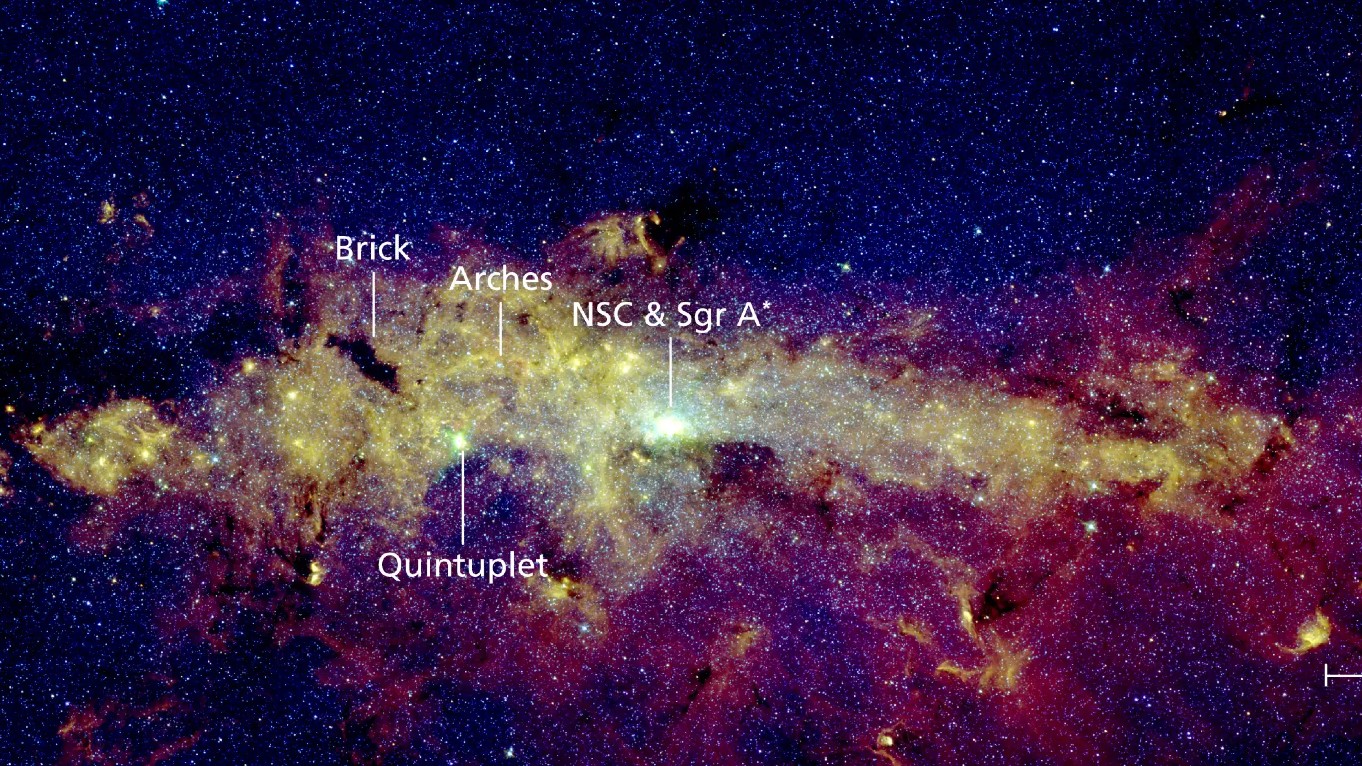
Astronomers using the James Webb Space Telescope (JWST) have peered deep into "The Brick," a dark, dense region near the heart of the Milky Way, revealing what appears to be a paradox: It's simultaneously warm and icy. The discovery could shake up our theories of star formation.
The Brick, officially known as G0.253+0.016 is a rectangular shaped, turbulent, near-opaque cloud of gas with a mass equivalent to around 100,000 suns in an estimated length of around 50 light-years and width of around 20 light-years, making it incredibly dense. Part of a complex of gas called the Central Molecular Zone, which is 1,000 to 2,000 light-years wide, the Brick has long fascinated astronomers because, despite being replete with cool, dense gas — the building blocks of stars — stellar birth is unexpectedly low in the region.