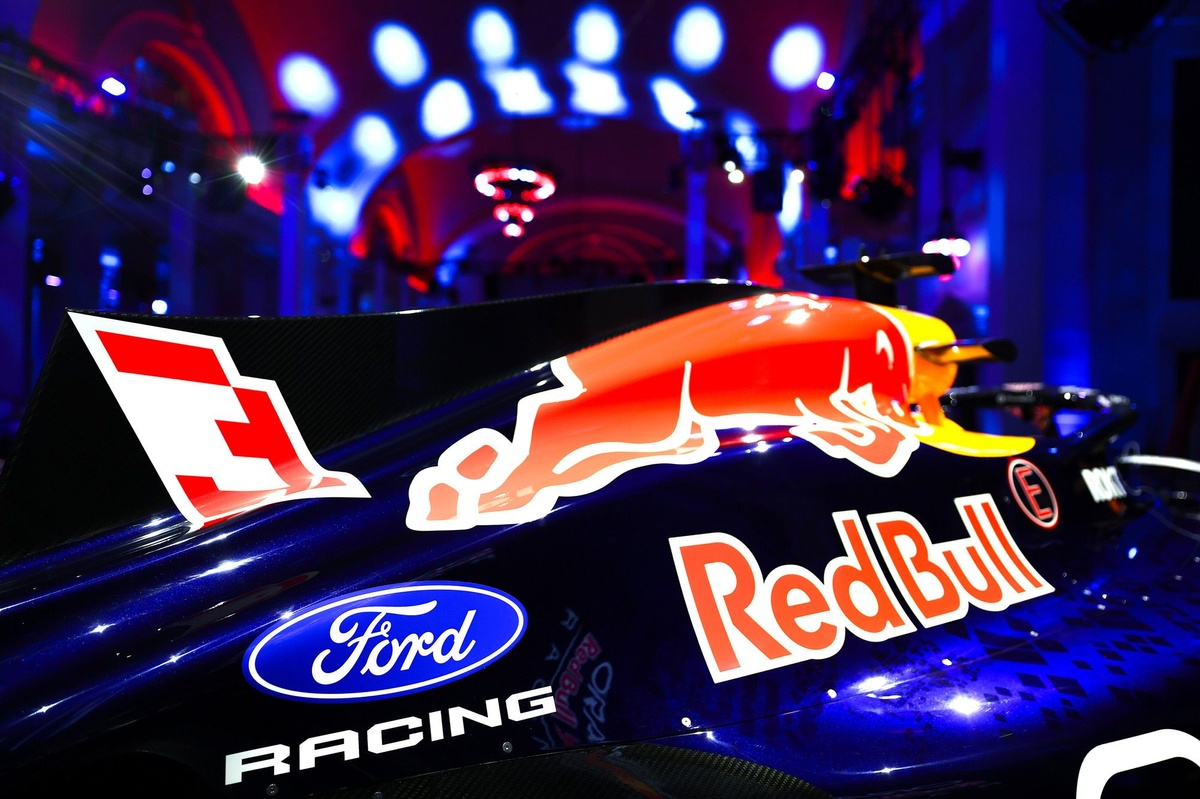
Red Bull will compete with its own F1 power unit for the first time this season. But how has the project been built up over the past four years, and what is its current state?
On Thursday, the collaboration between Red Bull and Ford was officially launched with an event in Detroit – Ford’s home city – although this was largely symbolic. Behind the scenes, work has been underway for four years on the Red Bull Campus in Milton Keynes.
Laurent Mekies described it as “insane” for an energy drink company to take on the challenge of building Formula 1 engines, although on closer inspection the idea is not as far-fetched as it might sound. In fact, it had already landed on the desk of Dietrich Mateschitz two decades ago.
“I can still remember that when I was at the team, I was encouraging them to buy Cosworth and build their own engines,” David Coulthard reflects on Red Bull’s F1 debut. “We were a customer to Ford first of all, then we were a customer to Ferrari, then Renault and being a customer sucks. I had experienced that at Renault and at McLaren-Mercedes, and it just felt we were always going to be handicapped by being a customer team.
“When the team bought Toro Rosso, I was like ‘hold on, it’s difficult enough to win with one team, how are we going to win with two teams?’ So, personally, this is something I was saying 20 years ago, we should have our own engines,” the Scot laughs.
“If you want to be in control of your own destiny, you don’t rely on anyone else. Now the team is 100% in control of its own destiny. It will be challenging, of course it will be, and it may not work in the beginning. It didn’t work in the beginning as a Formula 1 team, but it eventually worked, and Red Bull has the commitment, resources, and people to make it work in the long term.”

The core of Coulthard’s theory is exactly what Christian Horner – one of the driving forces behind the project – emphasised: bringing everything under one roof will bring benefits longer term, especially with the integration of the power unit into the chassis. Moreover, after a frustrating end to its relationship with Renault and Honda’s sudden decision to formally leave F1 at the end of 2021, Red Bull did not want to be dependent again.
Standing on your own feet may sound appealing, but in practice it involved far more than simply developing an engine based on the 2026 regulations. The first step for Red Bull was to actually build a facility in Milton Keynes and, in parallel, to find capable people.
Work on the Jochen Rindt Building – the official name of the engine hall – got underway at the start of 2022. The facility is located on the other side of the road from MK7. Upon entering, visitors walk into ‘Brodie’s Boulevard’, a corridor named after Steve Brodie – a former Mercedes employee who was one of the first to make the move in August 2021 and played an important role in setting up the facility. In that corridor also sits an internal combustion engine: the V6 from the very first fire-up in August 2022, a moment that Mateschitz was still able to witness shortly before his passing.
At the same time as building the facility, Red Bull needed to find a partner – both to help fund the project and to provide additional know-how. Porsche was plan A, but after those talks collapsed, Ford Performance director Mark Rushbrook did not hesitate and, by his own admission, simply sent Horner an email asking: “Hey, Ford is interested. Would you like to talk?” Not long after that email, meetings with Bill Ford and Jim Farley were arranged, and the signatures were put in place.
From five pioneers to seven hundred employees
By that point, Red Bull Powertrains director Ben Hodgkinson had already been mapping out the project for almost a year. The Briton was announced as the leader of Red Bull’s ambitious plans in April 2021, having moved from Mercedes High Performance Powertrains – like many others, with Horner estimating that as many as 220 people made the switch, although his calculations might be a bit ambitious.
Almost five years later, Hodgkinson grins: “Let's not beat around the bush, I probably got this job because of the success another team had!” he says, referring to Mercedes’ dominance since 2014 and his role in it.
“When I first got presented the opportunity, I loved the idea of it being a blank sheet of paper, not just the power unit but the whole company. We could custom build it to what we knew the regulations were going to be. It was a pretty cool opportunity, and I needed to try and turn that into an advantage.”

But there was a significant downside to it as well: “Starting from scratch is a very short sentence but the gravity of what that meant took a while to really sink in. Trying to find what's turned into 700 people in a short space of time has been really challenging. The company started with just five people in a small office before the factories were even built,” Hodgkinson explains when asked by Motorsport.com.
From there, people were rapidly brought together from Red Bull itself, Honda, Mercedes and other companies such as AVL. For Hodgkinson, the day-to-day work felt like a start-up.
“Every month, 20 more people started, so your roles and responsibilities changed from week to week. You had one person that was designing bits, ordering bits and building bits, and the next week another guy to build them turned up, so he stopped doing that. It's been a constantly evolving beast.”
Rushbrook also pointed to another complicating factor: bringing together people from different backgrounds and getting them to work as efficiently as possible. At established manufacturers, the corporate structure and culture were already in place, but at Red Bull this had to be built.
“Meanwhile, we've got to try and settle into what the Red Bull culture is, and we've got to try and extract everything from all the new starters to make sure that we are getting the best of all of those worlds. But actually, I think that has created a real cognitive diversity in the group, which I think has created some really high rate of change.
“The other thing that, if it was deliberate, it would be genius, but it was a bit of an accident: if you create a really bold and audacious project, it only really attracts bold and audacious people. All the people that are a bit cautious and think that sounds a bit risky, they stay put. The sort of people [that come in] fit the Red Bull culture like a glove, and it's brilliant for the rate of innovation. It's been an exciting but also intense four years.”

Can a newcomer be competitive straight away?
On the technical side, Red Bull – as the first fire-up in August 2022 showed – started with the internal combustion engine. The build shop was divided into two halves: one for a V6, the other for a single cylinder. That setup is closely linked to development time and the cost cap. Testing new ideas on a single cylinder is faster and cheaper than on a full V6, meaning changes were only tested on a complete V6 once they worked on a single cylinder.
At first glance, the overall approach differs slightly from Honda’s, with Koji Watanabe explaining that the Japanese manufacturer initially focused more on the electrical components. Both approaches make sense given the different backgrounds, as Red Bull had to build its engine facility from scratch and starting with the ICE was the obvious choice.
The key question, of course, is how competitive Red Bull can be after this four-year build-up. It’s a question Hodgkinson cannot answer either, although he uses a fitting metaphor.
“I've described it before to some of my teammates, it's like a 400-metre race. I use 400m because a 400m race is basically a sprint, so it feels like a sprint. But you're doing it in a stadium on your own, with no crowd, and in a different country to all of your competitors.”
With that analogy, Hodgkinson highlights that Red Bull Powertrains has no idea what the other manufacturers are doing. “All I know is that we're running as fast as we possibly can.”
In that respect, Hodgkinson believes Red Bull Powertrains is in as good a position as possible heading into its first season.
“Obviously I've got a lot of experience in designing F1 engines. I've been in it since the V10 days, so I know what a good company looks like. I've got the very unique opportunity here to try and shape what the perfect power unit manufacturer needed to look like. Red Bull has been very accommodating in terms of what facilities we've got, so I'm pretty confident in our facilities.
“I think the people we've got are amazing as well, so I think we've got all the ingredients. Whether it will turn into a Michelin meal, we'll have to see. I'm confident that we've built the right company and that we’ve got the right people, but I think confidence is something that somebody that's about to lose will have,” he laughs.
In reality, even people within the Red Bull project don’t know how it'll shape up against competitors with decades of F1 experience. Mekies called it “naïve” to think that Red Bull can show up with the best power unit, although Hodgkinson emphasises that everything possible has been done over the past four years. It’s far from a guarantee of success, but it’s at least fulfilling the second dream that Mateschitz had.
Read and post comments