Get all your news in one place.
100's of premium titles.
One app.
Start reading
The Economic Times
The Economic Times
Team Global

In 2020, researchers tested a self-moistening hydrogel mat under solar panels; it cooled them by at least 10°C and boosted output by up to 19%

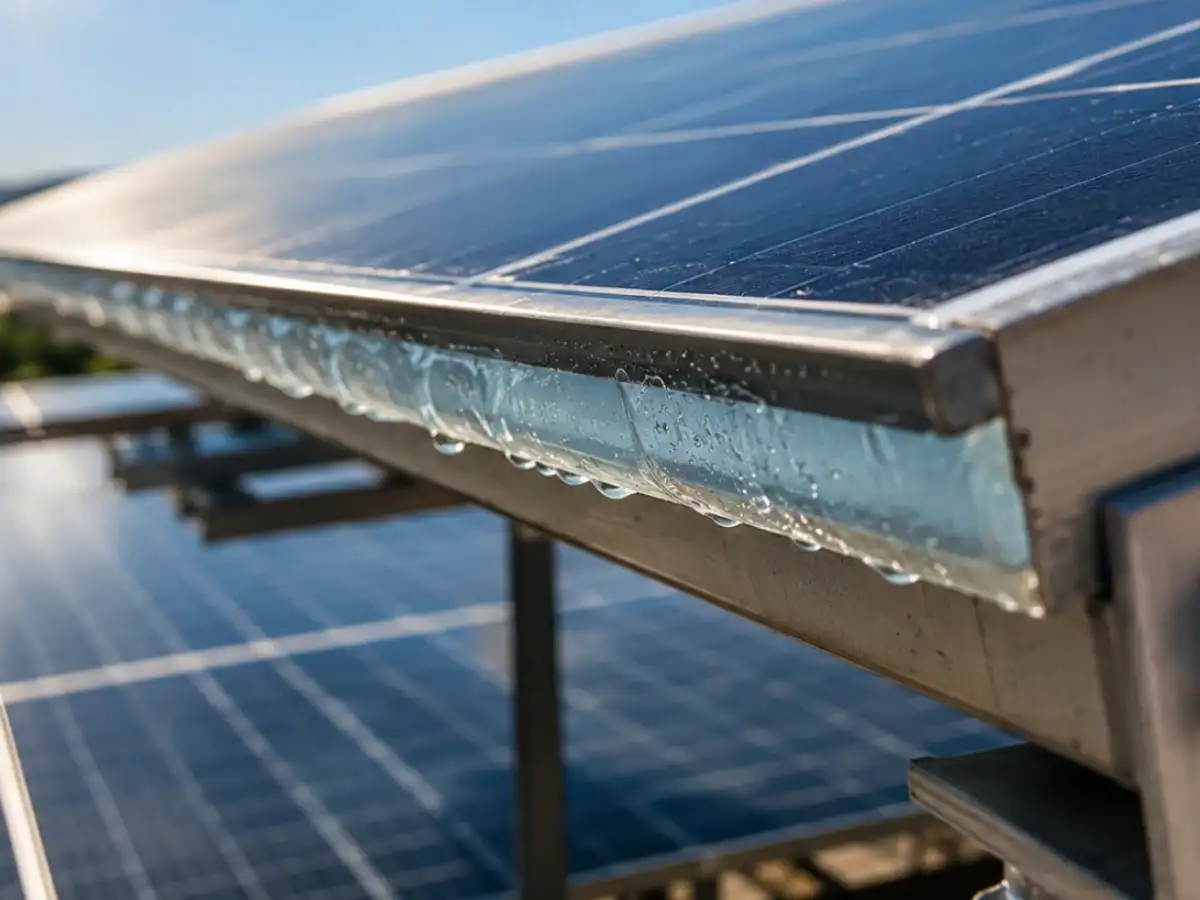
Solar panels often lose power as they heat up in the sun. A 2020 study titled 'Photovoltaic panel cooling by atmospheric water sorption–evaporation cycle,' published in Nature Sustainability, tested a solution for this: a gel that sucks up water from the air at night, then gently releases it as vapor during the day. Solar cells are more efficient when they stay cool, and at high temperatures a panel's electricity-generating efficiency decreases; existing fixes like fans, water sprays, or reflective coatings typically require extra energy and constant maintenance. The study found this cooling effect lowered panel temperatures by at least 10°C in lab tests. In outdoor field tests in Saudi Arabia over two seasons, this one change increased electricity output by 13% to 19%, according to the paper.

How the gel actually works

The team behind this study, from KAUST and Hong Kong Polytechnic University, created this gel from a cocktail of polyacrylamide, carbon nanotubes, and the salt calcium chloride. They applied a thick layer to the underside of a standard solar panel. At night, the gel pulls moisture directly out of the air, like salt left out in a humid kitchen gets damp. The following day, when the panel heats up, the stored water evaporates off the gel. This absorbs heat and cools the panel, much like sweat cools human skin. In laboratory tests, the system achieved a steady cooling power of 295 watts per square metre, enough to keep the panel significantly cooler during peak sun hours.

A newer version pushes efficiency further

Since that original study, a separate KAUST team led by Qiaoqiang Gan, with researchers including Saichao Dang and Huangyu Fang, has developed a related but distinct hydrogel: lithium chloride salt embedded in a cross-linked sodium polyacrylate network, described in a 2025 paper in Materials Science and Engineering: R: Reports. Attached to the rear of the panel, like the original gel, the material is designed to be cheaper and easier to manufacture at scale than earlier hygroscopic composites. In an outdoor test at the KAUST campus in Thuwal, Saudi Arabia, over 21 days, the composite reversibly absorbed and released water without failure, and at 38°C ambient temperature it reduced panel temperature by up to 14.1°C, increasing power conversion efficiency by 12.9 percent. The team also found that panels with this cooling layer lasted more than twice as long as uncooled panels under the same test conditions. KAUST researchers estimate the approach could reduce the overall cost of producing solar electricity by 18%, but this is based on their own modeling, not a full-scale deployment.

Sign up to read this article
Read news from 100's of titles, curated specifically for you.
Already a member? Sign in here
Related Stories
Top stories on inkl right now
One subscription that gives you access to news from hundreds of sites
Already a member? Sign in here
Our Picks
Fourteen days free
Download the app
One app. One membership.
100+ trusted global sources.