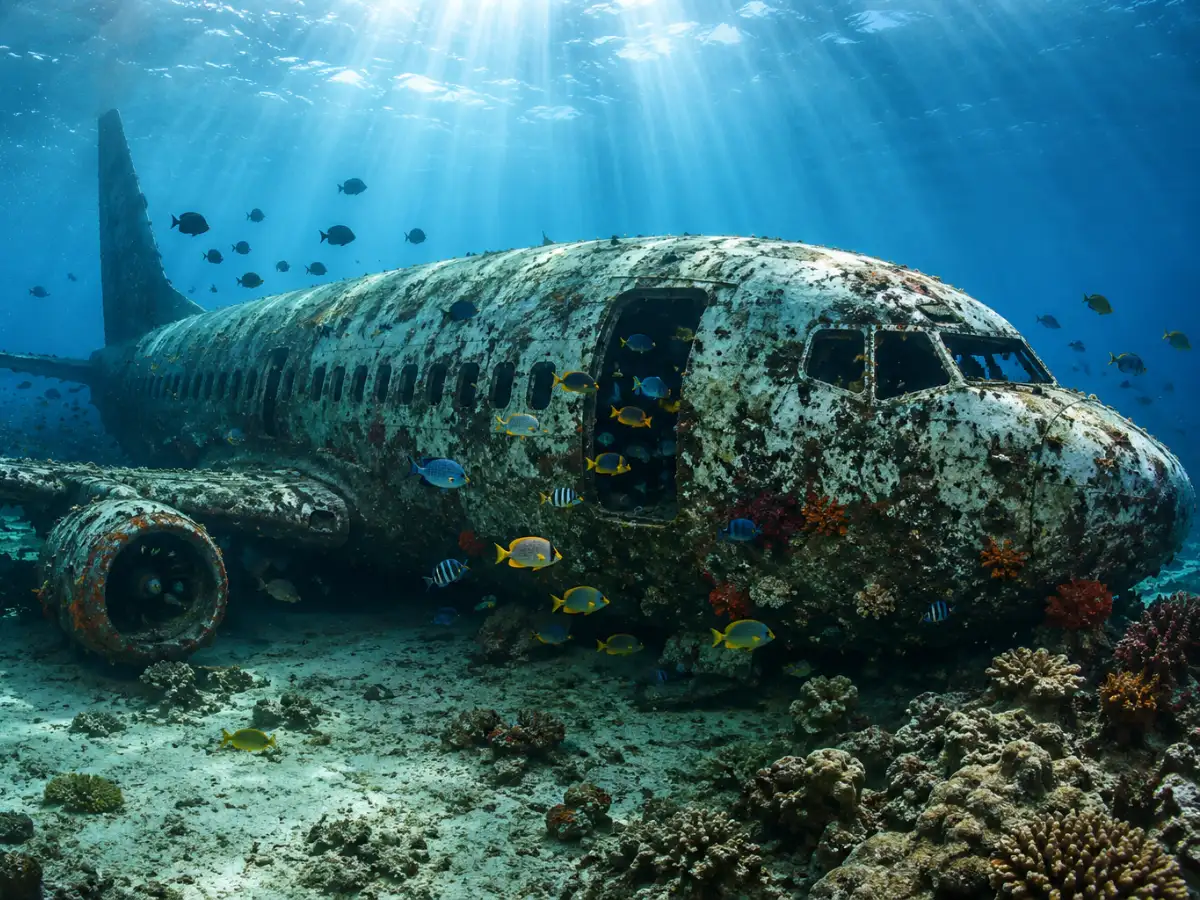
Somewhere off the coast of Vancouver Island, a retired passenger jet sits on the seafloor like it just took off. It hasn't flown in twenty-five years, but it still draws people underwater. This is the story of the Xihuw Reef, a Boeing 737 transformed into an artificial reef by Canada. But these structures are not just quirky tourist attractions, NOAA's National Centers for Coastal Ocean Science says. Research has shown that artificial reefs and shipwrecks may attract large numbers of fish, even top predators.
A plane's strange path to the seafloor
The aircraft was built in 1975. It first flew with Pacific Western Airlines, then Canadian Airlines, and finally with Air Canada, which retired it in 2001 after more than 73,000 flight hours. Instead of stripping it for parts, Air Canada sold the aircraft to Qwest Air Parts of Memphis, Tennessee, for its valuable components. A crew at the Vancouver airport removed engines, landing gear, and other salvageable parts, and Air Canada then donated the stripped airframe to the Artificial Reef Society of British Columbia in 2002.
Volunteers worked on the aircraft for the next several years. They removed anything that could pollute the ocean, cleaned the frame, and cut holes in the wings for marine life to settle. The 30-ton fuselage was lowered by a crane on January 14, 2006, into the water near Chemainus, British Columbia, where it came to rest upright on 11-foot support stands. The reef was named by local Hul'qumi'num First Nations for Xihuw, the red sea urchin, a species once abundant in these waters before pollution and overfishing thinned it out. According to local accounts, the name was intended as a hopeful gesture that the reef might help restore that life.