Get all your news in one place.
100's of premium titles.
One app.
Start reading
The Conversation
The Conversation
Adam R. Seipp, Professor of History, Texas A&M University

Holocaust comparisons are frequent in US politics – and reflect a shallow understanding of the actual genocide and the US response

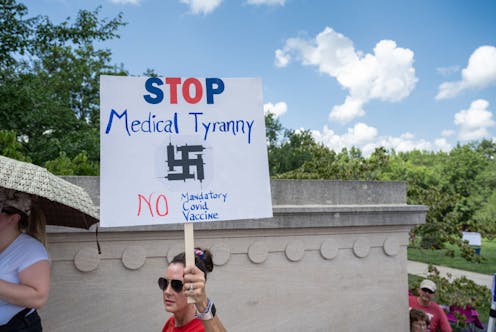
A woman holds a sign denouncing COVID-19 vaccine mandates, with syringes in the shape of a swastika, during a 2021 rally at the Kentucky Capitol in Frankfort. Jon Cherry/Getty Images

Robert Keith Packer, a 57-year-old Virginian, achieved a measure of infamy at the Jan. 6 Capitol riot when he was photographed wearing a sweatshirt emblazoned with a skull and crossbones along with the words “Camp Auschwitz.” “Work Brings Freedom,” the front said, a translation of the notorious motto “Arbeit macht frei” that appeared on the gates of Auschwitz and several other Nazi concentration camps. On the back was the word “Staff.”

Packer was sentenced to 75 days in prison on Sept. 16, 2022, for his role in the riot – he was tried for his actions, not his clothing. But his sweatshirt was far from the only Holocaust reference on Jan. 6 or in its aftermath.

Sign up to read this article
Read news from 100's of titles, curated specifically for you.
Already a member? Sign in here
Related Stories
Top stories on inkl right now
One subscription that gives you access to news from hundreds of sites
Already a member? Sign in here
Our Picks
Fourteen days free
Download the app
One app. One membership.
100+ trusted global sources.